Published by: Saif (Aug 2026) | Platform: Roblox | Game: Grow a Garden
| What is the Moonbeam mutation in Grow a Garden?
The Moonbeam mutation is a Harvest Moon event-exclusive mutation introduced on August 1, 2026. Unlike every other mutation in Grow a Garden, Moonbeam carries no Sheckle multiplier — it does not increase crop sell value at all. Instead, Moonbeam-mutated fruits are sold at the Moon Sell Stand in exchange for Moon Coins, the dedicated event currency, where yield scales with crop rarity (roughly 1 Moon Coin for Common up to 6 for Divine). Players earn the mutation by summoning the Harvest Moon weather (50% chance per fruit on harvest), or passively through the Moongrain Meadow crop, Moon Staff gear, Night Horse and Moon Dragon pets, the Moonbeam Radar gear (Part 2), and the Wise Owl NPC fill bar (Part 2). Moonbeam vs Moonlit: The Critical DifferenceBefore anything else, this needs to be addressed directly because it is the single most common source of confusion in the current Harvest Moon event. Moonbeam and Moonlit are two completely separate mutations. They look similar in name, they both involve lunar themes, and search results frequently mix them together. But they work in entirely different economies. See our detailed guide on all mutations in GAG. |
| Feature | Moonbeam Mutation | Moonlit Mutation |
| Type | Event-exclusive (limited) | Standard (permanent mechanic) |
| Trigger | Harvest Moon event / passive sources | Night cycle only |
| Availability | August 1, 2026 event window (GAG1) | Always available at night |
| Effect on crop | Earns Moon Coins at Moon Sell Stand | 2x Sheckle multiplier |
| Sell location | Moon Sell Stand (event platform) | Steven’s regular sell stand |
| Frequency | 50% chance per plant during event | 6 random plants every 2 minutes at night |
| After event ends | Fruits no longer yield Moon Coins | Permanent mechanic, unchanged |
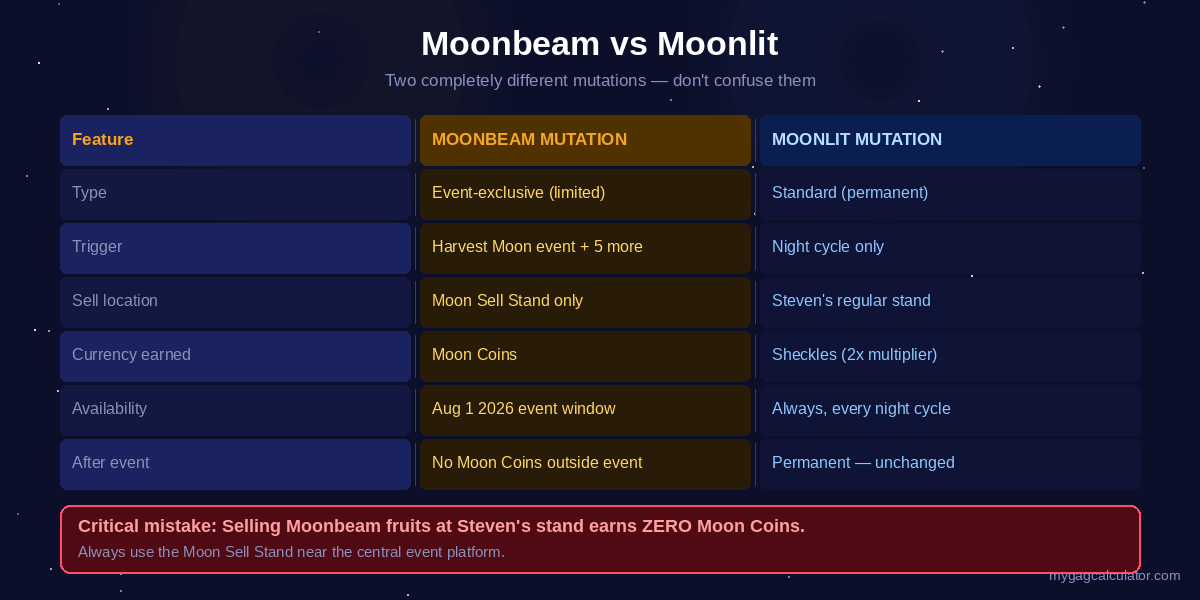
The most expensive mistake a player can make is earning Moonbeam-mutated fruits during the Harvest Moon event and then walking to Steven’s stand out of habit. Moonbeam fruits sold at Steven’s stand give only the base crop value with absolutely no Moon Coin reward. The Moon Sell Stand near the central event platform is the only place Moonbeam creates event value.
What Is the Moonbeam Mutation Grow a Garden?
The Moonbeam mutation grow a garden is the core mechanic powering the entire Harvest Moon event economy in Grow a Garden. It was added to the game on August 1, 2026 as part of the Harvest Moon update and exists exclusively in GAG1. When a fruit carries the Moonbeam mutation, it takes on a glowing, luminescent visual effect that clearly distinguishes it from un-mutated crops in the garden. The top 20 beginner mistakes in GAG.
The key distinction from every other mutation in the game is this: Moonbeam does not function as a Sheckle multiplier. Players familiar with how the Shocked mutation (100x) or the Celestial mutation (120x) stack to inflate crop sell values at the regular stand should understand that Moonbeam operates in a completely parallel economy. It earns Moon Coins — the dedicated Harvest Moon event currency — exclusively through the Moon Sell Stand.
Moon Coins are then spent in the Moon Coin Shop on event-exclusive items, or they count toward the Moon Coin Madness 7-milestone progression track. Reaching all 7 milestones unlocks the Lunar Lantern Seed as the final reward.
All Six Ways to Get the Moonbeam Mutation
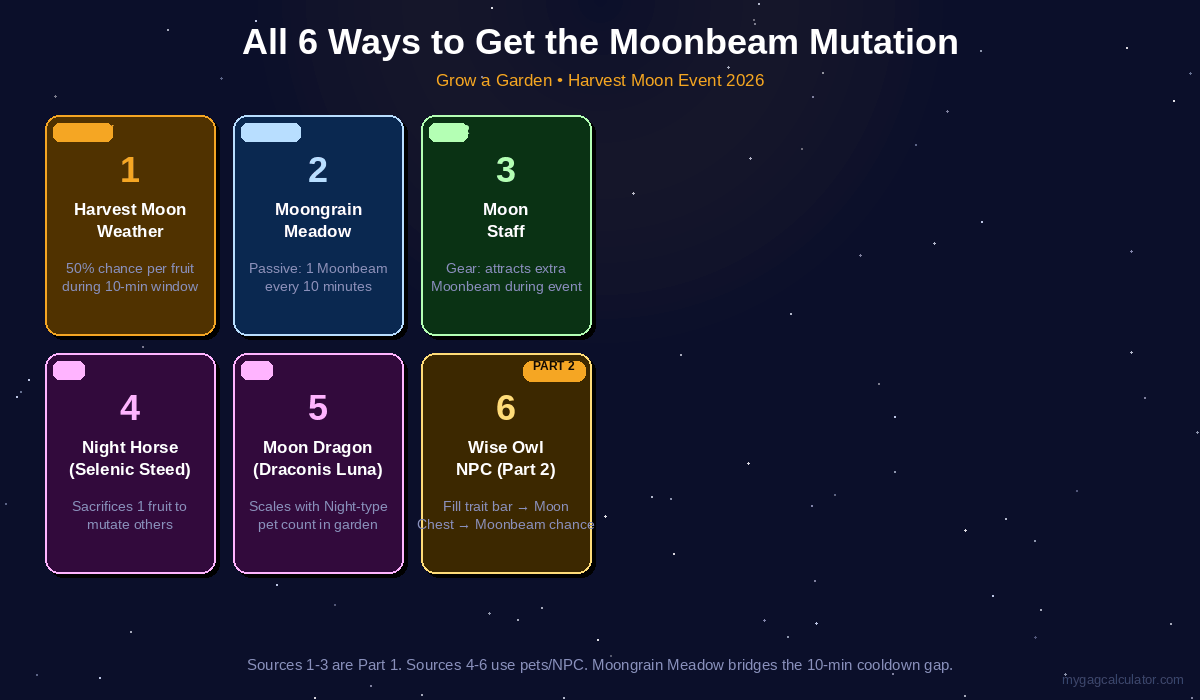
There are six confirmed sources of the Moonbeam mutation in Grow a Garden, split between Part 1 and Part 2 of the Harvest Moon event. Understanding all six is what separates a casual event player from someone who is farming Moon Coins efficiently across every available window.
Source 1: Harvest Moon Weather (Primary Method)
The main and most accessible source of the Moonbeam mutation is the Harvest Moon weather itself. To summon it, players place 10 fruits on the pedestals surrounding the central platform. Some pedestal slots accept plain fruits without any mutation; others require a fruit that already carries a specific mutation, such as Frozen or Chilled. Keeping a stockpile of commonly-mutated fruits between summons is a practical habit that saves time.
Once all 10 pedestals are filled, the Harvest Moon activates server-wide for 10 minutes. During this window, every plant in the garden has a 50% chance to gain the Moonbeam mutation on harvest. The weather then enters a 10-minute cooldown before it can be resummoned, creating a 10-on/10-off cycle and giving players roughly three active Moonbeam windows per hour.
| Key tip: Do not harvest crops before the Harvest Moon is fully summoned. Fruits must be collected during the active weather window to have a chance at Moonbeam. Fruits already harvested before the event starts will not be retroactively mutated. |
Source 2: Moongrain Meadow Passive
The Moongrain Meadow is a Transcendent multi-harvest crop and the most strategically significant permanent Moonbeam source in the game. Its passive ability automatically applies the Moonbeam mutation to a nearby fruit every 10 minutes, running continuously without any player input. For a deeper look at how Transcendent crops work in the broader farming meta, the all crops in Grow a Garden guide covers rarity tiers and multi-harvest mechanics.
What makes the Moongrain Meadow so valuable is a timing detail that no competitor article has addressed directly: its 10-minute passive trigger syncs exactly with the 10-minute Harvest Moon cooldown window. That means while the event is cooling down and cannot be resummoned, the Moongrain Meadow keeps producing Moonbeam-mutated fruits. Players with a Moongrain Meadow never have a true dead period in their Moon Coin farming loop.
The seed is available only through the Harvest Moon Seed Shop, with a 0.14% (1 in 700) chance to appear after each shop refresh. It costs 2.5 trillion Sheckles or 1,599 Robux. The price is high, but for players committed to the full Harvest Moon event, it is the only passive Moonbeam source that bridges the cooldown gap automatically.
| Placement tip: Position the Moongrain Meadow next to your highest-value crops so that its 10-minute passive targets the fruits that generate the most Moon Coins per Moonbeam sale. |
Source 3: Moon Staff Gear
The Moon Staff is a gear item available from the Moon Coin Shop that attracts additional Moonbeam mutations during active Harvest Moon weather. It is meant to be equipped before the weather window begins — equipping it after the moon rises reduces the benefit. For anyone reviewing the full gear landscape in the game, the grow a garden gears list shows how event gear slots into the overall gear priority system.
The exact radius of the Moon Staff’s attraction effect has not been published in official patch notes, and no competitor source has tested and documented it in detail. What is confirmed from the official patch notes and community testing is that it increases the rate at which Moonbeam mutations appear on nearby crops during the active 10-minute window. Equip it before summoning and keep it active throughout the weather period.
Source 4: Night Horse Pet (Selenic Steed)
The Night Horse is a Mythical pet obtained by hatching the Moon Egg, with a 9.5% hatch chance. Its passive ability, called Selenic Steed, channels magic through one random fruit, sacrificing it, and applies the Moonbeam mutation to other random fruits in the garden. This means the Night Horse generates Moonbeam outside of the Harvest Moon event window entirely. For the complete picture of pet abilities in Grow a Garden, including how event pets fit into standard loadouts, the pet ability guide has the full breakdown.
The sacrifice mechanic is worth thinking through strategically. The Night Horse targets a random fruit for sacrifice, so players running high-value crops risk losing an expensive fruit to feed the ability. A practical approach is to plant one row of cheap, fast-growing crops like Carrots near the Night Horse’s position so the sacrifice is more likely to land on a low-value fruit rather than a Divine-tier one. The Moon Coins generated from the Moonbeam it applies to other fruits typically outweigh the sacrifice loss, especially on higher-rarity targets.
The Moon Egg costs 40 Moon Coins or 149 Robux from the Moon Coin Shop. It carries a 5% restock chance per shop refresh, so monitoring the shop regularly is necessary. The egg pool contains four pets: Opossum (55% hatch), Lunar Moth (35%), Night Horse (9.5%), and Moon Dragon (0.5%).
Source 5: Moon Dragon Pet (Draconis Luna)
The Moon Dragon is the rarest pet available from the Moon Egg at a 0.5% hatch chance. Its passive ability, Draconis Luna, occasionally applies either the Moonlit or Moonbeam mutation to fruits in the garden. The number of fruits it can target per activation scales directly with the number of Night-type pets currently active in the garden. Stacking multiple Night-type pets alongside the Moon Dragon increases how many fruits receive mutations per cycle.
Each fruit mutated by Draconis Luna also carries an independent chance to increase the level of a random pet in the garden by one. This makes the Moon Dragon useful in two simultaneous ways: it boosts Moon Coin earnings through Moonbeam production and it accelerates pet leveling passively in the background. Night-type pets confirmed to work with the scaling include the Night Horse, Lunar Moth, Opossum, and the Moon Dragon itself.
The Moon Dragon is the chase pull from the Moon Egg and one of the most coveted pets from the Harvest Moon event. Players who hatch one should be aware that its Moonbeam output is directly proportional to their Night-type pet count, meaning its value increases as the garden roster grows.
Source 6: Wise Owl NPC and Moon Chest (Part 2)
The Wise Owl NPC was added in Harvest Moon Part 2 (Update 1.62.0, August 2026). Players submit fruits with specific plant traits to the Wise Owl to fill a progress bar. Every hour, the trait requirement changes, so players need to adapt what they submit based on the current request.
Each time the bar is fully filled, players receive a Moon Chest, which contains three possible seeds and three possible pets — and also grants a chance for a fruit in the garden to receive the Moonbeam mutation directly. This is the only Moonbeam source that does not require the Harvest Moon weather to be active or a specific pet or crop in the garden. It runs parallel to the rest of the event loop.
Harvest Moon Part 2 also confirmed Season Pass 7 with 50 levels of new rewards, additional seeds (Luna Bloom, Emberpear, Spirecrest, Strange Man’s Wheat, Maple Flower, Clove, Sun Melon, Crescent Petal, Twineberry), and the Moonbeam Radar gear item covered in the next section.
The Moonbeam Radar: Part 2 Gear for Hands-Free Collection
The Moonbeam Radar is an Uncommon gear item added in Harvest Moon Part 2. It is available from the Moon Event Shop for 12 Moon Coins or 199 Robux and has a 50% chance to restock per shop refresh. Its function is exactly what the name implies: it scans the garden and automatically collects all fruits carrying the Moonbeam mutation.
In practical terms, the Moonbeam Radar removes the manual collection step from the Moonbeam farming loop entirely. During the active 10-minute Harvest Moon window, players no longer need to run across the garden harvesting individual mutated fruits — the radar handles collection automatically. Combined with the T-Rex and Mimic spread method below, the Moonbeam Radar means the only active task left is summoning the moon and managing the pet loadout swap. For players who have built a strong AFK farming setup, the Moonbeam Radar makes the Harvest Moon event significantly more passive.
| Note: The Moonbeam Radar collects mutated fruits but does not sell them automatically. Players still need to bring the collected fruits to the Moon Sell Stand to convert them into Moon Coins. |
How the Moon Coin Economy Works
Moon Coins are the dedicated currency of the Harvest Moon event. They are earned exclusively by selling Moonbeam-mutated fruits at the Moon Sell Stand near the central platform. The Moon Sell Stand does not accept un-mutated fruits and does not pay out Sheckles — only Moon Coins for Moonbeam crops.
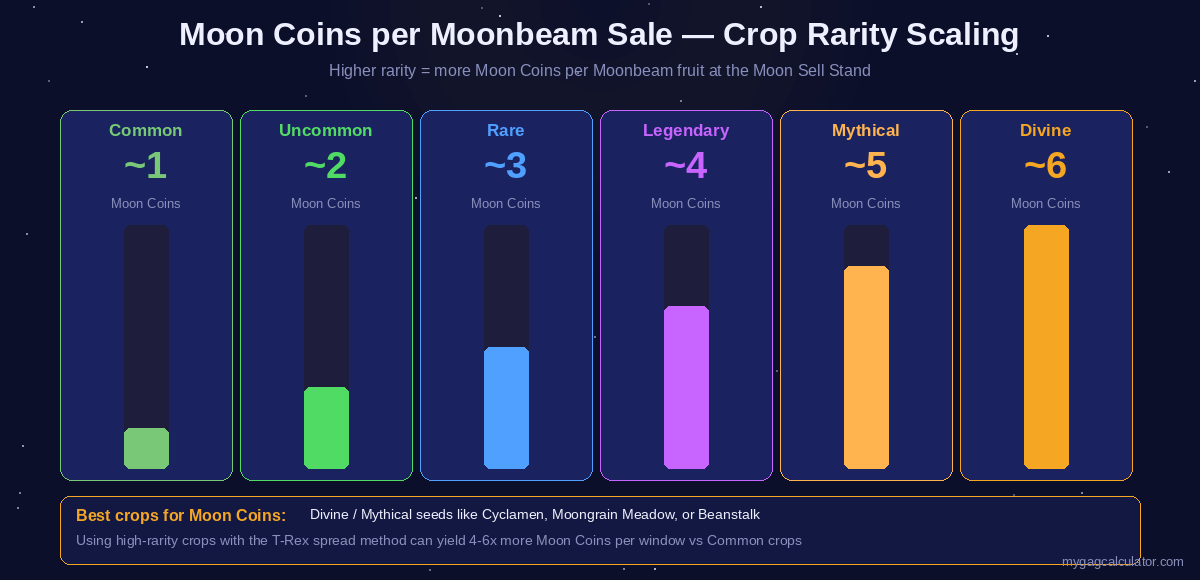
The most important mechanic for Moon Coin yield is crop rarity. Higher-rarity crops generate more Moon Coins per Moonbeam sale. The approximate yield tiers based on community-verified testing are:
| Crop Rarity | Approx. Moon Coins per Moonbeam Sale |
| Common | ~1 Moon Coin |
| Uncommon | ~2 Moon Coins |
| Rare | ~3 Moon Coins |
| Legendary | ~4 Moon Coins |
| Mythical | ~5 Moon Coins |
| Divine | ~6 Moon Coins |
This rarity scaling is why filling the garden with high-value crops before summoning the Harvest Moon makes a significant difference. A garden full of Divine or Mythical seeds like the Cyclamen or Beanstalk produces dramatically more Moon Coins per Moonbeam window than a garden of Common or Uncommon crops. Players who want to check the exact Sheckle value of their crops before deciding which ones to prioritize can use the Grow a Garden Profit Calculator to model crop value and help plan which seeds are worth the investment.
The Moon Sell Stand Location and Use
The Moon Sell Stand is located near the central platform in the Harvest Moon event area, close to the pedestals used to summon the weather. Players walk up to the stand and sell Moonbeam-mutated fruits directly. The stand only accepts Moonbeam crops — attempting to sell regular fruits there does not yield Moon Coins.
Moon Coins earned at the stand serve two simultaneous purposes: they count toward the Moon Coin Madness milestone progression track automatically, and they can be spent in the Moon Coin Shop at any time. The standard advice is to prioritize the milestone track over shop spending, since clearing all 7 milestones unlocks the Lunar Lantern Seed as the final reward.
Moon Coin Madness: 7 Milestones and the Lunar Lantern Seed
Moon Coin Madness is the linear progression track tied to the Harvest Moon event. It has 7 milestone stages, and every Moon Coin earned at the Moon Sell Stand counts toward the current stage automatically. Each milestone completed pays out a reward — seeds, pets, cosmetics, or currency — and clearing all 7 unlocks the Lunar Lantern Seed as the final milestone prize.
Teaming up with other players speeds up milestone progression. Groups of up to 4 players can work together, with individual and team reward tracks running simultaneously. The team event lasts 14 days from the event launch date, meaning steady farming across the full window is more reliable than trying to burst all 7 milestones in a single session.
| Planning tip: Use the progression table above to estimate how many Moonbeam windows your current crop loadout needs to clear each milestone. Divine-rarity crops at 6 Moon Coins per sale can clear milestones significantly faster than Common crops at 1 coin per sale. |
The Moon Coin Shop also stocks the Moon Egg for 40 Moon Coins, the Moon Crate for 6 event cosmetics, the Moon Staff, and the Moonbeam Radar (Part 2 addition). For players managing multiple event currencies across events, the how to farm coins fast in Grow a Garden guide covers how to prioritize event currencies without burning through resources on low-value items.
The Moonbeam Spread Meta: Step-by-Step Farming Strategy
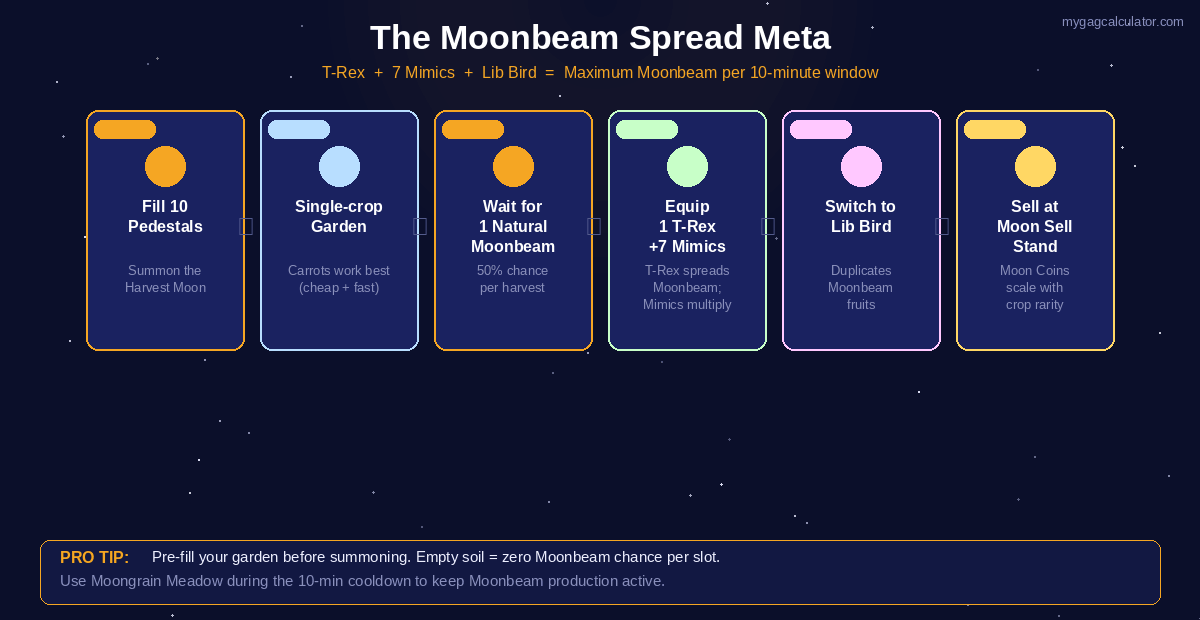
The fastest confirmed method for maximizing Moonbeam mutations per 10-minute window is the T-Rex, Mimic, and Lib Bird combination. This strategy takes one naturally occurring Moonbeam mutation and spreads it across as many fruits as possible before the window closes.
Step-by-Step Execution
- Fill all 10 pedestals to summon the Harvest Moon. Have pre-mutated fruits ready for pedestal slots that require specific mutations.
- Switch to a single crop type garden. Carrots are the standard recommendation — they are cheap, grow fast, and maximize the number of harvest events during the 10-minute window.
- Equip the Moon Staff before the weather activates to attract additional Moonbeam mutations throughout the window.
- Wait for at least one fruit to receive the Moonbeam mutation naturally during the active weather (50% chance per harvest).
- Switch to a pet loadout of 1 T-Rex and 7 Mimics. When the T-Rex ability fires, it spreads the Moonbeam mutation to nearby fruits. The 7 Mimics replicate the spread, multiplying the number of affected fruits across the garden.
- The T-Rex pet page explains the Apex Predator ability in full detail and shows how it stacks with companion pets across different mutation scenarios.
- Before harvesting, switch the Lib Bird into the pet loadout. Its duplication ability gives Moonbeam-mutated fruits a chance to produce an additional copy. Using Lib Bird after the T-Rex spread means duplicating already-mutated fruits rather than plain ones.
- Harvest every Moonbeam fruit and bring the entire collection to the Moon Sell Stand before the cooldown ends.
| Pro note: Prepare the carrot garden before summoning the moon. Do not leave empty soil — every slot without a crop is a missed Moonbeam opportunity during the window. |
The Moongrain Meadow Bridge Strategy
For players who have access to the Moongrain Meadow, the optimal play is to run it continuously alongside the T-Rex method. During the 10-minute cooldown when the Harvest Moon cannot be resummoned, the Moongrain Meadow passively fires its 10-minute Moonbeam trigger, keeping Moon Coin production active in the downtime. This eliminates the dead window and turns the event into a near-continuous Moonbeam farming loop.
To maximize output from this strategy, position the Moongrain Meadow next to the highest-value crops in the garden. The passive Moonbeam targets a nearby fruit randomly — stacking expensive seeds adjacent to it improves the odds that the mutation lands on a crop worth more Moon Coins. For a current reference on which crops hold the highest base values in the game, the grow a garden farming guide includes crop tier breakdowns and value benchmarks.
Does Crop Rarity During the T-Rex Spread Matter?
Yes, significantly. The T-Rex spreads Moonbeam to nearby fruits without discrimination, but the Moon Coin yield from each fruit sold at the Moon Sell Stand scales with crop rarity. Running the T-Rex spread on a garden of Legendary or Mythical crops means every mutation that lands generates 4-5 Moon Coins instead of 1-2.
The trade-off is that higher-rarity seeds cost more to plant and may have longer grow times. For players at the endgame stage with access to Divine seeds, maximizing crop value before summoning is the single biggest lever available for Moon Coin output. The Grow a Garden Mutation Calculator at mygagcalculator.com helps calculate the full value of any crop and mutation combination before committing to a farming approach.
Moonbeam Mutation Mistakes to Avoid
Many of the most common Moonbeam farming errors fall into familiar patterns that also show up in broader beginner mistakes in Grow a Garden. These are the ones that specifically affect the Harvest Moon event.
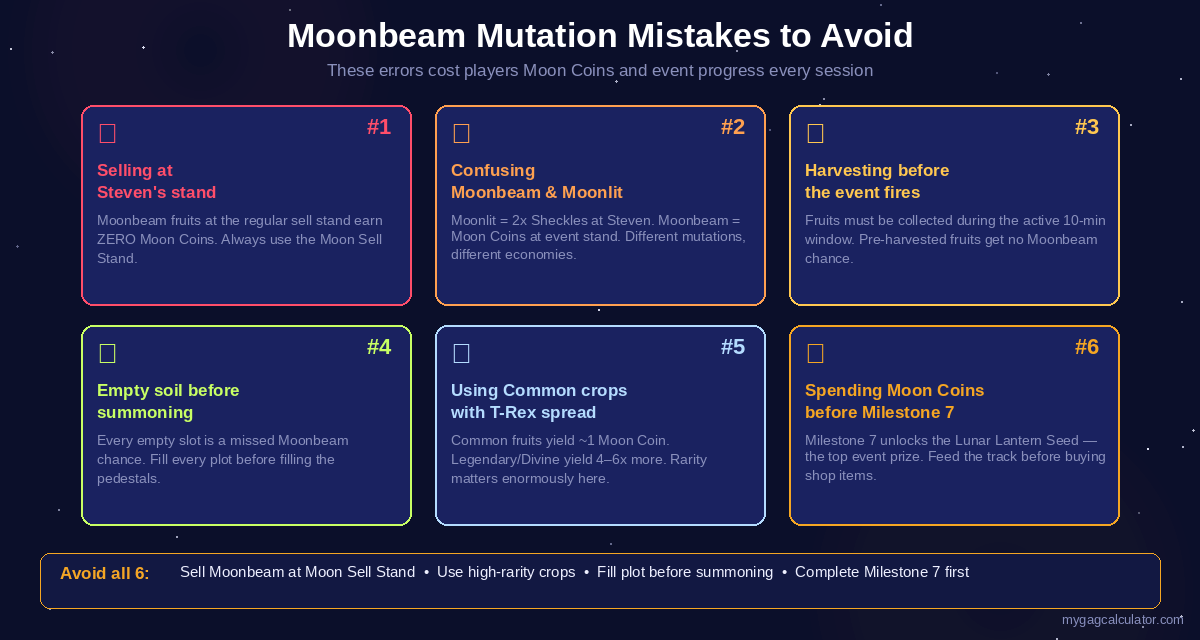
- Selling Moonbeam fruits at Steven’s stand: This is the most costly mistake in the entire event. Steven gives only base crop value and zero Moon Coins. Always sell at the Moon Sell Stand.
- Confusing Moonbeam with Moonlit: Moonlit doubles Sheckle value at the regular stand. Moonbeam earns Moon Coins at the event stand. They are not interchangeable.
- Harvesting before the event is summoned: Fruits must be on the plant and harvested during the active Harvest Moon window to have a 50% chance at Moonbeam. Pre-harvested fruits sitting in the inventory do not receive the mutation.
- Leaving the plot empty before summoning: Every empty soil slot is a wasted Moonbeam chance. Fill every plot before the Harvest Moon is summoned to maximize the number of fruits rolling the 50% mutation chance.
- Using low-rarity crops for the T-Rex spread: Common rarity crops yield only ~1 Moon Coin per Moonbeam sale. The same farming effort with Legendary or Mythical crops produces 4-5x more Moon Coins per window.
- Not using the Lib Bird after the T-Rex spread: The Lib Bird’s duplication chance should always be applied to the already-mutated fruits, not the un-mutated ones. Trigger the T-Rex spread first, then swap to Lib Bird before harvesting.
- Spending Moon Coins on shop items before completing milestones: Milestone 7 rewards the Lunar Lantern Seed — the most valuable item in the entire event. Prioritize the milestone track before spending coins in the Moon Shop.
- Buying the Moongrain Meadow expecting a Sheckle multiplier: The Moongrain Meadow’s value is its passive Moonbeam production during the cooldown window. It does not boost Sheckle crop value directly.
New Seeds and Rewards from the Harvest Moon Event
The Harvest Moon event introduced six new seeds in Part 1, all limited-time and available only during the event window. After the event ends, they can be obtained only through trade.
| Seed | Source | Notes |
| Moongrain Meadow | Harvest Moon Seed Shop (0.14% restock) | Transcendent, passive Moonbeam every 10 min |
| Astral Grape | Harvest Moon Seed Shop | Event seed |
| Fennel | Harvest Moon Seed Shop | Event seed |
| Crescent Reed | Harvest Moon Seed Shop | Event seed |
| Lunar Lily | Harvest Moon Seed Shop | Event seed |
| Lunar Lantern | Moon Coin Madness — Milestone 7 reward | Final progression prize |
Harvest Moon Part 2 added a further wave of seeds: Luna Bloom, Emberpear, Spirecrest, Strange Man’s Wheat, Maple Flower, Clove, Sun Melon, Crescent Petal, and Twineberry — all tied to the Part 2 update content and Season Pass 7.
Harvest Moon Pets and Their Moonbeam Abilities
Five pets arrived with the Harvest Moon event, three of which have direct relevance to Moonbeam farming. For egg hatch odds and a comparison of all event pets against the full pet roster, the Grow a Garden Pet Calculator has hatch rates and trade values verified against the latest available data.
| Pet | Source | Hatch Chance | Moonbeam Relevance |
| Moon Dragon | Moon Egg | 0.5% | Draconis Luna: applies Moonlit or Moonbeam to fruits; scales with Night-type pet count; levels random pets |
| Night Horse | Moon Egg | 9.5% | Selenic Steed: sacrifices one fruit to spread Moonbeam to random garden fruits |
| Lunar Moth | Moon Egg | 35% | Moonsong: advances plant growth and restores pet hunger nearby — supports event farming efficiency |
| Opossum | Moon Egg | 55% | Night Support: reduces cooldown of Night-type pets after they use abilities |
| Wise Owl | Moon Chest (Part 2) | Rare pull | Associated with the Wise Owl NPC fill bar mechanic; obtainable from Moon Chest |
The Moon Egg costs 40 Moon Coins or 149 Robux and has a 5% restock chance per Moon Shop refresh. It is the only way to obtain the Night Horse, Moon Dragon, Lunar Moth, and Opossum. For players tracking how each pet fits into broader farming strategies, the Grow a Garden pet tier list ranks all pets by farming utility and trade value.
Is Skipping Pedestals With Robux Worth It?
If a player does not have the required mutated fruit for a specific pedestal slot, there are two Robux skip options: skip a single pedestal for 39 Robux, or skip the entire 10-pedestal offering for 299 Robux and summon the moon immediately.
Whether this is worthwhile depends entirely on the Moon Coin yield per window. A garden of Divine-rarity crops using the T-Rex spread method can generate a significant number of Moonbeam fruits per 10-minute window. If the fruit shortfall is a regular problem and the skip cost saves meaningful session time, the math can favor the skip. For a single pedestal miss, 39 Robux is the efficient option. Paying 299 Robux for a full skip when only 1-2 pedestals need a fruit is inefficient.
The better long-term solution is pre-stocking a small inventory of commonly-required mutated fruits — Frozen and Chilled are the most frequently requested pedestal mutations — so the skip never becomes necessary. Running a weather-event crop setup between summons keeps a steady supply of common mutations available.
Frequently Asked Questions
What is the Moonbeam mutation in Grow a Garden?
The Moonbeam mutation is a Harvest Moon event-exclusive mutation introduced on August 1, 2026. Crops carrying it must be sold at the Moon Sell Stand near the central platform in exchange for Moon Coins. It does not function as a standard Sheckle multiplier.
Is Moonbeam the same as Moonlit in Grow a Garden?
No. Moonlit is a standard night-cycle mutation (always available) that doubles Sheckle crop value when sold at Steven’s stand. Moonbeam is a separate event mutation tied to the Harvest Moon event that earns Moon Coins at the Moon Sell Stand. Selling a Moonbeam fruit at Steven’s stand earns only the base crop value with zero Moon Coins.
What multiplier does Moonbeam give in Grow a Garden?
Moonbeam does not function as a Sheckle multiplier. It is an event-economy mutation that converts crop value into Moon Coins at the Moon Sell Stand. The Moon Coin yield scales with crop rarity, from approximately 1 coin for Common crops up to approximately 6 coins for Divine crops.
How do you summon the Harvest Moon in Grow a Garden?
Place 10 fruits on the pedestals surrounding the central platform. Some slots accept plain fruits; others require fruits carrying specific mutations. Once all 10 pedestals are filled, the Harvest Moon weather activates server-wide for 10 minutes, giving every plant a 50% chance to gain Moonbeam on harvest.
Can you get Moonbeam outside the Harvest Moon event window?
Yes. The Moongrain Meadow passive fires every 10 minutes regardless of whether the Harvest Moon weather is active. The Night Horse Selenic Steed ability and Moon Dragon Draconis Luna passive also produce Moonbeam independently of the weather. The Wise Owl NPC fill bar in Part 2 also grants Moonbeam chances outside the active weather window.
Does Moonbeam mutation stack with other mutations?
Moonbeam is primarily an event-economy mutation. Its Moon Coin value comes from selling at the Moon Sell Stand, not from stacking with other Sheckle multipliers. For any stacking questions across the full mutation system, the Grow a Garden Mutation Calculator covers all additive and multiplicative stacking rules with a full conflict checker.
What is the fastest way to farm Moon Coins in Grow a Garden?
Summon the Harvest Moon, plant a single fast-growing crop type, equip the Moon Staff before the weather activates, wait for one natural Moonbeam mutation, then switch to 1 T-Rex and 7 Mimics to spread the mutation. Before harvesting, swap in the Lib Bird to duplicate mutated fruits. Sell everything at the Moon Sell Stand. Running a Moongrain Meadow alongside this strategy fills the 10-minute cooldown gap with passive Moonbeam production.
What new content did Harvest Moon Part 2 add?
Harvest Moon Part 2 added the Moonbeam Radar gear (12 Moon Coins or 199 Robux, 50% restock) which automatically collects Moonbeam-mutated fruits, the Wise Owl NPC with its hourly trait submission bar and Moon Chest reward mechanic, a new wave of seeds (Luna Bloom, Emberpear, Spirecrest, and others), Season Pass 7 with 50 reward levels, and a new Season Pass Shop.
How do I use the Moonbeam Radar?
Purchase the Moonbeam Radar from the Moon Event Shop for 12 Moon Coins or 199 Robux (watch for restocks at 50% chance). Once equipped, it scans the garden and automatically collects all fruits carrying the Moonbeam mutation. Players still need to sell the collected fruits at the Moon Sell Stand manually.
What is the Wise Owl in Grow a Garden and how does it give Moonbeam?
The Wise Owl is an NPC added in Harvest Moon Part 2. Players submit fruits with specific plant traits to fill a progress bar. The required trait changes every hour. Each time the bar is fully filled, players receive a Moon Chest containing possible seeds and pets, plus a chance for a fruit in the garden to receive the Moonbeam mutation. The Wise Owl mechanic runs parallel to the standard Harvest Moon summoning loop.