Published by: Saif (Updated: Aug 2026) | Platform: Roblox | Game: Grow a Garden
In Grow a Garden (GAG1), every pet placed in an active garden slot runs a unique ability on its own internal timer — no player input required. Passive abilities like the Starfish XP aura run continuously with no cooldown. Active abilities like the Kitsune’s Nine-Tailed Myth fire every 15 to 25 minutes based on the pet’s weight and age. Abilities require hunger above zero to remain active, and both ability strength and cooldown speed improve as pets age. The system launched in Update 1.04.0 on May 3, 2025. As of July 2026, GAG1 has 358+ obtainable pets across seven rarity tiers.
GAG1 vs GAG2: Are you in the right place? This guide covers Grow a Garden pet abilities (GAG1) in full detail (the original game with 358+ pets, egg hatching, age scaling, and cooldowns). For the sequel, the GAG2 Pet Abilities guide covers the new 14-pet system and how it differs. |
Pet abilities are the engine of every Grow a Garden farming strategy. The system launched in Update 1.04.0 on May 3, 2025, and has grown into one of the most sophisticated passive income layers in any Roblox game. As of July 2026, the original game hosts 358+ obtainable pets across seven rarity tiers, each running a unique ability from its active slot around the clock. Whether a player is building mutation combos, leveling pets overnight for the Pet Calculator, or optimizing a hatch speed setup, the ability system is where the real decisions happen.
This guide covers everything: passive versus active ability mechanics, the hunger system, age and weight scaling, the complete ability list by rarity tier, stacking rules, best combos by playstyle, the pet Mutation Machine, common mistakes. Individual ability deep dives on the Kitsune, Empress Bee, Disco Bee, Capybara, Praying Mantis, and Griffin sit at the end for players searching specific pets.
Grow a Garden Pet Cooldown Calculator
Select up to 3 pets to see how many times each ability fires per hour and across your full session.
Only pets with confirmed cooldown-based active abilities are included. Passive pets like Capybara and Starfish are listed as always active.
For all cooldown management methods including Empress Bee, Queen Bee, Peacock, and Meerkat, see Part 8: Cooldown Management below.
Part 1: How Grow a Garden Pet Abilities Work (GAG1)
Passive vs Active Abilities: The Foundational Rule
There are two ability types in Grow a Garden, and confusing them is the single most common beginner mistake when building a pet loadout.
- Passive abilities run continuously with no cooldown gap and no trigger needed. The Starfish generating XP every second is the clearest example. The Capybara’s hunger prevention aura is another. Passive abilities simply exist as an always-on field the moment the pet enters an active slot.
- Active abilities fire on an internal timer that resets automatically after each trigger. A Kitsune fires roughly every 22 minutes. A Dragonfly fires roughly every 5 minutes. Players cannot manually trigger active abilities — the pet fires on its own schedule regardless of what the player is doing.
Both types require hunger to remain above zero. A pet sitting at zero hunger pauses all ability activity and stops aging — the single most punishing error in any long farming session.
Hunger: The Most Punishing System Most Players Ignore
The hunger bar drains over roughly 12 hours of real time. When it hits zero, active ability timers freeze and the pet accumulates no age progress until hunger is restored. Feeding pets any harvested crop refills the bar, and heavier or rarer fruits restore more hunger per feed.
The Capybara is the standard solution. Its passive radius prevents all pets within 15.48 studs from losing hunger at all. Any serious long-session or AFK build should include at least one Capybara placed at the center of the garden so that all other pets fall within its protection zone.
The Sugar Apple and Burning Bud are among the most hunger-efficient feeding crops. For a complete crop-by-crop analysis of sell value versus hunger restoration, the Grow a Garden Profit Calculator covers per-crop value across all mutation states.
One important exception: the Starfish gains XP passively even when its hunger is at zero. This makes the Starfish uniquely self-sustaining in a way no other pet in the game replicates.
Part 2: Age Scaling, Weight Classification, and the Age 50 Milestone
How Age Changes Ability Strength
Every pet in Grow a Garden improves its ability with age. Cooldowns shorten, success rates rise, and multipliers climb as the pet accumulates XP and advances through age milestones. The age system is not linear — the most important jumps happen at specific thresholds.
| Age | Ability Change | Cooldown Impact | Key Unlock |
|---|---|---|---|
| Age 1 | ~50% of full effectiveness | Baseline (slowest) | Ability begins |
| Age 10 | Full ability activation | Noticeable reduction | Ability reaches 100% power |
| Age 25 | Bonus multiplier unlocked | Moderate reduction | Success rate bonuses apply |
| Age 50 | Peak base ability strength | Significant reduction | Mutation Machine unlocked |
| Age 100+ | Endgame scaling continues | Continuous improvement | Godly weight class tier |
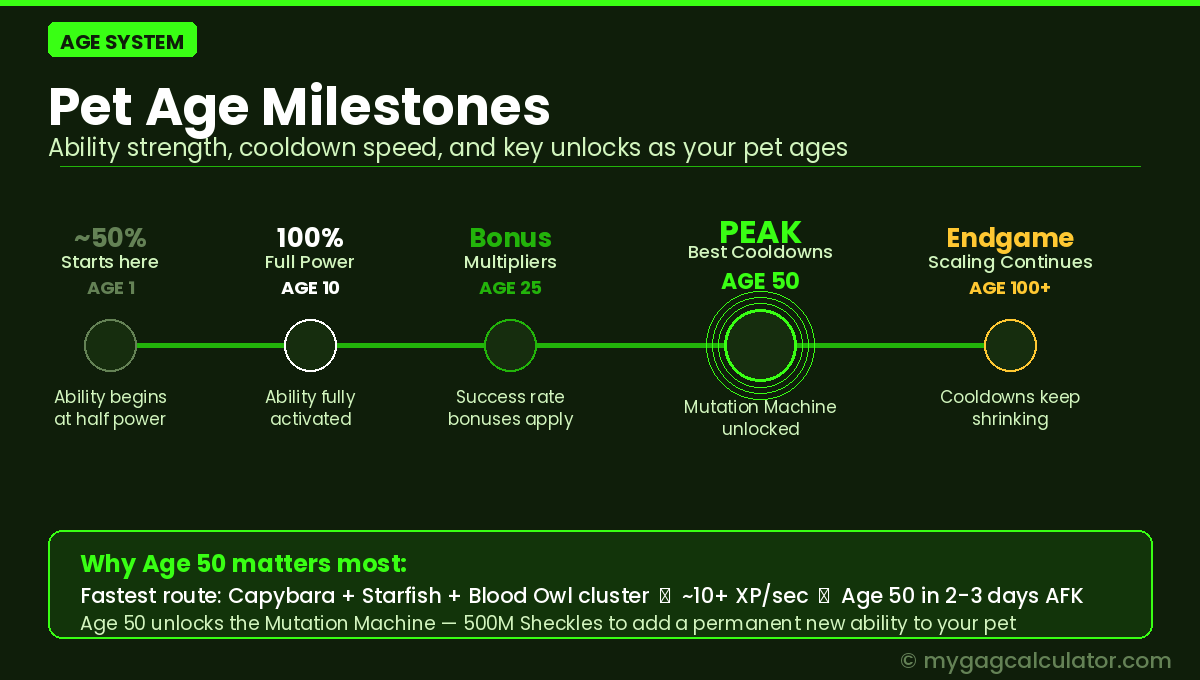
Reaching Age 50 is the primary leveling goal for any pet worth keeping. The fastest sustainable route is a tight cluster of Capybara plus Starfish plus Blood Owl — Capybara prevents hunger loss, Starfish generates 6.36 XP per second for itself, and Blood Owl adds weight-scaled XP to all active pets in the lineup. This combination can push a pet to Age 50 in two to three days of AFK farming. For precise time estimates at any rarity, the Pet Ability Calculator shows age milestone timelines with and without XP boosts applied.
Weight Classification and What It Actually Changes
Pet weight determines ability strength numerically — more weight means shorter active ability cooldowns and higher success rates on passive triggers. Weight increases with age and varies by rarity tier, with Mega pets starting at a higher base weight than standard versions of the same pet.
- Huge: top 10% of weight for that pet type
- Titanic: top 5% of weight for that pet type
- Godly: top 1% of weight for that pet type — the rarest size classification
Three support pets specifically increase weight at the point of acquisition: the Brontosaurus (increases weight upon egg hatching), the Barn Owl (increases weight of store-bought pets), and the Mummy (increases weight of chest-obtained pets). The Pack Mule performs the same function for crafted pets.
Players who want to find their pet’s exact weight tier and how it compares to the Godly threshold can check the Grow a Garden Weight Calculator which calculates Huge, Titanic, and Godly cutoffs for every pet type.
Part 3: How Pet Ability Stacking Actually Works
Ability stacking is the most misunderstood topic in the entire pet system. Community forums repeat the same wrong answers constantly. The correct rules are straightforward once they are separated by ability category.
| Ability Type | Stacking Method | Example Pets | Combined Effect |
|---|---|---|---|
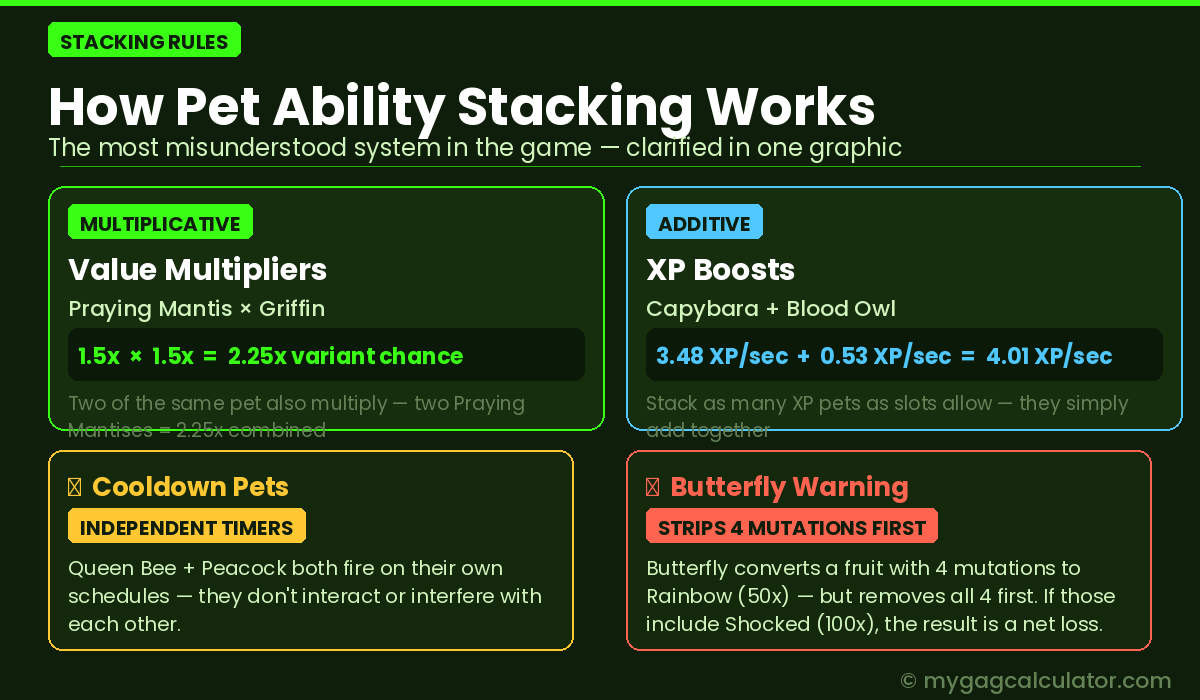
| Value Multipliers | Multiplicative | Praying Mantis + Griffin | 1.5x × 1.5x = 2.25x variant chance |
| XP Boosts | Additive | Capybara + Blood Owl | 3.48 + 0.53 = 4.01 XP/sec |
| Hatch Speed | Additive (cap on some) | Kiwi + Rooster | -25s + -45s = -70s per 60 sec |
| Cooldown Reduction | Independent timers | Queen Bee + Peacock | Both fire on separate cycles |
| Mutation Applicators | Independent (no blocking) | Dragonfly + T-Rex | Both apply mutations separately |
Key Stacking Facts That Most Guides Get Wrong
- Two Praying Mantises do not give 2x variant chance additively — they stack multiplicatively (1.5x times 1.5x equals 2.25x combined). Two Griffins do the same. Praying Mantis plus Griffin together give 2.25x combined variant chance, which is why this combo is considered the most accessible high-efficiency income pairing in the game.
- Same pet, multiple copies: each copy runs its own independent ability cycle. Two Dragonflies mean two separate Gold mutation applications per cycle window. Two Raccoons mean two independent visit cycles per session. There is no universal cap on stacking the same pet.
- Butterfly warning: Butterfly strips all 4 existing mutations before applying Rainbow. If those 4 mutations include high-value ones like Shocked (100x) or Celestial (120x), the conversion to Rainbow (50x) is a net loss. Only use Butterfly intentionally when 4 low-value mutations are ready for conversion.
- Queen Bee does not reset all pets — it targets the single pet with the longest current cooldown. Empress Bee is the only pet that resets all cooldowns simultaneously.
Part 4: Complete Pet Ability List by Rarity Tier (GAG1)
Values shown reflect base performance at the lowest age and weight. Both ability strength and cooldown speed improve as pets age. For the complete ranked pet value breakdown with trade considerations, see the Grow a Garden Pet Tier List. For specific rare pet drop rates and hatch odds, see the rarest pets in Grow a Garden guide.
| Pet | Ability | Cooldown / Trigger | Ability Type |
|---|---|---|---|
| COMMON TIER | |||
| Cat | Digs up a random seed periodically | Every ~60 sec | Active |
| Dog | 10% chance to dig a seed every minute; higher chance for rare seeds as it ages | Every ~60 sec | Active |
| Rabbit | Digs seeds; older rabbit increases seed-dig rate | Every ~60 sec | Active |
| Chicken | Reduces egg hatch time periodically | Active | Active |
| Rooster | Reduces hatch time by 45 sec per cycle; does not stack with same type | Every ~60 sec | Active |
| Frog | Advances a random plant’s growth by 24 hours | Periodic | Active |
| Duck | Passive aura boosts growth of nearby plants | Passive | Passive |
| Cow | Increases growth rate of plants inside radius | Passive radius | Passive |
| Kiwi | Reduces hatch time of eggs by 25 seconds per cycle | Every ~60 sec | Active |
| Mouse | Gains bonus XP; boosts player movement speed | Passive | Passive |
| Seagull | Beach scavenger; small chance to drop same seed when shoveling | Passive | Passive |
| UNCOMMON TIER | |||
| Shiba Inu | 15% chance to dig a seed every 60 seconds; better seed quality than Dog | Every 60 sec | Active |
| Maneki-Neko | Small chance to refund the fruit sold back to inventory | Passive | Passive |
| Sunny-Side Chicken | Boosts hatch speed by 20%; does NOT stack with same type | Passive | Passive |
| Bacon Pig | Passive aura doubles the variant chance of crops within radius | Passive radius | Passive |
| Jackalope | Applies Sandy mutation to nearby crops periodically | Periodic | Active |
| Elk | Increases berry-fruit variant chance | Passive | Passive |
| Oxpecker | Reduces cooldown of safari-type pets periodically | Periodic | Active |
| RARE TIER | |||
| Starfish | Generates 6.36 XP per second passively; unique — ages even at zero hunger | Passive (continuous) | Passive |
| Capybara | Prevents pets within 15.48 studs from losing hunger; generates 3.48 XP/sec | Passive radius | Passive |
| Owl / Night Owl | All active pets gain additional XP per second during night or continuously | Passive | Passive |
| Blood Owl | Weight-based XP formula (0.53 XP/sec at base weight); scales with weight | Passive | Passive |
| Meerkat | Reduces cooldown of random pets in the garden periodically | Periodic | Active |
| Stegosaurus | Small chance to duplicate a harvested fruit | Per harvest | Passive |
| Gecko | Safari-type plants have higher chance of getting variants | Passive | Passive |
| Brown Mouse | Increases fruit size when napping within radius | Passive radius | Passive |
| Hummingbird | Converts a random single-harvest plant to its seed equivalent | Every ~60 sec | Active |
| Chimpanzee | Picks up a random harvest from the garden and auto-sells it at the shop | Periodic | Active |
| Eggnog Chicken | Nearby eggs get boosted hatch rate | Passive radius | Passive |
| LEGENDARY TIER | |||
| Dragonfly | Applies Gold mutation (20x) to a random nearby fruit every 5 minutes | Every ~5 min | Active |
| German Shepherd | Digs random seeds; small chance for a golden seed | Every ~60 sec | Active |
| Fennec Fox | Copies a mutation from one fruit and spreads it to other crops in the garden | Every ~8 min | Active |
| T-Rex | Applies a random mutation to 3 fruits every 3 to 4 minutes | Every 3-4 min | Active |
| Triceratops | Advances growth of 3 random plants at regular intervals | Periodic | Active |
| Pterodactyl | Applies Windstruck mutation; small chance for Twisted mutation as well | Periodic | Active |
| Brontosaurus | Increases weight gain upon egg hatching (Prehistoric Event pet) | On hatch | Passive |
| Peacock / Albino Peacock | Fans feathers every ~10 min; advances nearby pets’ cooldowns by 60 seconds and grants bonus XP | Every ~10 min | Active |
| Dairy Cow | Plants within radius grow faster; selling the pet has a chance to give a Beanstalk seed | Passive radius | Passive |
| Rhino | Reduces egg hatch time and applies the Mirage mutation | Periodic | Active |
| Spinosaurus | Takes a random mutation from a fruit and applies it to one other random harvest | Every ~5 min | Active |
| Ankylosaurus | 16% chance to return a fruit stolen from the player’s garden | Passive | Passive |
| Peach Wasp | Applies Plasma mutation to plants and advances the pet ability cooldown on trigger | Periodic | Active |
| Griffin | Cyclonic mutation; accessible Mythical-level value; stacks multiplicatively with Praying Mantis | Every ~15 min | Active |
| MYTHICAL TIER | |||
| Praying Mantis | Prayer ability (80-sec window, 10 studs radius): 1.5x variant chance for Rainbow, Gold, and Silver variants | Every ~15 min | Active |
| Butterfly | Converts any fruit that reaches 4 mutations into Rainbow mutation (50x); strips the 4 previous mutations | Passive trigger | Passive (trigger) |
| Raccoon | Rascal: every ~15 min visits another player’s plot, duplicates a random crop for Raccoon owner (original player keeps crop); reverted to duplicate April 25, 2026 | Every ~15 min | Active |
| Space Squirrel | Applies the Voidtouched mutation to crops periodically | Every ~20 min | Active |
| Swan | Copies another player’s pet ability every ~22 min; also applies Graceful mutation | Every ~22 min | Active |
| Mimic Octopus | Copies whichever pet in lineup just fired, every ~20 min; no fixed ability — effectively doubles highest-ceiling ability in slot | Every ~20 min | Active (copy) |
| Carnival Elephant | Reactivates a pet’s passive ability again on trigger cycle | Periodic | Active |
| Fire Wisp | Fireheart ability: applies Ember pet mutation (+32%, best pet mutation in game) to level 100+ pets; only source of Ember mutation | Periodic | Active |
| Nightjar | Nocturnal passive; Moonlit/Bloodlit synergy during night cycle (Summer Campfire event) | Night passive | Passive |
| DIVINE TIER | |||
| Queen Bee | Resets the single pet with the longest current cooldown; also applies Pollinated mutation every 22 to 25 min | Every 22-25 min | Active |
| Empress Bee | For the Empress: resets ALL equipped pet cooldowns simultaneously; 250,000 hunger; Upgrade Tree permanent after Bizzy Bees 2026 | Periodic | Active |
| Disco Bee | Disco Ball: applies Disco mutation (125x) to a nearby fruit every ~15 min; only pet that can give Disco mutation; 0.25% Anti Bee Egg hatch rate | Every ~15 min | Active |
| Bear Bee | Applies HoneyGlazed mutation (5x) to crops; only source of HoneyGlazed mutation | Every ~25 min | Active |
| Moss Wyvern | Sylvan mutation chain (35x); trade-only after June 27, 2026; Season 5 Level 47 pass | Periodic | Active |
| PRISMATIC TIER | |||
| Kitsune | Nine-Tailed Myth: every ~22 min visits another player’s fruit, applies Chakra (5x) or rare Foxfire Chakra (90x), and duplicates fruit for owner. Reverted to duplicate April 25, 2026. | Every ~22 min | Active |
| Corrupted Kitsune | Every ~21 min, launches cursed energy at 9 fruits in owner’s own garden; each fruit has ~20% chance of Corrupted Chakra (15x); rare Corrupted Foxfire Chakra (90x) | Every ~21 min | Active |
| Black Spotty Dragon | Applies Spotty mutation to 5 fruits every ~20 min | Every ~20 min | Active |
| Headless Horseman | Haunt ability: applies Dreadbound or Soulflame pet mutations; Dreadbound gives 6-30 XP/sec, Soulflame gives 60% XP boost | Periodic | Active |
| Ruby Squid | Copies a nearby active pet’s passive ability and performs it; cycles every ~22 min | Every ~22 min | Active (copy) |
Part 5: High-Value Ability Deep Dives
Kitsune: Nine-Tailed Myth (Prismatic)
| Ability History Note: The Kitsune ability has changed three times.
Originally: duplicates fruit. Valentine’s 2026 update: changed to steal (victim loses the fruit). Easter Finale Part 4 (April 25, 2026): reverted to duplication. Current state: the original player keeps their fruit; the Kitsune owner receives a duplicate. Several guides still describe it as stealing — those guides are outdated as of April 25, 2026. |
The Kitsune’s Nine-Tailed Myth fires every roughly 22 minutes. It visits another player’s fruit in the same server, applies either Chakra (5x multiplier) or the rare Foxfire Chakra (90x), and creates a duplicate of that fruit for the Kitsune owner. The target player keeps their original fruit, making this a true win-win interaction.
The ceiling play for Kitsune is the private server combo. With a Corrupted Kitsune running alongside a Kitsune on the same private server, Chakra plus Corrupted Chakra produces Harmonized Chakra (35x). Foxfire Chakra plus Corrupted Foxfire Chakra produces Harmonized Foxfire Chakra (190x) — the highest single mutation value currently in the game. Adding a Queen Bee to the loadout accelerates the 22-minute Kitsune cycle.
For mutation stacking math on Kitsune-affected crops, the Grow a Garden Mutation Calculator models exact multiplier combinations.
Empress Bee: For the Empress (Divine)
The Empress Bee resets the cooldowns of ALL equipped pets simultaneously on a single trigger — not just the longest-waiting pet like Queen Bee. With 250,000 hunger and a permanent Upgrade Tree purchased from a dedicated NPC during the Bizzy Bees 2026 event, the Empress Bee is the strongest cooldown management tool in the game. The Upgrade Tree upgrades persist permanently after the event ends.
Paired with the Disco Bee, the Empress Bee resets the 125x Disco mutation cycle faster, increasing the number of Disco procs per hour. This combination forms the core of the highest-income farming setup currently available to players who can access both pets.
The Empress Bee became permanent after Bizzy Bees 2026 concluded. For the complete Bizzy Bees 2026 event context including Honey Compressor mechanics and Bee Egg tiers, see the Bizzy Bee Event guide.
Disco Bee: Disco Ball (Divine)
The Disco Bee is the only pet in the game that can apply the Disco mutation (125x multiplier) to crops. It fires every roughly 15 minutes, applying the Disco mutation to a nearby fruit. At 0.25% hatch rate from the Anti Bee Egg, it is four times rarer than the Queen Bee and one of the most sought-after pets in the post-Bizzy Bees 2026 trading market.
For current trade value of the Disco Bee and Disco mutation crop values, the Grow a Garden Trade Calculator covers current market rates.
Capybara: Hunger Prevention Plus XP (Rare)
The Capybara generates 3.48 XP per second for itself while preventing all pets within 15.48 studs from losing hunger at all. For AFK or long overnight sessions, the Capybara is described consistently by experienced players as non-negotiable. A garden without one relies on the player being online to feed pets, which defeats the purpose of an AFK build.
Five Capybaras in a tight cluster covering the same plot provides redundant hunger prevention for every pet in the garden and stacks the 3.48 XP/sec passively. A Capybara plus Starfish plus Blood Owl combination reaches approximately 10+ XP per second for all pets in the radius — fast enough to hit Age 50 in two to three days of unattended farming.
Praying Mantis and Griffin: The Multiplicative Stack (Mythical / Legendary)
The Praying Mantis triggers a prayer window every roughly 15 minutes — an 80-second window covering a 10-stud radius during which all crops have 1.5x the normal chance of producing Rainbow, Gold, or Silver variants. At Age 50, this multiplier scales significantly higher. The Griffin applies the Cyclonic mutation and stacks multiplicatively with the Praying Mantis rather than additively — Praying Mantis times Griffin combined delivers approximately 2.25x variant chance total.
This multiplicative interaction makes the Praying Mantis plus Griffin the best accessible high-income pet pair for players who do not have Kitsune. For a full breakdown of the Griffin specifically, see the Griffin pet guide.
Raccoon: Rascal (Mythical)
The Raccoon’s Rascal ability fires every roughly 15 minutes. It visits another player’s plot in the same server, duplicates a random crop, and delivers the copy to the Raccoon owner. The original player keeps their crop. Like the Kitsune, this ability was temporarily changed to a steal mechanic during the Valentine’s 2026 event and reverted to duplication on April 25, 2026.
Each Raccoon in the lineup runs its own independent 15-minute cycle. Multiple Raccoons stack independently, each delivering a separate duplicated crop per cycle. The classic Raccoon Method uses a private server: an alt account plants one high-value crop while the main account runs multiple Raccoons in the same server, guaranteeing high-quality duplication targets every 15 minutes.
For the complete Raccoon strategy guide, see the Raccoon pet guide.
Part 6: Best Pet Ability Combos by Playstyle Goal
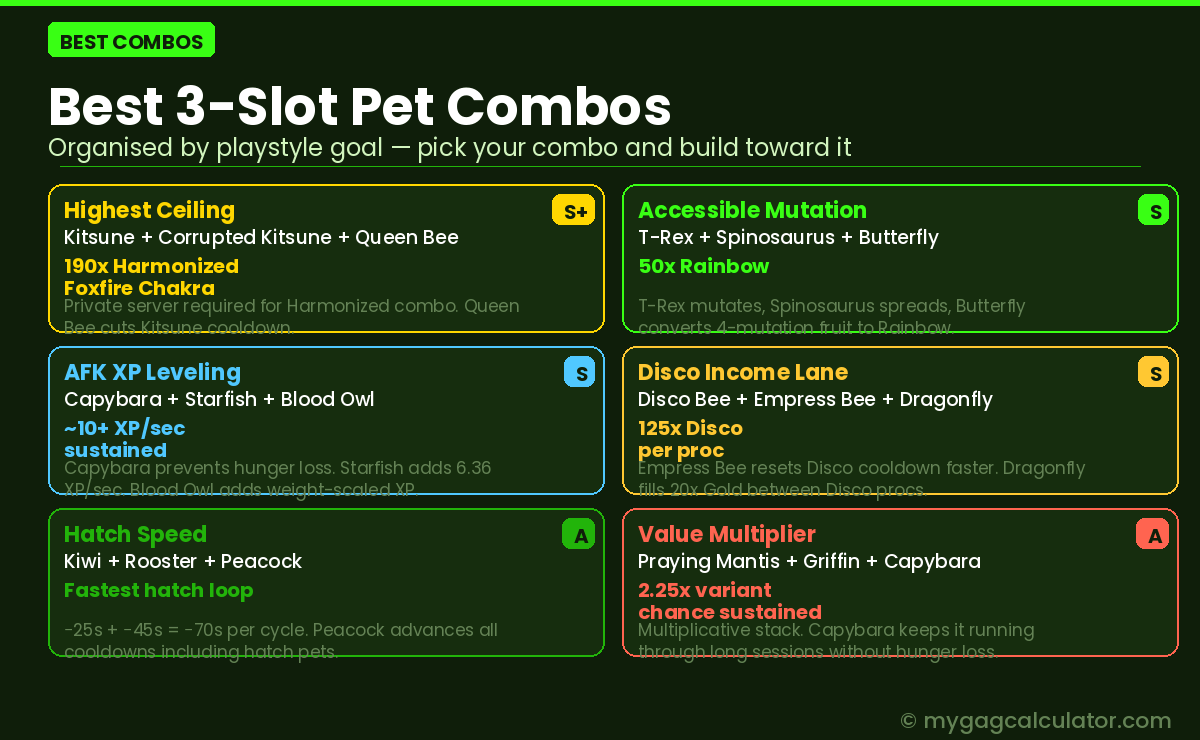
Every player has three active pet slots by default, expandable to eight through gamepasses and Ascension Shop upgrades. The combos below are organized by farming goal rather than by rarity — accessibility matters as much as ceiling for most players.
| Playstyle Goal | Recommended 3-Slot Combo | Why It Works | Ceiling |
|---|---|---|---|
| Mutation Farming | Kitsune + Dragonfly + Capybara | Kitsune seeds high-value chakra mutations; Dragonfly ensures steady Gold (20x); Capybara keeps session sustainable | 190x (Harmonized Foxfire Chakra) |
| Accessible Mutation | T-Rex + Spinosaurus + Butterfly | T-Rex mutates; Spinosaurus spreads; Butterfly converts 4-mutation fruit to Rainbow (50x) | 50x Rainbow |
| XP Leveling (AFK) | Capybara + Starfish + Blood Owl | Capybara prevents hunger loss; Starfish adds 6.36 XP/sec; Blood Owl adds weight-scaled XP to all active pets | ~10+ XP/sec sustained |
| Hatch Speed | Kiwi + Rooster + Peacock | -25s + -45s = -70s per cycle; Peacock advances all cooldowns including hatch pets | Fastest hatch loop |
| Income (Disco Lane) | Disco Bee + Empress Bee + Dragonfly | Disco Bee fires 125x; Empress Bee resets Disco cooldown faster; Dragonfly fills Gold (20x) between Disco procs | 125x per Disco proc |
| Cooldown Cycling | Empress Bee + Queen Bee + Kitsune | Empress resets all; Queen targets highest-CD pet as backup; Kitsune benefits from the faster cycling | Maximum cycle speed |
For weather event timing to align high-value pet ability windows with Blood Moon, Meteor Shower, or Thunderstorm schedules, the Grow a Garden Weather Tracker covers all active event countdowns for GAG1.
For calculating which crops produce the most Sheckles with a specific pet combo applied, the Grow a Garden Crop Planner lets players model crop selection against mutation and ability combinations.
Part 7: Pet Mutations and the Mutation Machine
Pet mutations are a separate system from crop mutations. They allow players to permanently add a new ability to any pet that has reached Age 50 or above. The Mutation Machine is located near the pet egg shop. Mutating a pet costs 500 million Sheckles (or 49 Robux to skip the 1-hour wait), and the process resets the pet’s age to 1.
Available Pet Mutation Abilities
- Dreadbound: 6 to 30 XP per second passive gain (from Headless Horseman)
- Soulflame: 60% XP boost to all active pets (from Headless Horseman)
- Ember: +32% farming efficiency — the best pet mutation currently in the game (from Fire Wisp; requires target pet to be Level 100+)
- Shiny: +15% XP bonus
- Inverted: +30% XP bonus
- Tiny: -10% XP penalty (negative mutation — avoid)
- Mega: +5% XP bonus
- Rainbow: stacks with one additional pet mutation for a combined bonus
- Golden: passive performance boost (mutation type)
| Fire Wisp Warning: Fire Wisp’s Fireheart ability applies the Ember pet mutation to level 100+ pets. Before each Fire Wisp cycle, favorite the specific pet to receive Ember. Without favoriting, Fire Wisp may apply the mutation to a pet the player did not intend to mutate. |
All pet mutation bonuses stack multiplicatively with the pet’s base ability — a Kitsune with an Ascended pet mutation does not change how Nine-Tailed Myth works, but it does increase the pet’s trading value significantly.
For trade value of mutated pets, the Grow a Garden Trade Calculator factors in pet mutation when evaluating offer fairness.
Part 8: Cooldown Management — Every Method Available
Shortening ability cooldowns is one of the highest-impact optimizations available once the core pet lineup is stable. Here are all current cooldown management tools in GAG1, ranked by impact:
Empress Bee (For the Empress): Resets ALL equipped pet cooldowns simultaneously on a single trigger. The strongest cooldown tool in the game. Became permanent after Bizzy Bees 2026.
Queen Bee: Resets the single pet with the longest current cooldown. Not a substitute for Empress Bee, but a useful secondary tool in lineups that include both.
Peacock / Albino Peacock: Fans feathers every roughly 10 minutes, advancing nearby pets’ cooldown timers by 60 seconds and granting bonus XP. Consistent mid-session cooldown support.
Meerkat: Reduces the cooldown of a random pet in the garden periodically. Less predictable than Empress Bee or Peacock but useful as a third-slot option.
Peach Wasp: Applies Plasma mutation and advances pet cooldowns on trigger — dual utility in a single slot.
Pet aging: The most consistent long-term cooldown reduction. An Age 50 Kitsune has a noticeably shorter cycle than the same Kitsune at Age 1. Pairing Starfish and Capybara to accelerate aging speeds this up naturally.
Energy Chew (consumable): A gear item from the Chubby Chipmunk event. Using it on any pet immediately resets that pet’s cooldown to zero. Non-farmable, limited supply — best reserved for high-value resets like Kitsune or Disco Bee.
Part 9: The 8 Biggest Pet Ability Mistakes in Grow a Garden
| Mistake | Why It Hurts | The Fix |
|---|---|---|
| Letting hunger reach zero | All active abilities pause; pet stops aging | Feed before going AFK; run a Capybara |
| Running Butterfly with active mutation pets | Butterfly strips 4 mutations to apply Rainbow — if those mutations are high-value, net result can be negative | Use Butterfly only when crop has 4 low-value mutations ready to convert |
| Trusting Sunny-Side Chicken + Rooster stacking | Sunny-Side Chicken 20% hatch boost does not stack with the same type — second copy wasted | Use one Sunny-Side Chicken + Rooster + Kiwi instead |
| Placing pets outside Capybara radius | Capybara radius is 15.48 studs — pets outside it still lose hunger | Cluster all pets within 15 studs of the Capybara |
| Expecting Queen Bee to reset all pets | Queen Bee resets only the single pet with the longest cooldown — not all pets | Use Empress Bee for full garden reset |
| Using Kitsune on a public server | Public servers have random players — target quality is unpredictable and mutation value is lower | Use Kitsune in a private server with a friend running high-value crops |
| Not favoriting pets before Fire Wisp fires | Fire Wisp applies Ember mutation to level 100+ pets that are not favorited — can overwrite a pet you did not want mutated | Favorite the specific pet you want Ember applied to before the cycle triggers |
| Judging a pet by its Age 1 ability only | A Kitsune at Age 1 is dramatically weaker than the same pet at Age 50 — cooldowns are longer, multipliers lower | Evaluate pets at their Age 50 potential, not their starting values |
Frequently Asked Questions
What are pet abilities in Grow a Garden?
Pet abilities are automatic effects that each pet performs from its active garden slot. Passive abilities run continuously with no cooldown. Active abilities fire on an internal timer every 15 to 25 minutes depending on the pet’s rarity, age, and weight. No player input is required for either type — pets work even while the player is offline.
Do pet abilities stack in Grow a Garden?
Yes, and the stacking method depends on ability type. Value multiplier pets (like Praying Mantis and Griffin) stack multiplicatively with each other — two Praying Mantises give 1.5x times 1.5x equals 2.25x combined variant chance. XP boost abilities (Capybara, Blood Owl) stack additively. Cooldown reduction pets each operate on independent timers. The same pet placed multiple times runs independent cycles — two Dragonflies give two separate Gold mutation proc cycles.
What happens when a pet’s hunger reaches zero?
When hunger reaches zero, all active abilities pause completely and the pet stops gaining age. The only exception is the Starfish, whose passive XP generation continues even at zero hunger. This makes hunger management the single most impactful basic system for AFK or long farming sessions. Running a Capybara prevents pets within 15.48 studs from losing hunger at all.
What is the best pet combo in Grow a Garden?
For the absolute highest ceiling: Kitsune plus Corrupted Kitsune in a private server generates Harmonized Foxfire Chakra at 190x, the highest mutation value in the game. For accessible players: T-Rex plus Spinosaurus plus Butterfly is the best mutation combo — T-Rex applies mutations, Spinosaurus spreads them, and Butterfly converts any fruit with 4 mutations to Rainbow (50x). For AFK XP leveling: Capybara plus Starfish plus Blood Owl is the most efficient sustained setup.
What is the Kitsune ability in Grow a Garden?
The Kitsune’s ability is called Nine-Tailed Myth. Every roughly 22 minutes, it visits another player’s fruit in the same server, applies the Chakra mutation (5x) or the rarer Foxfire Chakra (90x), and duplicates that fruit for the Kitsune owner. The original player keeps their fruit. This ability was temporarily changed to a steal mechanic during the Valentine’s 2026 event, then reverted to duplication on April 25, 2026. When paired with a Corrupted Kitsune in a private server, the combined result is Harmonized Foxfire Chakra at 190x.
What does the Empress Bee do in Grow a Garden?
The Empress Bee’s ability is called For the Empress. It resets the cooldowns of ALL equipped pets simultaneously in a single trigger. It has 250,000 hunger and comes with a permanent Upgrade Tree purchased from a dedicated NPC during the Bizzy Bees 2026 event. The Upgrade Tree upgrades persist permanently even after the event ends. It is a strict upgrade over Queen Bee, which only resets the single pet with the longest cooldown.
How do pet abilities scale with age?
Pet abilities scale at every age milestone. At Age 1, abilities operate at roughly 50% of full effectiveness. At Age 10, full activation is reached. At Age 25, bonus multipliers unlock. At Age 50, the Mutation Machine becomes available and cooldowns are significantly shorter. At Age 100 and beyond, endgame scaling continues with further cooldown reduction and ability strength improvement. Mega pets start with better base stats equivalent to higher-age versions of standard pets.
Do pet abilities work the same in Grow a Garden 2?
No. GAG2 runs a completely separate pet system with no hunger mechanic, no age progression, and no cooldown timers. See the GAG2 Pet Abilities guide for the full breakdown.
What is the pet mutation machine in Grow a Garden?
The Mutation Machine allows players to permanently mutate a pet that has reached Age 50 or above, giving it a new additional ability on top of its original one. The machine costs 500 million Sheckles per mutation and is located near the pet egg shop. Mutating a pet resets its age to 1, so the leveling investment must be made again after mutation. Mutation sources include the Mutation Machine, Golden Acorns, Pet Mutation Shards, and specific pets like the Headless Horseman.
What are the most common pet ability mistakes?
The most damaging mistakes are: letting hunger hit zero during a long AFK session (all abilities pause), running Butterfly alongside active mutation applicator pets without understanding it strips 4 mutations first, placing pets outside the Capybara’s 15.48-stud radius where hunger drain still applies, expecting Queen Bee to reset all pets (it only resets the single longest-cooldown pet), and using Kitsune in a public server where target quality is uncontrolled.