Published by: Saif (Jun 2026) | Platform: Roblox | Game: Grow a Garden
The Grow a Garden T-Rex is one of the most talked-about pets, and for good reason. Introduced during the Prehistoric Update on July 5, 2025, this Divine-tier dinosaur brings a game-changing passive ability that no other pet in the game replicates. Whether someone wants to understand exactly how it works, figure out what it is worth on the trading market, or learn how to squeeze every drop of value out of it, this guide covers everything in detail.
This is the most complete T-Rex guide available. Every mechanic, every edge case, every strategy, and every trading consideration is covered here. No filler, no guesswork.
What Is the T-Rex in Grow a Garden?Rarity: Divine (highest standard tier) Ability: Apex Predator Cooldown: Every 20 minutes and 24 seconds What it does: Devours one mutation from a random fruit in the garden, then roars and spreads that mutation to 3 or more other random fruits Source: Dinosaur Egg (Prehistoric Event, July 2025 — now event-exclusive, trade only) Hatch rate: 0.5% per Dinosaur Egg Current value: Normal T-Rex approximately 1.7M to 2.2M Sheckles; Huge T-Rex approximately 60M to 70M Sheckles Can it still be obtained by hatching? No. The Prehistoric Event has ended. T-Rex is now available through player trading only. |
What Is Grow a Garden T-Rex?
The T-Rex is a Divine rarity pet that was exclusively introduced as part of the Prehistoric Event, the biggest content update the game had seen up to that point. It launched on July 5, 2025, alongside a wave of dinosaur-themed pets, fossil crops, and new event mechanics. Visit our guide on pet tier list, every pet ranked by tier.
Visually, the T-Rex stands out immediately. It has a light-green body with light brown belly skin, and it is noticeably larger than any average pet. When a player holds it, the T-Rex uses a distinct two-armed carrying animation that is shared only with the other Dinosaur Egg pets and Primal Egg pets.
Its rarity sits at Divine tier, which in Grow a Garden terms means it sits just below Mythical and Prismatic in the rarity ladder but above Legendary, Rare, Uncommon, and Common. Divine pets are associated with rare, powerful abilities, and the T-Rex lives up to that expectation fully.
Unlike most pets that apply effects passively or boost garden-wide stats, the T-Rex does something uniquely tactical: it interacts directly with the mutation ecosystem by transferring existing mutations between crops. That single mechanic makes it one of the most strategically interesting pets in the entire game.
T-Rex Apex Predator Ability: Full Mechanic Breakdown
The T-Rex has one ability: Apex Predator. Understanding it precisely is the difference between using the T-Rex passively and building an optimized farming setup around it. See our gide on every pet ability in grow a garden.
How Apex Predator Works
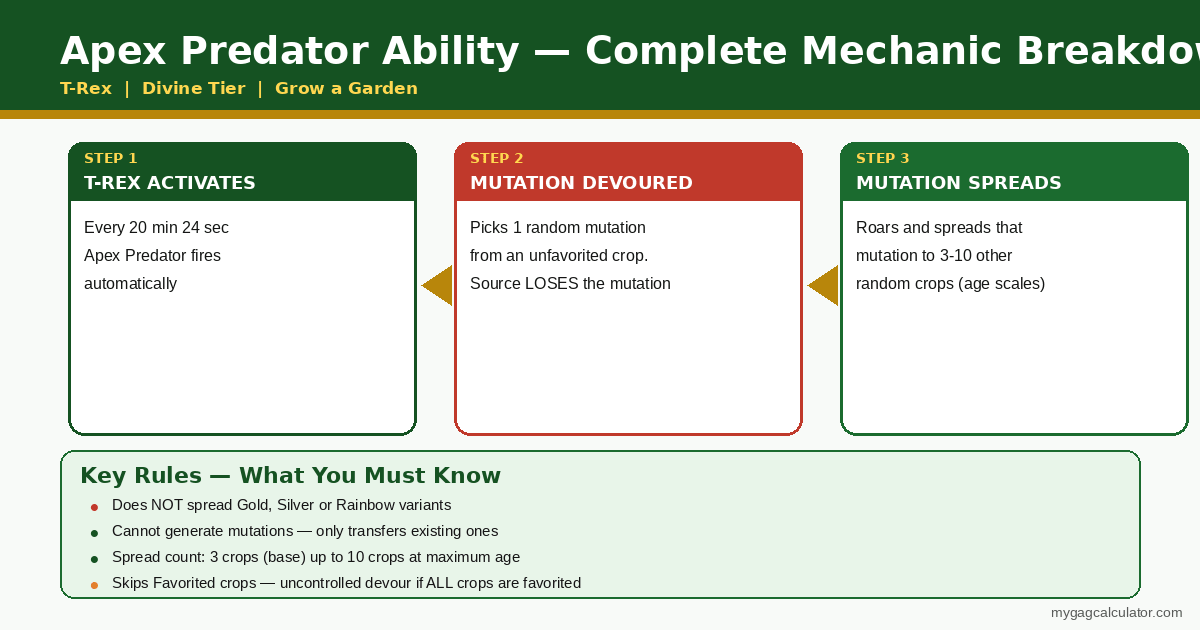
Every 20 minutes and 24 seconds (the listed cooldown is 20:24, though in practice it can vary slightly by a few seconds), the T-Rex triggers Apex Predator. Here is exactly what happens:
- The T-Rex selects a random fruit in the garden that has at least one mutation on it.
- It devours one mutation from that fruit. That mutation is permanently removed from the source fruit.
- The T-Rex roars and then applies that same mutation to 3 or more other random fruits in the garden.
The spread count starts at 3 fruits at base and scales upward as the pet ages. A max-aged T-Rex can spread a mutation to up to 10 crops per activation. This makes age one of the most important factors in its long-term farming value.
A key distinction that confuses many players: the T-Rex does not copy mutations. It transfers them. The source fruit loses the mutation permanently after the ability fires. Keeping this in mind is critical for garden management, especially when using the Favorite system.
What Mutations Does T-Rex Not Spread?
The T-Rex does not devour or spread Gold, Silver, or Rainbow variants. These special variants are excluded from its ability entirely, which prevents the mechanic from becoming economically broken and keeps the game balanced.
It also cannot create mutations on its own. The T-Rex only works with mutations that already exist in the garden. If a garden has no mutated crops, Apex Predator triggers but nothing happens.
The Random Selection Problem and How to Control It
This is the most overlooked part of T-Rex strategy: the pet selects mutations randomly. It does not automatically prioritize the highest-value mutation. That means if a garden has a mix of a Wet mutation (2x value) and a Molten mutation (25x value), the T-Rex is just as likely to spread the Wet mutation as it is the Molten one.
The practical implication: players who want maximum value per activation need to actively control what mutations are present in the garden. Removing low-value mutations using the Cleaning Spray gear is the standard method for doing this. The goal is a garden where every mutation available for T-Rex to choose from is a high-value one.
The Devour Without Target Bug
There is a known edge case where the T-Rex devours a mutation but fails to spread it to any other crop. This happens when every crop in the garden already has the mutation that was just devoured. In that scenario, the source fruit loses its mutation and no other crop gains anything. Net result: pure loss.
To avoid this, players should ensure the garden has variety in its mutations, or at minimum a few crops without the specific mutation the T-Rex is likely to pick. Monitoring garden mutation coverage before an activation cycle is a good habit for players doing serious AFK farming.
Apex Predator and the Favorite System
The Favorite system adds a layer of strategic control. By default, the T-Rex will not devour mutations from fruits that a player has marked as Favorited. This is intentional and very useful: players can lock down their best-mutated crops and let the T-Rex only pick from unfavorited ones.
There is one important exception. If every fruit in the garden is favorited, and the T-Rex has no unfavorited fruit with mutations to choose from, it will begin devouring from favorited fruits regardless. The T-Rex enters what can be described as an uncontrolled devour state. This is a known mechanic, not a bug.
The practical takeaway: never favorite every single crop. Always leave at least a few unfavorited fruits with lower-priority mutations in the garden to give the T-Rex a preferred target pool.
Ability Summary Table
|
How to Get T-Rex in Grow a Garden
The T-Rex was exclusively tied to the Prehistoric Event, which ran in July 2025. The event has ended. As of now, Dinosaur Eggs are no longer directly obtainable through normal gameplay. The only way to acquire a T-Rex in Grow a Garden today is through player-to-player trading.
For players who want to understand the original acquisition methods, or who are curious about how the pet was introduced, here is how the T-Rex was obtained during the event.
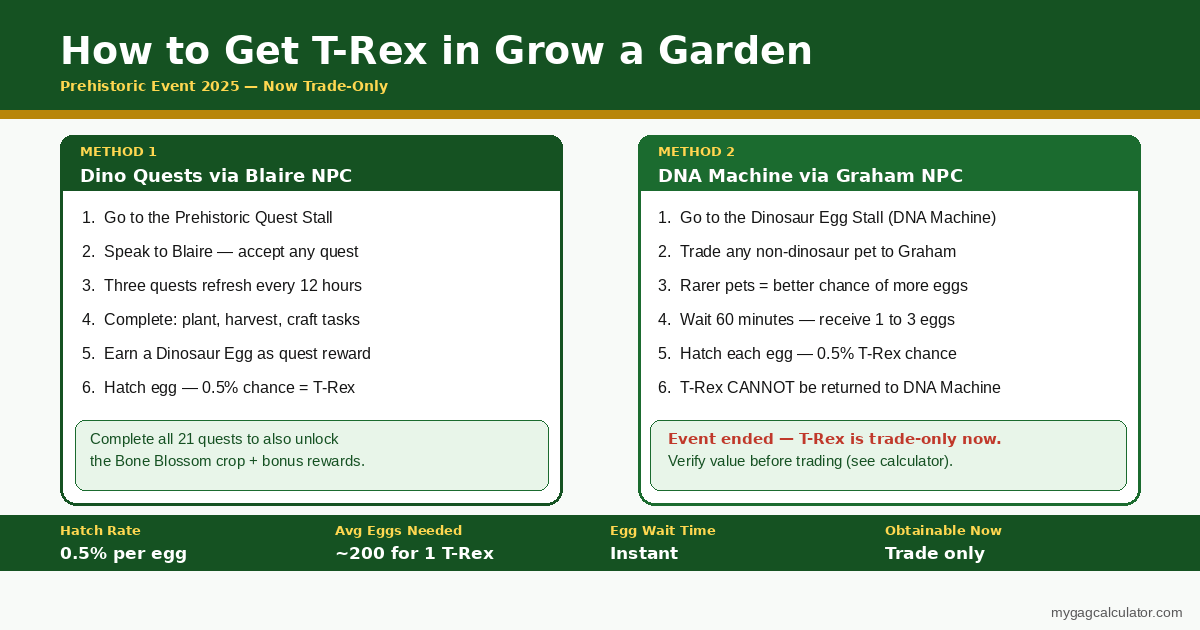
Method 1: Dino Quests via the Prehistoric Quest Stall (Blaire NPC)
During the event, players could speak to Blaire at the Prehistoric Quest Stall to receive three randomized quests every 12 hours. Quests involved tasks such as planting and harvesting crops, growing pets, or crafting items. See guide on all NPC available in Grow a Garden.
Completing a full set of three Dino Quests rewarded players with a Dinosaur Egg, a Dino Crate, and an Ancient Seed Pack. Every completed quest also added one tick to a milestone progress bar. After reaching 21 total completed quests, players unlocked the Bone Blossom crop alongside multiple packs and sprays.
This method was the most reliable way to accumulate Dinosaur Eggs over the course of the event for active players.
Method 2: Trading Pets at the DNA Machine (Graham NPC)
Graham, the NPC stationed at the Dinosaur Egg Stall (also called the DNA Machine), accepted non-dinosaur pets in exchange for Dinosaur Eggs. Players would trade any eligible pet (such as a Golden Lab, Bunny, or Dog) to Graham, who would initiate a 60-minute incubation process. At the end, the player received one to three Dinosaur Eggs depending on the rarity of the pet traded.
Rarer pets generally improved the odds of receiving multiple eggs per trade, making high-tier pets more efficient fuel for this method.
The Hatch Rate
Each Dinosaur Egg had approximately a 0.5% chance of hatching a T-Rex. Some sources have reported this as 1%, but the figure most consistently cited by the community and confirmed through large-sample hatching records is 0.5%. At that rate, on average a player would need around 200 Dinosaur Eggs to have a statistically expected one T-Rex hatch, though probability does not guarantee outcomes. See the Grow a Garden eggs list and theri hatch time.
Like all pets hatched from the Dinosaur Egg, the T-Rex cannot be placed back into the DNA Machine after hatching.
Getting a T-Rex Now: Trading Only
Since the Prehistoric Event has ended, the only path to owning a T-Rex is through trading with other players. The T-Rex is considered an exclusive legacy pet, which adds to its long-term collectible appeal even as its raw farming utility is matched by newer pets.
Before trading, it is worth using a reliable trade calculator to verify the current value on both sides of the exchange. The Grow a Garden Trade Calculator at MyGAGCalculator can help assess whether a deal is fair based on current market data. For scam prevention tips, see the full guide on Grow a Garden scam prevention.
T-Rex Value in Grow a Garden: Current Worth and Market Trends
The T-Rex sits in a unique market position. It is a powerful pet with real farming utility, but it is also an exclusive event pet that can no longer be obtained by hatching. That scarcity adds a collectible premium on top of its utility value.
Current Trade Value
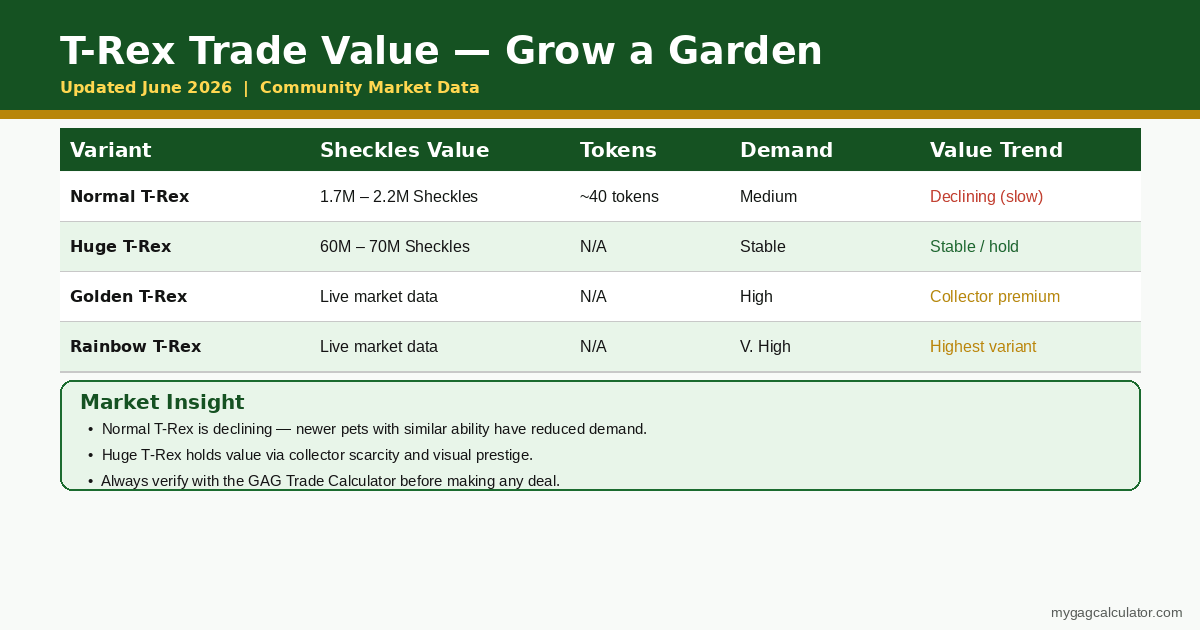
|
Note: Pet values in Grow a Garden shift frequently. The figures above reflect community data from mid-2026. For live market data, it is always worth checking a real-time source before making a trade. The Grow a Garden Pet Calculator and the Grow a Garden Trade Calculator are good starting points for checking pet-specific value at any given time.
Why T-Rex Value Is Declining
According to real-time market data, the normal T-Rex has been on a steady downward value trend. Several factors explain this:
- The game has introduced newer Divine and Mythical pets with comparable or stronger mutation-related abilities.
- The overall Sheckles economy has inflated as players accumulate wealth, pushing the relative perceived value of older pets downward.
- The T-Rex cannot be placed in the DNA Machine, which limits its ability to scale with the weight-based value systems available to other pets.
- The Huge T-Rex has remained more stable because of its visual appeal and the difficulty of obtaining it, keeping collector demand stronger.
When to Trade vs. Hold
Players holding a normal T-Rex should weigh whether they want to use it actively or trade it for something with better current market value. If the pet is being used in a serious farming build, holding makes sense because the utility value of Apex Predator in an optimized garden can outperform the trade return. If the T-Rex is sitting idle, trading it now before further value erosion is the more economically rational choice.
Huge T-Rex holders are in a better position. That variant has held its value more consistently and has additional collector appeal from its size tier. Holding is more defensible for Huge T-Rex.
To run the numbers on a specific trade offer, the Grow a Garden Profit Calculator can help estimate whether swapping a T-Rex for a different pet or crop-based setup would produce better long-term Sheckles per hour.
T-Rex Farming Strategies: How to Actually Maximize Apex Predator
The T-Rex is one of those pets where casual use and optimized use produce radically different results. Here are the strategies that serious farmers use.
Strategy 1: The Mutation Bait Crop Method
This is the most underutilized T-Rex strategy and produces the best results for mid-to-late game gardens.
The idea: plant cheap, fast-growing crops specifically as mutation bait for the T-Rex. Good bait crops are Watermelon or Potato because they grow quickly, accumulate environmental mutations from weather events, and are inexpensive to replace if mutations are lost.
Once bait crops have accumulated mutations, the T-Rex devours from them and spreads those mutations to the high-value crops. The high-value crops, which may include Bone Blossom, Candy Blossom, or Dragon Pepper, sit favorited to prevent T-Rex from accidentally consuming the mutations they already hold.
The result: high-value crops steadily accumulate mutations sourced from bait crops, and the garden’s total Sheckle value climbs each T-Rex cycle without having to rely on random weather events to mutate expensive crops directly.
Understanding which mutations are worth stacking on which crops is essential here. The Grow a Garden Mutation Calculator can calculate expected crop values for specific mutation combinations, making it easier to decide which bait crop setups produce the most valuable spreads.
Strategy 2: Cleaning Spray Curation
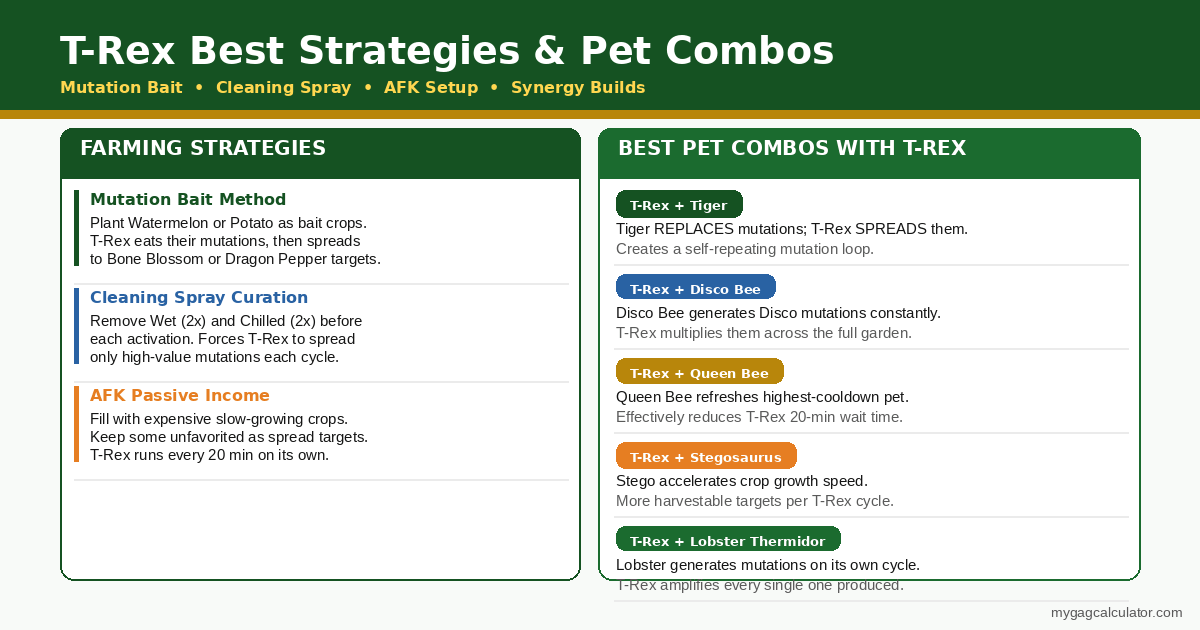
Cleaning Spray is a gear item that removes a mutation from a fruit. Used strategically before a T-Rex activation cycle, it allows players to eliminate low-value mutations from the garden so that the T-Rex’s random selection is forced to choose from only profitable options.
The typical workflow:
- Monitor the garden 5 minutes before the expected T-Rex activation.
- Identify any fruits carrying low-value mutations such as Wet (2x), Chilled (2x), or other common environmental mutations.
- Apply Cleaning Spray to remove those mutations.
- Allow T-Rex to activate. With low-value options removed, the probability of it spreading a high-value mutation like Molten (25x), Meteoric (125x), Aurora (90x), or Disco increases dramatically.
This strategy requires active management and is not suitable for pure AFK setups. But for players who are present in-game, it can significantly improve the average value generated per T-Rex cycle.
Strategy 3: AFK Passive Income Setup
For players who want to let the T-Rex run without active management, the key is setting up a garden where even a random activation produces meaningful value. The priorities are:
- Fill the garden with expensive, slow-growing crops. The more high-tier crops present, the higher the probability that a given spread lands on something valuable.
- Ensure at least one or two crops are always mutated. The T-Rex needs existing mutations to work from.
- Do not favorite everything. Leave bait crops unfavorited to give T-Rex a controlled target pool.
- Use the Grow a Garden Crop Planner to optimize garden layout for maximum coverage and mutation exposure.
For weather-enhanced setups, the T-Rex pairs very well with weather events that apply mutations broadly. Checking incoming weather through the Grow a Garden Weather Tracker can help time planting cycles so that crops pick up mutations from weather events right before a T-Rex activation, setting up a much more productive spread.
Strategy 4: Multiple T-Rex Stacking
It is possible to run multiple T-Rex pets in the same garden. Each T-Rex operates independently on its own cooldown. With two T-Rex pets active, the garden receives mutation spreads approximately twice as often. However, there are diminishing returns: if the garden’s mutation pool is thin, both T-Rex pets may end up spreading the same limited mutations, producing less net value than if those activation slots were occupied by mutation-generating pets instead.
Stacking multiple T-Rex pets is most effective in large, mutation-rich gardens where the bait crop method is already in place and there is a steady supply of varied mutations to spread.
Best Pet Combos for T-Rex
The T-Rex is a mutation multiplier. It does not generate mutations on its own. This means it reaches its full potential when paired with pets that produce mutations, control cooldowns, or scale the garden in complementary ways.
T-Rex + Tiger
This is the most synergistic combo available to T-Rex owners. Tigers have an ability that replaces mutations on crops. T-Rex spreads mutations. When both activate in a coordinated cycle, the Tiger continuously introduces fresh mutations and the T-Rex amplifies them across the garden. The cycle creates a self-reinforcing mutation loop: Tiger introduces, T-Rex spreads, Tiger replaces and refreshes, T-Rex spreads again.
T-Rex + Disco Bee and Lobster Thermidor
Both Disco Bee and Lobster Thermidor actively apply mutations to crops on their own cooldowns. Pairing either with the T-Rex means there is a steady supply of mutations being generated for the T-Rex to spread. The three-pet stack of T-Rex, Disco Bee, and Lobster Thermidor creates a mutation-dense garden environment where every T-Rex activation is likely to fire on a high-value mutation.
T-Rex + Queen Bee
Queen Bee has an ability that refreshes the pet with the highest cooldown in the garden. Given the T-Rex’s 20-minute cooldown (one of the longest in the game), Queen Bee can functionally reduce the time between T-Rex activations, increasing the number of mutation spreads per session.
T-Rex + Stegosaurus
The Stegosaurus is another Dinosaur Egg pet that boosts crop growth speed. Running Stegosaurus alongside T-Rex means crops grow to harvestable size faster, which reduces the time between planting cycles and ensures the garden is always populated with fruiting crops ready to receive T-Rex mutations.
T-Rex + Cockatrice or Corrupted Kitsune
Pets with powerful ongoing mutation generation abilities are generally strong T-Rex partners. Corrupted Kitsune, for example, periodically applies mutations to crops. More mutations in the garden means more meaningful choices for T-Rex to spread, making every Apex Predator activation more valuable.
Pet Combo Quick Reference
|
Using T-Rex for Quests: Zen Event and Connoisseur Food Reviews
This is one of the most underused applications of the T-Rex, and it is particularly relevant during time-sensitive event periods.
Zen Event Quests and Connoisseur Food Reviews both require players to present crops that have specific mutations. Getting mutations onto specific crops through normal means can be slow and dependent on weather RNG or specific event conditions.
The T-Rex short-circuits this process. By setting up a garden where a high-value or specific mutation already exists on one crop, the T-Rex can spread it to several other crops in a single activation. If three to four crops with a particular mutation are needed for quest completion, one well-timed T-Rex activation can satisfy that requirement instantly.
The practical setup:
- Identify what mutation the quest or food review requires.
- Obtain one crop with that mutation (through weather events, specific pets, or trading for mutated seeds).
- Unfavorite that crop and wait for T-Rex to activate.
- T-Rex spreads the mutation to up to 3 to 10 other crops depending on its age.
- Harvest the mutated crops for quest submission.
This method is especially powerful for players who have an aged T-Rex with a higher spread count, since a single activation can cover an entire quest requirement in one cycle.
T-Rex vs. Spinosaurus: Which Dinosaur Pet Is Better?
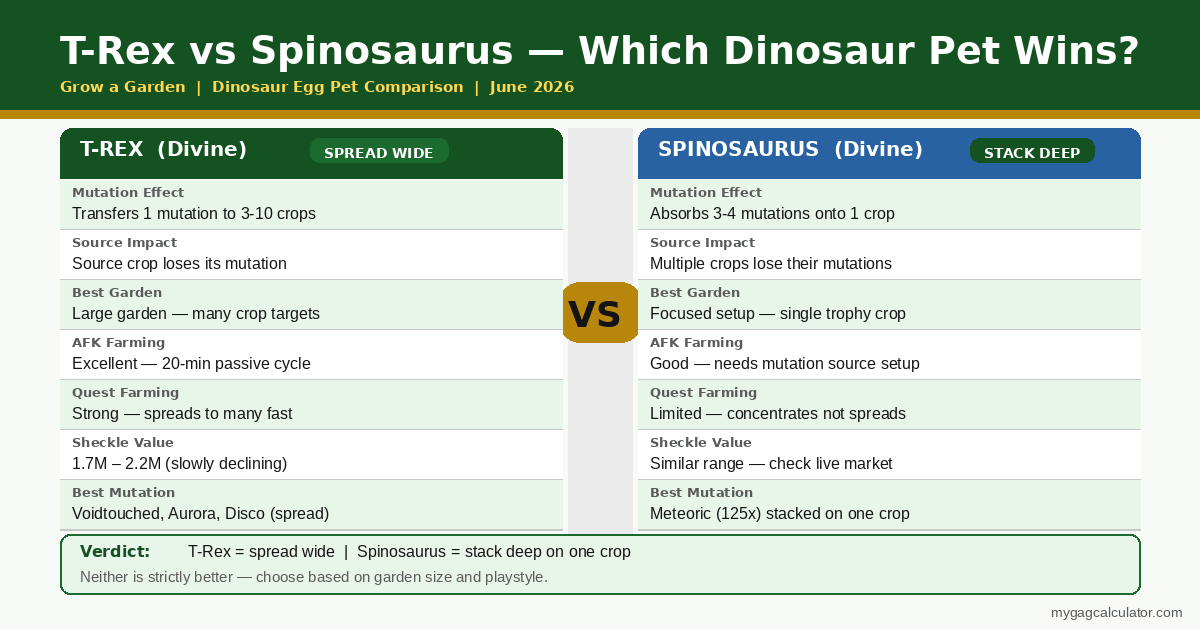
The Spinosaurus is the other high-tier Dinosaur Egg pet that players frequently compare to the T-Rex. Both are powerful, but they work in fundamentally different ways.
|
The T-Rex is better for players who want broad mutation distribution: getting one rare mutation onto many crops simultaneously. Spinosaurus is better for players who want to concentrate multiple mutations onto a single high-value crop, pushing it toward an extraordinarily high sell price.
Which is better depends entirely on playstyle. Wide gardens with many crops benefit more from T-Rex. Focused farming setups built around maximizing a single trophy crop lean toward Spinosaurus.
For a full comparison of pets across all tiers, the Grow a Garden Pet Calculator can be used to model expected returns for different pet builds.
T-Rex Normal vs. Huge T-Rex: Is the Upgrade Worth It?
The Huge T-Rex is a significantly more valuable variant of the same pet, both in trade terms and in appearance. Here is how the two compare.
| Factor | Normal T-Rex | Huge T-Rex |
|---|---|---|
| Trade Value | ~1.7M to 2.2M Sheckles | ~60M to 70M Sheckles |
| Visual Size | Standard Divine size (already large) | Noticeably larger — dominant garden presence |
| Ability | Apex Predator (same) | Apex Predator (same) |
| Age Scaling | Spreads to up to 10 crops at max age | Same scaling applies |
| DNA Machine | Cannot be placed | Cannot be placed |
| Value Trend | Declining slowly | More stable — collector premium |
The ability itself does not change between Normal and Huge. Both versions of the T-Rex run the same Apex Predator mechanic. The primary differences are visual scale and trading value. Huge T-Rex commands a 30x to 35x price premium over normal T-Rex, which reflects both collector demand and the greater difficulty of obtaining a Huge variant of any event-exclusive pet.
For players focused purely on farming utility, a Normal T-Rex delivers the same ability output at a much lower acquisition cost. For players building a prestige collection or who want a higher-value trade asset, Huge T-Rex is the better hold.
The Grow a Garden Weight Calculator can help track age and weight progression for T-Rex pets, which affects how quickly the spread count scales up to its maximum.
Common Mistakes Players Make with T-Rex
These mistakes show up repeatedly in the community, especially among players new to using Divine-tier mutation pets.
- Expecting T-Rex to copy mutations: It transfers them. The source fruit always loses its mutation after spreading. Garden setup needs to account for this by having regenerating mutation sources.
- Favoriting every crop in the garden: If all crops are favorited, the T-Rex enters uncontrolled devour mode and will start eating mutations from favorited fruits regardless. Always keep a portion of crops unfavorited.
- Not removing low-value mutations before activation: Without Cleaning Spray curation, T-Rex may spend an activation spreading a Wet or Chilled mutation instead of something valuable. Active management of the mutation pool makes a significant difference.
- Trying to use the DNA Machine on T-Rex: Like all Dinosaur Egg pets, the T-Rex cannot be placed in the DNA Machine. This is a firm mechanic limit.
- Expecting T-Rex to work with no existing mutations: If no crops are currently mutated, Apex Predator activates but nothing happens. The T-Rex is an amplifier, not a generator.
- Ignoring age and weight as value factors: A young T-Rex spreads to only 3 crops per activation. An aged T-Rex can spread to 10. The pet is significantly more valuable at higher ages, both for farming and trading purposes.
Key Mutations to Stack with T-Rex
Not all mutations are equal targets for T-Rex spreading. Here is a reference for the highest-impact mutations to prioritize when curating a T-Rex garden.
| Mutation | Value Multiplier | T-Rex Priority |
|---|---|---|
| Meteoric | 125x | Highest priority — spread this first if available |
| Aurora | 90x | Extremely high value — excellent T-Rex target |
| Rainbow (variant) | Cannot be spread | Protect via Favorite — T-Rex cannot spread this |
| Dawnbound | High (event-specific) | Strong target — spreads well via T-Rex |
| Voidtouched | Very high | Ideal for T-Rex spreading in endgame setups |
| Disco | High with stacking | Popular T-Rex target — compounds well with other mutations |
| Molten | 25x | Strong — good bait crop target |
| Shocked | Notable multiplier | Good T-Rex spread candidate |
| Wet | 2x | Low value — remove with Cleaning Spray before activation |
| Chilled | 2x | Low value — remove with Cleaning Spray before activation |
For mutation stacking math and value projections, the Grow a Garden Mutation Calculator handles the calculations automatically for any crop and mutation combination. Understanding the value of Voidtouched mutations in detail is covered in the dedicated Grow a Garden Voidtouched Mutation guide, and the full breakdown of Dawnbound mutations can be found in the Grow a Garden Dawnbound Mutation guide.
T-Rex and Giant Crops: A Profitable Combination
Giant crops, which are oversized crop variants with significantly higher base sell values, are natural targets for T-Rex mutation spreading. Because giant crops already carry a size-based value premium, adding high-value mutations on top through T-Rex spreads creates a multiplicative profit increase.
The weight system in Grow a Garden means heavier crops sell for more. A giant crop that receives an Aurora or Voidtouched mutation from a T-Rex spread is worth substantially more than either the mutation or the giant status alone. The full breakdown of how weight interacts with crop value is covered in the Giant Crops guide and can be calculated in detail with the Grow a Garden Weight Calculator.
T-Rex in the Broader Prehistoric Event Context
The Prehistoric Update in July 2025 introduced a substantial amount of content beyond just the T-Rex. The event featured the full Dinosaur Egg pet pool, the Primal Egg system, new fossil-themed crops including the Bone Blossom and Fossilight, the Stonebite crop, the Prehistoric Event island, the DNA Machine mechanic, and both Graham and Blaire as new NPCs.
The T-Rex was the rarest pet from the Dinosaur Egg pool, sitting at Divine tier with a 0.5% hatch rate. The other Dinosaur Egg pets, including Raptor (approximately 35% hatch rate), Triceratops, Stegosaurus, Pterodactyl, Pachycephalosaurus, Parasaurolophus, Ankylosaurus, and Spinosaurus, rounded out the prehistoric pet roster with varying rarities and utility ratings.
The entire Prehistoric Event ecosystem is now locked behind trading, making the T-Rex a legacy collectible as much as a functional farm pet.
Is the T-Rex Worth Getting in 2026?
| Honest Verdict
The T-Rex is worth getting for players who run large, mutation-rich gardens and want a passive multiplier working on every 20-minute cycle. Its Apex Predator ability has no direct equivalent in the game — no other pet replicates mutation transfer mechanics. It is less compelling for players who are just starting out. The mutation bait strategy and Cleaning Spray curation require a reasonably advanced garden setup to produce meaningful returns. A T-Rex sitting in a garden with only one or two crops will generate minimal value. For collectors, the Huge T-Rex in particular is a strong hold. Its value has remained more stable than the normal variant, and as an event-exclusive pet with no reissue in sight, its scarcity increases over time. |
Frequently Asked Questions
What does T-Rex do in Grow a Garden?
The T-Rex has a passive ability called Apex Predator. Every 20 minutes and 24 seconds, it selects a random mutation from an unfavorited crop, removes it from that crop, then spreads it to 3 or more other random crops. The number of crops it spreads to increases with the pet’s age, reaching up to 10 at maximum age.
Does T-Rex copy or remove mutations?
The T-Rex removes (transfers) the mutation from the source crop. After Apex Predator fires, the source fruit no longer has that mutation. It is a transfer, not a copy.
Can the T-Rex spread Gold or Rainbow mutations?
No. The T-Rex does not devour or spread Gold, Silver, or Rainbow variants. These are specifically excluded from its ability.
Can the T-Rex eat mutations from favorited plants?
Normally no. The T-Rex will not devour from favorited crops. The exception is when all crops in a garden are favorited, in which case it will start devouring from favorited crops uncontrollably. Always keep some crops unfavorited to avoid this.
Is T-Rex still obtainable in Grow a Garden?
Not through hatching. The Prehistoric Event ended in 2025, and Dinosaur Eggs are no longer available through normal gameplay. The only way to obtain a T-Rex now is by trading with other players.
How much is the T-Rex worth in Grow a Garden?
The normal T-Rex currently trades for approximately 1.7 million to 2.2 million Sheckles, with medium demand and a slightly declining trend. The Huge T-Rex trades for approximately 60 million to 70 million Sheckles and has held its value more consistently.
What is the best strategy for using T-Rex?
The most effective strategy is the mutation bait crop method: plant cheap fast-growing crops as mutation sources, favorite high-value crops to protect them, and let the T-Rex devour from bait crops and spread those mutations to the expensive ones. Pairing with Cleaning Spray to remove low-value mutations before each T-Rex activation maximizes value per cycle.
What pets pair best with T-Rex?
Tiger creates a mutation cycling loop with T-Rex. Disco Bee and Lobster Thermidor generate mutations for T-Rex to spread. Queen Bee reduces the effective T-Rex cooldown. Stegosaurus accelerates crop growth to keep targets ready.
Is T-Rex better than Spinosaurus?
They serve different purposes. T-Rex spreads one mutation to many crops, making it better for wide gardens. Spinosaurus concentrates multiple mutations onto one crop, making it better for building a single high-value trophy crop. Neither is strictly better; they suit different playstyles.
How does T-Rex age affect its ability?
At base, T-Rex spreads mutations to 3 crops per activation. As the pet ages, this number scales upward, reaching a maximum of 10 crops at max age. Age also generally increases the pet’s trading value.
Can multiple T-Rex pets be used in the same garden?
Yes. Multiple T-Rex pets run independent cooldowns and activate separately. Stacking two or more T-Rex pets approximately doubles the frequency of mutation spreads. This is most effective in mutation-rich gardens where there is enough variety to make each activation meaningful.
Can T-Rex work with Voidtouched or Dawnbound mutations?
Yes. T-Rex can spread Voidtouched and Dawnbound mutations the same as any other eligible mutation, provided they are not Gold, Silver, or Rainbow variants. These are among the most valuable mutations for T-Rex to spread.