Published by: Saif (Updated: Jun 2026) | Platform: Roblox | Game: Grow a Garden
Land an 85x multiplier on a single fruit and even an average crop turns into a serious Sheckle payday. That is the entire appeal of the Sundried Mutation Grow a Garden, and it explains why the keyword shows up in so many player searches every week. Roblox farming games live and die on multiplier mechanics like this one, and Sundried sits among the small group of mutations any player can chase without waiting on a developer to flip a switch.
This guide reflects the current build of the game rather than the version most older articles were written against. A few things changed since Sundried first launched: the Tanning Mirror moved out of the Gear Shop and into the Crafting Station, the Paradisal combo received a serious multiplier buff that plenty of guides still get wrong, and a second event called Solar Flare can now apply Sundried outside of Heat Wave entirely. Every section below works through what currently holds true, also see the guide on all mutations available in Grow a Garden.
Quick Answer
| What to know | Detail |
| Multiplier | 85x Sheckle value on whatever fruit it lands on |
| How to get it | Heat Wave weather event, or the rarer admin-triggered Solar Flare event |
| Tool that helps | Tanning Mirror, crafted at the Crafting Station (no longer sold in the Gear Shop) |
| Best crops | Feijoa, Loquat, Dragon Fruit, Sugar Apple, Cauliflower |
| Stacks with | Disco (125x) and Ceramic, compounding into far larger totals |
| Gets replaced by | Paradisal (100x) if Verdant lands on the same fruit |
| Rarity category | Legendary, weather-type mutation |
| Added | Summer Harvest Event, 2025 |
| Can it be triggered manually? | No, though Solar Flare offers an admin-triggered alternative path |
What Is the Sundried Mutation Grow a Garden?
The Sundried Mutation is a Legendary, weather-type modifier that multiplies a fruit’s sell value by 85 times. It belongs to the same weather mutation family as Shocked, Celestial, and Aurora, meaning it comes from a specific environmental event rather than a pet ability or a crafted item.
Visually, a Sundried fruit looks like it spent too long under direct sun. Bright crops fade and wash out, pale crops like Cauliflower pick up an orange or yellow tint, and darker green crops take on a dry, sun-bleached look. The in-game mutation label confirms it whenever the color change alone is not obvious enough to read at a glance.
Sundried arrived during the Summer Harvest Event of 2025, alongside Verdant, Paradisal, Windstruck, and several new Summer-themed seeds including Feijoa and Loquat. That batch of additions is worth knowing as a group, since several of those mutations interact directly with each other, and the most valuable of those interactions runs straight through Sundried, covered later in this guide.
How Sundried Compares to Other High-Value Mutations
It is worth being upfront about something a lot of older guides get wrong: Sundried’s 85x is no longer the strongest natural multiplier in the game, and treating it as untouchable does readers a disservice. A handful of mutations now sit above it, and each comes from its own distinct source.
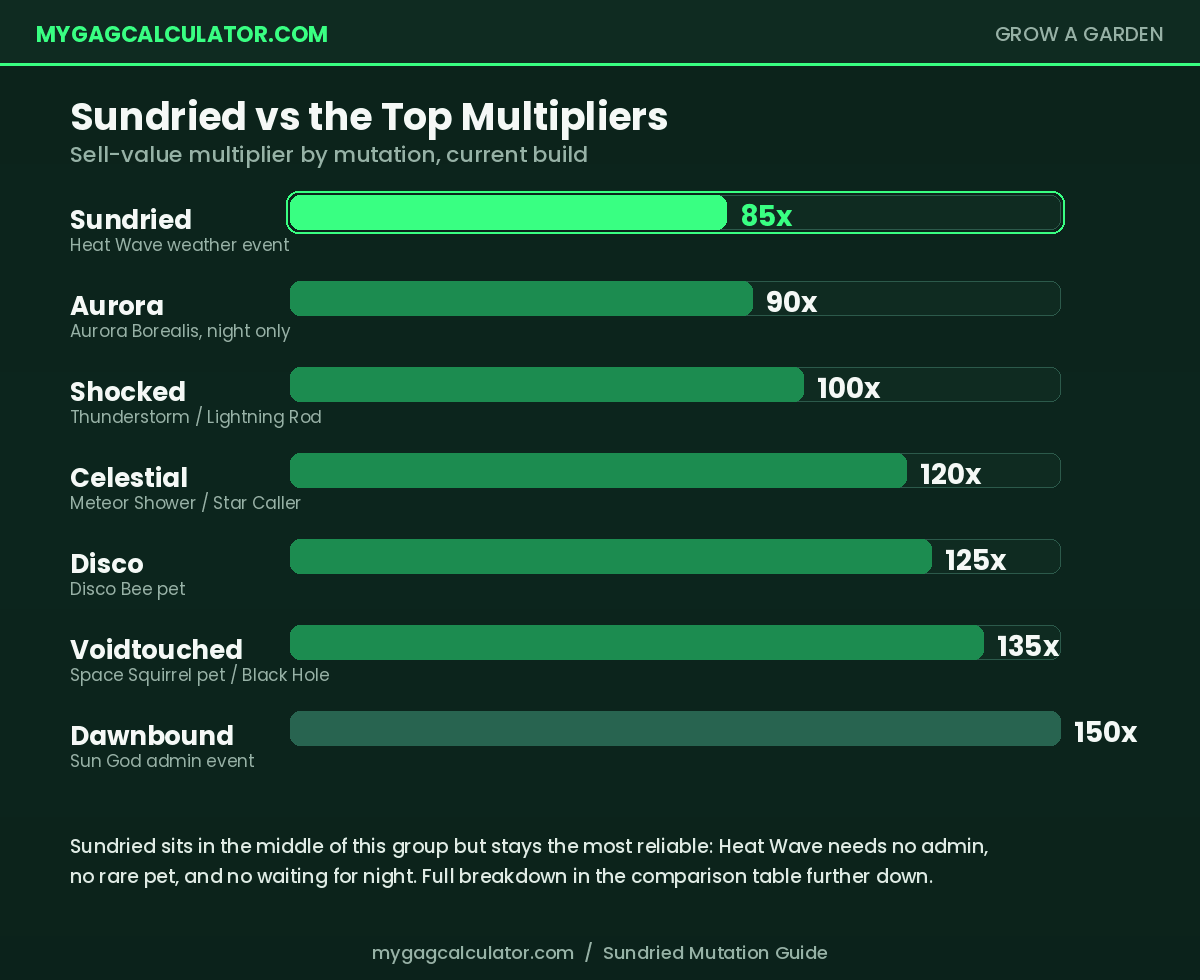
| Mutation | Multiplier | How players get it | Admin required? |
| Sundried | 85x | Heat Wave weather event | No |
| Aurora | 89.44x (rounded to 90x) | Aurora Borealis weather event, night cycle only | No |
| Shocked | 100x | Thunderstorm, boosted by the Lightning Rod | No |
| Celestial | 120x | Meteor Shower, boosted by the Star Caller | No |
| Disco | 125x | Disco Bee pet | No |
| Voidtouched | 135x | Space Squirrel pet, or the Black Hole event | No |
| Dawnbound | 150x | Sun God admin event | Yes |
What keeps Sundried relevant despite sitting in the middle of that list is reliability. Heat Wave cycles through the standard weather rotation on every server, multiple times in a typical session, with no admin involvement and no rare pet required. Aurora and Shocked both edge it out slightly, but Aurora only fires at night and Shocked needs a lightning strike to land in the right spot.
Dawnbound and Voidtouched hit harder still, but one needs an admin to run an event and the other needs a specific pet most players have not hatched yet. For a mutation any player can realistically farm in a normal session without spending Robux or waiting on RNG pets, Sundried still earns its spot near the top. Full breakdowns of Celestial and Voidtouched sit in their own dedicated guides if a deeper comparison is useful.
How to Get the Sundried Mutation in Grow a Garden
There are two ways to land Sundried on a crop, and only one of them is something players can actually plan a session around.
Method 1: Heat Wave, the Reliable Path
Heat Wave is a standard weather event that fires on every server independently, as part of the wider weather event rotation in Grow a Garden. A sun icon appears in the bottom right corner of the screen, the garden takes on a warm yellow tint, and visible sunbeams strike crops at random. Any fruit a beam touches has a chance to come away with Sundried.
The event runs for a few minutes at a time and tends to repeat multiple times across a normal play session, though the game does not publish an exact frequency, so it is worth treating any specific timer claims with some skepticism. Checking the Weather Tracker before a farming session is the fastest way to confirm whether Heat Wave or any other event is currently active on a server, rather than guessing from memory. Heat Wave also keeps appearing in this standard rotation regardless of whatever limited-time event happens to be live, including the current Summer Campfire event, so there is no need to wait for a season to end before farming it.
| Heads up: Heat Wave cannot be triggered manually. No item, spray, or pet forces it to start. Preparation before the event, not action during a countdown, is what actually moves the needle on results. |
Method 2: Solar Flare, the Admin-Triggered Alternative
Solar Flare is a separate, admin-triggered event that can also apply Sundried, and it carries one advantage Heat Wave does not: it is capable of landing Sundried and Verdant on the same fruit within a single event cycle, which is the fastest known route into the Paradisal mutation covered further down this guide.
The catch is control. Heat Wave runs on a recurring cycle that shows up without anyone needing to act. Solar Flare only fires when the game’s administrators trigger it, with no public schedule and no warning countdown. Following the official Discord or checking the admin events schedule is the closest thing to advance notice most players will get.
The Tanning Mirror: How to Get and Use It Correctly
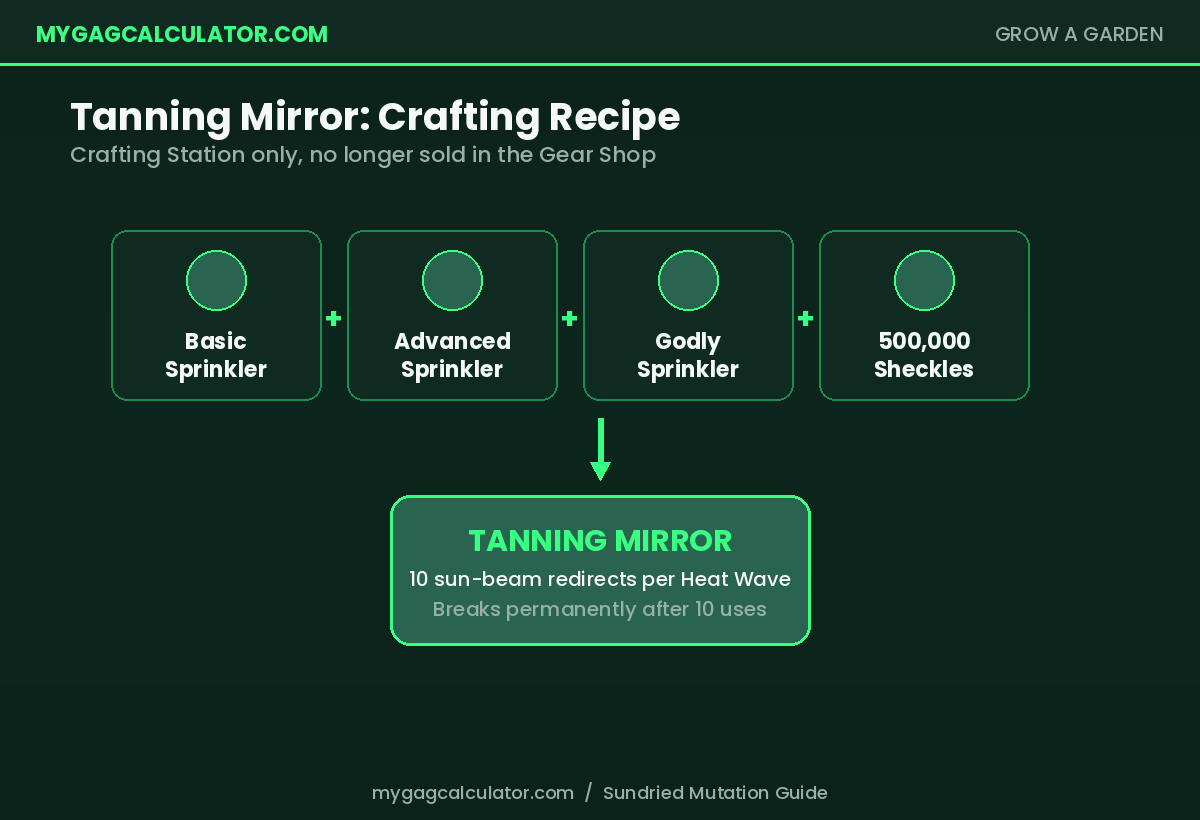
This is where a lot of guides written earlier in the year are now out of date, including some on this very site that have not caught up yet. The Tanning Mirror used to be a straightforward Gear Shop purchase for 1,000,000 Sheckles. That changed. The Tanning Mirror is now exclusive to the Crafting Station, and Eloise no longer stocks it at all.
| Tanning Mirror | Detail |
| Source | Crafting Station only, not the Gear Shop |
| Recipe | Basic Sprinkler, Advanced Sprinkler, Godly Sprinkler, plus 500,000 Sheckles |
| Effect | Redirects 10 sun beams during Heat Wave toward nearby crops |
| Uses | 10 redirects, then it breaks permanently |
| Works during | Heat Wave only, does nothing outside the event |
Crafting one means having all three sprinkler tiers in inventory first, on top of the Sheckle cost. That is a heavier lift than the old one-click Gear Shop purchase, but it also means the Tanning Mirror is no longer locked behind random shop stock. Once a player has the ingredients, crafting it is guaranteed rather than a coin flip on whether Eloise happens to be selling one.
Placement still works the way it always has. Deploy it next to the highest-value multi-harvest crops in the garden, not in the center of a mixed plot where redirects waste on cheap plants. Before committing three sprinklers to a Tanning Mirror, running the numbers through the Profit Calculator is worth the thirty seconds, since the crafting cost only pays off if the crops nearby are actually worth redirecting beams toward.
Best Crops for the Sundried Mutation, Profit Ranked
The 85x multiplier applies to whatever a crop’s base sell value already is, so the best targets combine a high base price with multi-harvest growth, since more fruit on one plant means more chances for a sunbeam to land.
| Crop | Base value | Sundried value (85x) | Notes |
| Feijoa | 13,000 Sheckles | 1,105,000 Sheckles | Divine rarity, multi-harvest, among the strongest targets in the garden |
| Loquat | 8,000 Sheckles | 680,000 Sheckles | Divine rarity, multi-harvest, a reliable second choice |
| Dragon Fruit | 4,287 Sheckles minimum | 364,395 Sheckles | Pre-existing crop, up to five fruits per plant |
| Sugar Apple | Highest of the Summer seeds | Scales accordingly | Prismatic rarity, extremely rare to obtain |
| Cauliflower | Moderate | Scales accordingly | Turns a clear orange under Sundried, useful for spotting it fast |
| Prickly Pear | Moderate to high | Scales accordingly | Multi-harvest, reliable beam exposure per Heat Wave |
| Avocado | Moderate | Scales accordingly | Multi-harvest, consistent base value |
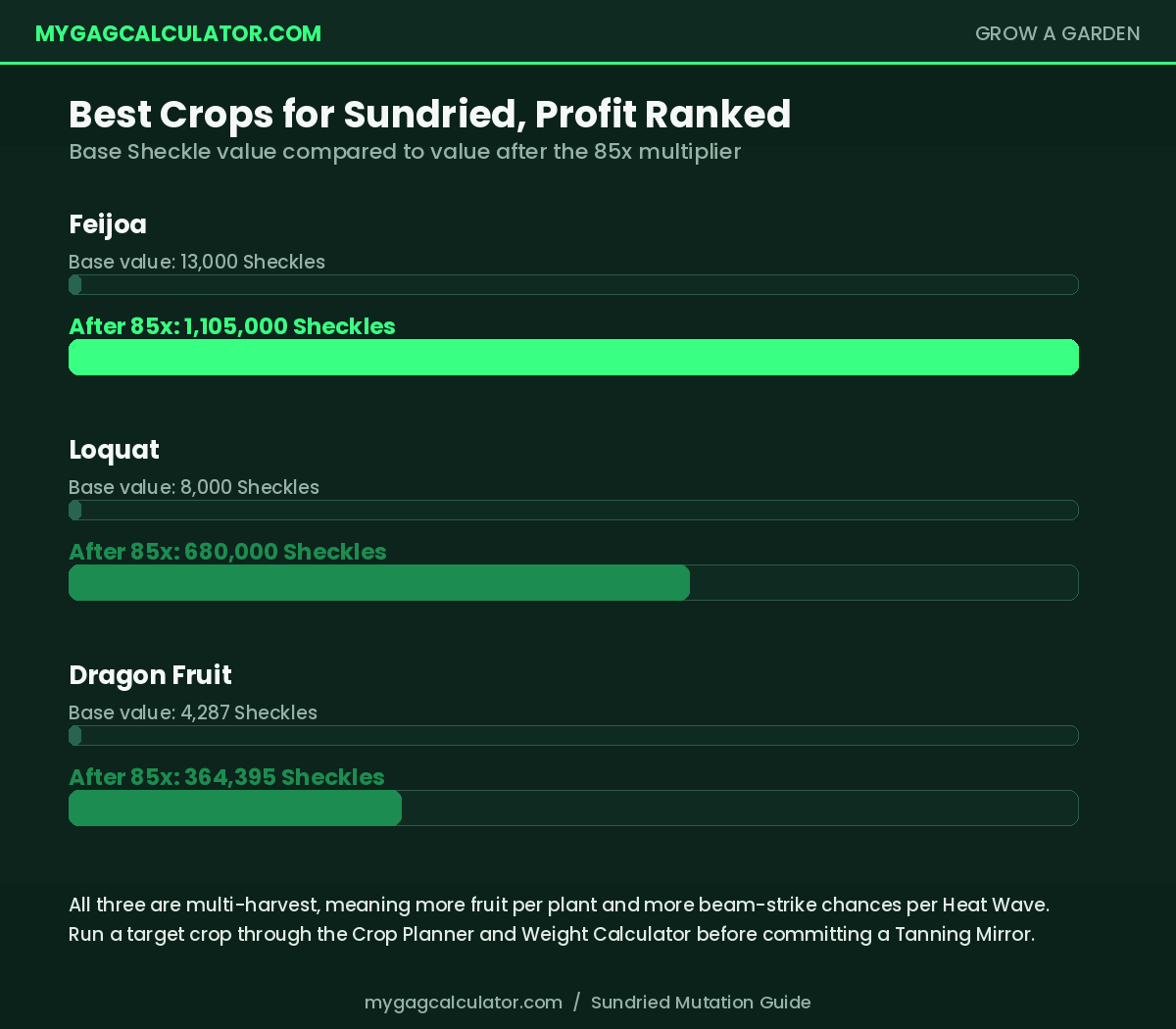
Crop weight adds another layer on top of all of this, since a heavier fruit of the same type sells for more before any multiplier even applies. Running a target crop through the Weight Calculator before harvest, alongside the Crop Planner for laying out a multi-harvest-heavy garden, turns this from a guess into an actual number worth planning around.
AFK Farming Blueprint for the Sundried Mutation
Sundried farming does not require active play, which makes it a strong candidate for an AFK setup. The structure below pulls from the general AFK farming method on this site, adapted specifically for Heat Wave.
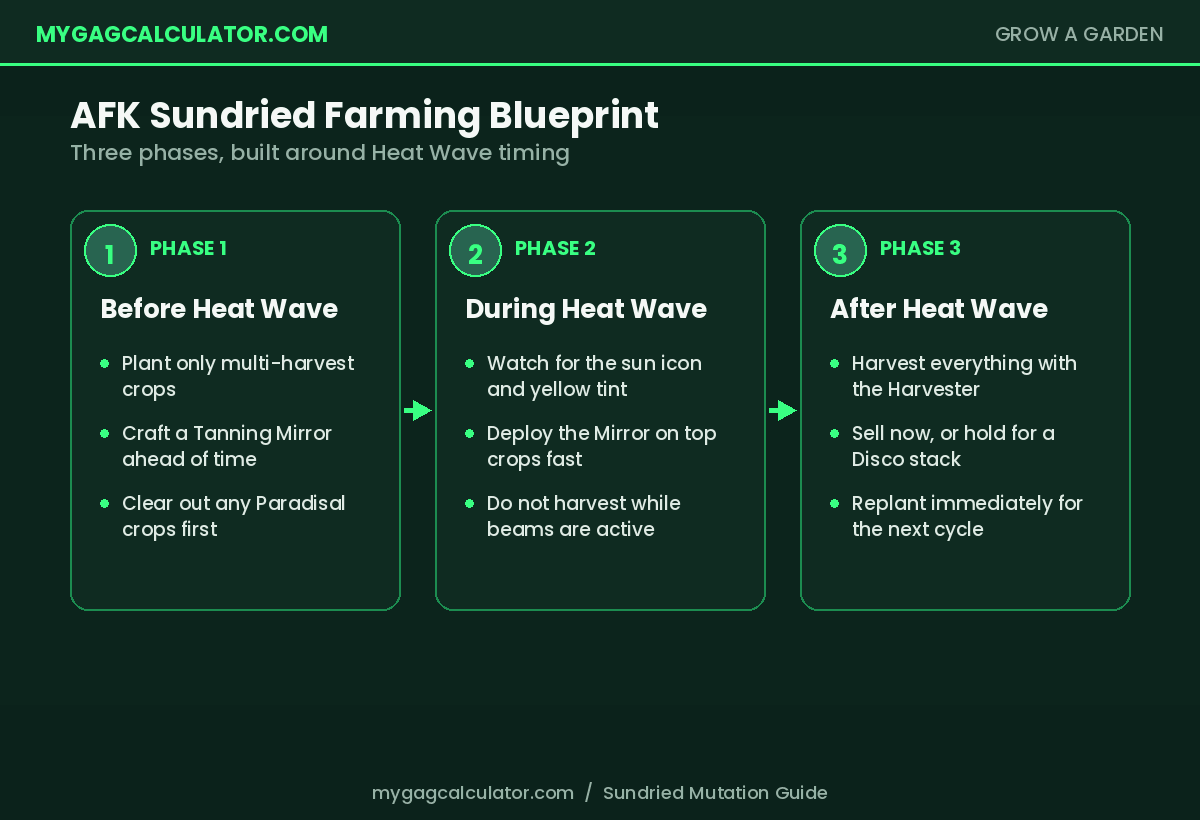
Before Heat Wave Starts
- Plant only multi-harvest crops. Every single-harvest plant in the garden during this window is a wasted slot.
- Craft a Tanning Mirror ahead of time and keep it in inventory, ready to place the moment Heat Wave begins.
- Clear out anything already carrying Paradisal, since those crops cannot receive Sundried anymore and are not worth a redirect.
During Heat Wave
- Watch for the sun icon and the yellow garden tint, or check the Weather Tracker remotely if stepping away mid-session.
- Deploy the Tanning Mirror next to the highest-value crops immediately once the event starts.
- Avoid harvesting while the event is active. Beams need fruit still attached to the plant to apply Sundried.
After Heat Wave Ends
- Harvest everything in one pass using the Harvester tool.
- Decide whether to sell immediately or hold for a Disco stack if one is realistically reachable in that session.
- Replant right away, since Heat Wave can repeat multiple times in a single session.
Mutation Stacking: What Combines With Sundried, What Replaces It
Sundried interacts with several other mutations, and the difference between a profitable stack and an accidental downgrade comes down to understanding which interactions are additive and which ones quietly replace what a player already has.
Disco Plus Sundried, the Strongest Stack Available
Disco carries a 125x multiplier and comes from the Disco Bee pet rather than an admin event, a correction worth making since plenty of older guides still describe it as developer-exclusive. A fruit carrying both Disco and Sundried compounds into a genuinely large number. On a Feijoa at 13,000 base value, stacking both mutations on the same fruit can clear eight figures from a single harvest.
Ceramic Plus Sundried, a Less Obvious Coexistence
Ceramic forms when a Clay-mutated crop also picks up Sundried, Fried, Burnt, or Molten. Clay itself is a fusion of Wet and Sandy, so a crop needs to pass through that stage first. Once Ceramic forms through a Sundried trigger, Sundried stays on the fruit rather than getting consumed, which is different from how Paradisal behaves below. The full mechanics, including exactly how Clay forms in the first place, are covered in the Ceramic Mutation guide.
The Paradisal Combo: Verdant Plus Sundried Equals 100x
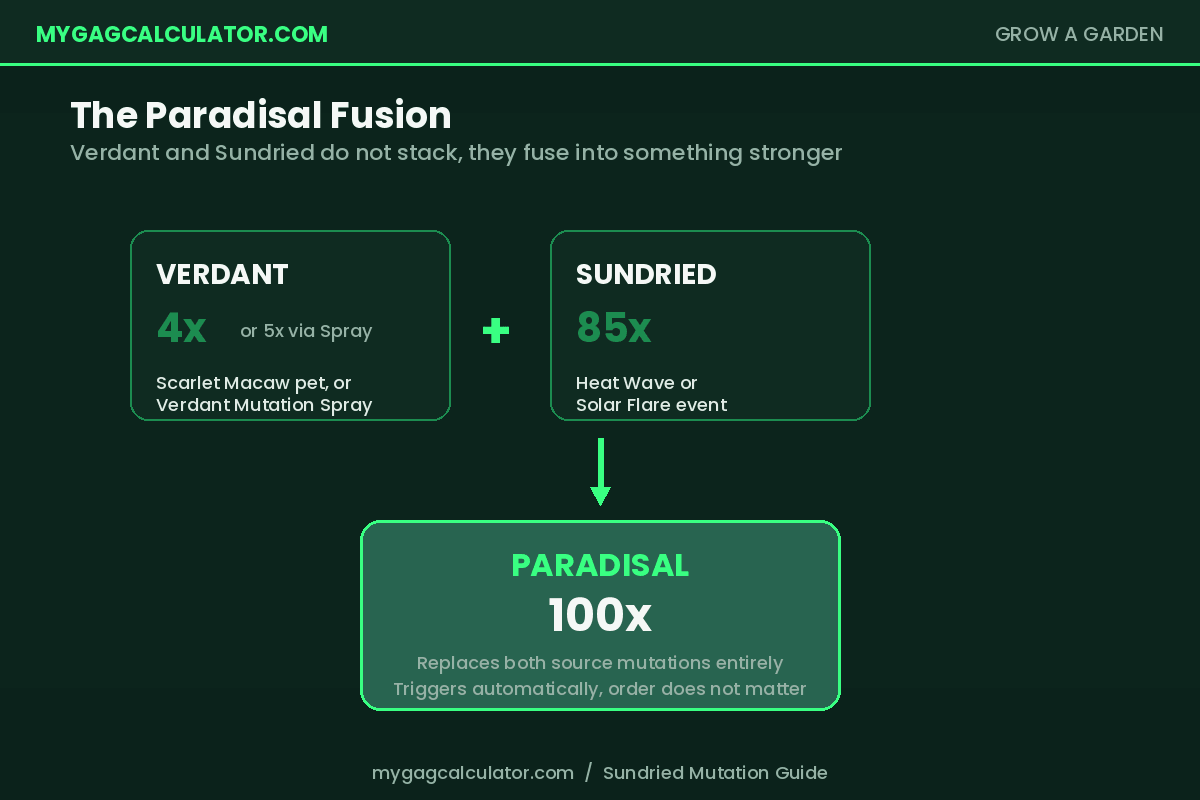
This is the interaction most worth understanding properly, because the common explanation, that Paradisal simply removes Sundried, only tells half the story.
Paradisal is a fusion mutation. It triggers automatically the moment Verdant and Sundried are both present on the same fruit at the same time, and when it triggers, it replaces both of its source mutations entirely. The order does not matter. A fruit that already has Verdant and then gets struck by a Heat Wave beam converts to Paradisal the instant Sundried would have landed. The reverse works too.
Paradisal currently sits at 100x. That detail matters because the mutation launched at only 18x during the Summer Harvest Event, and a surprising number of guides still quote that outdated figure. The buff makes Paradisal a genuine upgrade over keeping Sundried alone, not the value loss the original 18x version represented.
Verdant itself comes from two sources: the Scarlet Macaw pet’s passive ability, which applies a 4x version, or the Verdant Mutation Spray, which guarantees a 5x version with no pet required. Either path works for setting up a Paradisal attempt. Full mechanics on both routes, plus the exact trigger chances, live in the Verdant Mutation guide and the Paradisal Mutation guide.
The practical takeaway: if a fruit already has Verdant, do not harvest it before a Heat Wave passes through. Holding it through the event is how a 4x crop turns into a 100x one.
Can Pets Apply the Sundried Mutation?
No pet in the current game applies Sundried directly. Pets cover plenty of other mutations though. The Disco Bee handles Disco, the Space Squirrel handles Voidtouched, the Lobster Thermidor handles Meteoric, and several others each cover their own specific mutation. Checking what a specific pet’s passive ability actually does, rather than assuming, is worth a quick look at the Pet Calculator or the pet abilities reference before building a strategy around a pet that does not actually do what an old guide claims it does.
Mutation Probability: How Sundried RNG Actually Works
A detail that trips up a lot of players who just crafted a Tanning Mirror: the Mirror does not guarantee 10 Sundried mutations. It guarantees 10 additional beam redirects. Each of those redirects still rolls its own independent chance to apply Sundried, the same as a natural beam strike would. Buying the materials for the Mirror raises the number of attempts a garden gets during a single Heat Wave. It does not raise any single attempt’s odds, and it does not promise a fixed number of successful mutations. See the complete guide on what does a mutation do in Grow a Garden.
This matters for expectations. A player who crafts a Tanning Mirror, gets two or three Sundried fruits out of ten redirects, and assumes something is broken is misunderstanding the mechanic, not experiencing a bug. More fruit in range, whether through extra redirects or simply a fuller garden of multi-harvest crops, raises the total number of rolls. That is the actual lever available to players, not a guaranteed outcome count.
Visual Identification Guide
| Crop type | Sundried appearance |
| White or pale crops, like Cauliflower | Shifts to an orange or yellow tint |
| Brightly colored crops, like Dragon Fruit, Feijoa, or Loquat | Colors fade and wash out |
| Green crops | Picks up a dry, yellowish brown, sun-bleached look |
| Any crop type | Slightly desiccated texture overall; confirm with the in-game mutation label if unsure |
Mistakes That Cost Players Sundried Profit
- Spending Tanning Mirror redirects on cheap crops. Every redirect represents real crafting investment, and using it on Strawberries instead of Feijoa wastes that investment entirely.
- Harvesting during an active Heat Wave. A beam needs fruit still on the plant to apply Sundried, so pulling crops early removes them from the running.
- Letting a Verdant crop get harvested before a Heat Wave passes through, closing off a Paradisal opportunity that cannot be recovered once the fruit is picked.
- Assuming the Tanning Mirror guarantees results. Ten redirects mean ten chances, not ten guaranteed successes.
- Treating older guides as current. The Tanning Mirror’s move to the Crafting Station and Paradisal’s jump from 18x to 100x are exactly the kind of changes that make a guide written months ago actively misleading today.
- Skipping a check on whether a target crop’s weight justifies the effort. A low-weight fruit with Sundried still sells for less than a high-weight version of the same crop.
Sundried vs Dawnbound vs Aurora vs Shocked: Which Should Get Priority?
Players who already understand Sundried often ask how it stacks up against the other mutations competing for the same garden slots. The honest answer depends on what is actually reachable in a given session.
| Mutation | Multiplier | Source | Admin needed? |
| Sundried | 85x | Heat Wave weather event | No |
| Aurora | 89.44x | Aurora Borealis, night cycle only | No |
| Shocked | 100x | Thunderstorm, or Lightning Rod gear | No |
| Dawnbound | 150x | Sun God admin event | Yes |
Dawnbound’s 150x beats every figure on this list, but it only exists during an admin-run Sun God event, the same access problem Solar Flare has for Sundried. For players without a predictable admin event on their server, Shocked and Aurora are both stronger free-to-play options than Sundried on paper. What keeps Sundried in the conversation is the Paradisal pathway. Nothing on this comparison list has an equivalent combo route that turns a mid-tier multiplier into a 100x mutation just by holding a fruit through the right two events. Full breakdowns of each sit in their own dedicated guides: Dawnbound, Aurora, and Shocked.
Frequently Asked Questions
What is the Sundried Mutation in Grow a Garden?
The Sundried Mutation is a Legendary, weather-type modifier that applies an 85x Sheckle multiplier to any fruit it lands on. It comes from the Heat Wave weather event, and less commonly from the admin-triggered Solar Flare event. Affected fruit fades, pales, or picks up an orange tint depending on the crop.
How do you get the Sundried Mutation?
Have multi-harvest crops planted when a Heat Wave event begins, since sunbeams strike crops at random during the event and can apply Sundried on contact. Crafting a Tanning Mirror at the Crafting Station and placing it next to high-value crops adds ten extra beam redirects per Heat Wave, raising the total number of chances without guaranteeing a fixed result.
What is the Solar Flare event and how does it relate to Sundried?
Solar Flare is a separate, admin-triggered event capable of applying Sundried outside of Heat Wave. It can also land Verdant and Sundried on the same fruit in a single cycle, making it the fastest known route into the Paradisal mutation. Unlike Heat Wave, it has no public schedule and only fires when the game’s administrators activate it.
How much does the Tanning Mirror cost and how do you get one?
The Tanning Mirror is no longer sold in the Gear Shop. It is now exclusive to the Crafting Station, made from a Basic Sprinkler, an Advanced Sprinkler, a Godly Sprinkler, and 500,000 Sheckles. Once a player has those ingredients, crafting it is guaranteed rather than dependent on random shop stock.
Is the Tanning Mirror worth crafting?
Yes, when placed next to high base-value, multi-harvest crops. A single Sundried Feijoa at 13,000 base value returns 1,105,000 Sheckles, which clears the sprinkler ingredient cost well before all ten redirects are used. It becomes a poor investment only when placed near low-value crops like Strawberries or Carrots.
What are the best crops for the Sundried Mutation?
Feijoa, Loquat, Dragon Fruit, Sugar Apple, Cauliflower, Prickly Pear, and Avocado all combine a high base sell value with multi-harvest growth, meaning more fruit per plant and more chances for a beam to land. Feijoa and Loquat currently offer the strongest combination of value and availability.
Does the Sundried Mutation stack with other mutations?
Yes. Disco (125x) compounds with Sundried for one of the strongest combinations in the game, and Ceramic can coexist with Sundried when a Clay-mutated crop is also struck by a Sundried, Fried, Burnt, or Molten trigger. Verdant is the exception, since stacking it with Sundried does not simply add value, it converts the fruit into Paradisal instead.
Does Paradisal really remove Sundried, or do they combine?
They combine, then both source mutations disappear. Paradisal is a fusion mutation that triggers automatically the moment Verdant and Sundried are both present on the same fruit. Once it triggers, neither Verdant nor Sundried remains, and the fruit carries only Paradisal, currently valued at 100x after a buff from its original 18x launch figure.
Can pets apply the Sundried Mutation?
No pet in the current game applies Sundried. It is exclusive to the Heat Wave and Solar Flare weather events. Pets like the Disco Bee, Space Squirrel, and Lobster Thermidor each apply their own separate mutations, none of which is Sundried.
Does the Tanning Mirror guarantee 10 Sundried mutations?
No. It guarantees 10 additional beam redirects, and each redirect still rolls its own independent chance to apply Sundried. The Mirror increases the number of attempts during a Heat Wave. It does not guarantee a fixed number of successful mutations.
How does Sundried compare to Dawnbound and Aurora?
Dawnbound (150x) and Aurora (89.44x) both technically beat Sundried’s 85x, but each comes with a tradeoff. Dawnbound requires an admin-run Sun God event, and Aurora only fires during the night cycle through the Aurora Borealis event. Sundried’s advantage is consistency, since Heat Wave cycles through the standard rotation without needing an admin or a specific time window.
Can you AFK farm the Sundried Mutation?
Yes. Plant multi-harvest crops, craft and pre-place a Tanning Mirror before stepping away, and let Heat Wave apply Sundried passively while away from the keyboard. Checking the Weather Tracker remotely confirms whether the event is active before returning to harvest.
Conclusion: Building a Sundried Strategy That Actually Works
Sundried remains one of the most reliable multipliers in Grow a Garden specifically because it does not require luck with a rare pet or a developer showing up to run an event. Heat Wave cycles on its own, multi-harvest crops like Feijoa and Loquat turn that cycle into real Sheckles, and a crafted Tanning Mirror adds extra chances without needing the old Gear Shop RNG.
The bigger opportunity sits one step further. Holding a Verdant fruit through a Heat Wave, or catching a Solar Flare that delivers both mutations at once, converts an 85x mutation into a 100x Paradisal. That single mechanic is worth understanding properly rather than relying on the outdated explanation still floating around in older guides.
Before selling anything, running the numbers through the Mutation Calculator confirms the exact Sheckle output for a specific crop and mutation combination, and the Trade Calculator is worth a look for anyone considering trading a high-value Sundried or Paradisal fruit instead of selling it outright. For broader Sheckle strategy beyond this one mutation, the coin farming guide rounds out the rest of the economy.