Published by: Saif (Updated: Jun 2026) | Platform: Roblox | Game: Grow a Garden
The Ceramic mutation is one of the most misunderstood mutations in Grow a Garden. Players see that dark brown, glazed pottery texture and assume the job is done. It is not. Ceramic is a compound mutation platform, which means it is the starting point of the highest-value standard-gameplay stack available, not the destination. Players who sell immediately after Ceramic forms are leaving 40 to 70 percent of their potential Sheckles on the table.
This guide covers the full two-stage path to Ceramic mutation Grow a Garden, the seven heat mutations that can trigger it, the real Sheckle math at every stack stage, and the post-Ceramic strategy that separates average farmers from elite ones. For a broader look at every available mutation and multiplier, check the complete Grow a Garden mutations guide.
Ceramic Mutation at a Glance
| Attribute | Detail |
|---|---|
| Multiplier | 32x Sheckle value multiplier (community-verified; see multiplier note below) |
| Type | Compound environmental mutation (two-stage) |
| Prerequisites | Clay mutation (Wet + Sandy) plus any heat mutation |
| Fastest method | Sea Turtle pet for Wet + Sandstorm for Sandy + Burnt Mutation Spray |
| Added | Prehistoric Update, July 5, 2025 |
| Visual | Dark brown, kiln-fired pottery texture with visible surface cracking |
| Clay after Ceramic? | No. Ceramic permanently removes Clay from the mutation slot |
| Admin events required? | No. Achievable in standard gameplay with Burnt Mutation Spray |
| Mutually exclusive with | Clay (removed on formation), Burnt post-formation |
| Note on Multiplier: The Grow a Garden Fandom Wiki and community tracking sources both list Ceramic at 32x as of 2026. An earlier article on this site reported 30x based on in-game testing conducted in May 2026, version v1714+. The community consensus and multiple active calculators now agree on 32x. All Sheckle math in this guide uses 32x. Always verify with the Grow a Garden Mutation Calculator at mygagcalculator.com before any high-value trade. |
What Is the Ceramic Mutation Grow a Garden?
Ceramic is a compound environmental mutation that forms in two stages. It cannot be triggered by a single weather event. A crop must first develop the Clay mutation, and then receive any one of seven possible heat mutations. When both conditions are met, Ceramic appears instantly and Clay is permanently consumed. See our guide on what does a mutation do in GAG?
Visually, Ceramic gives the crop a deep brown, kiln-fired pottery look with visible surface cracking. It is similar to Sundried mutation in that both come from heat, but Ceramic is darker, matte, and heavier in appearance. Once formed, the crop gains a 32x Sheckle value multiplier. Ceramic was added to the game during the Prehistoric Update on July 5, 2025.
The strategic core of Ceramic is not the 32x number itself. It is what Ceramic unlocks afterward. Once Clay is consumed, the crop can begin receiving new mutations in slots that were previously blocked. The compound stacking that follows is where the real Sheckle value is built.
Clay vs Ceramic: The Confusion That Costs Players Millions
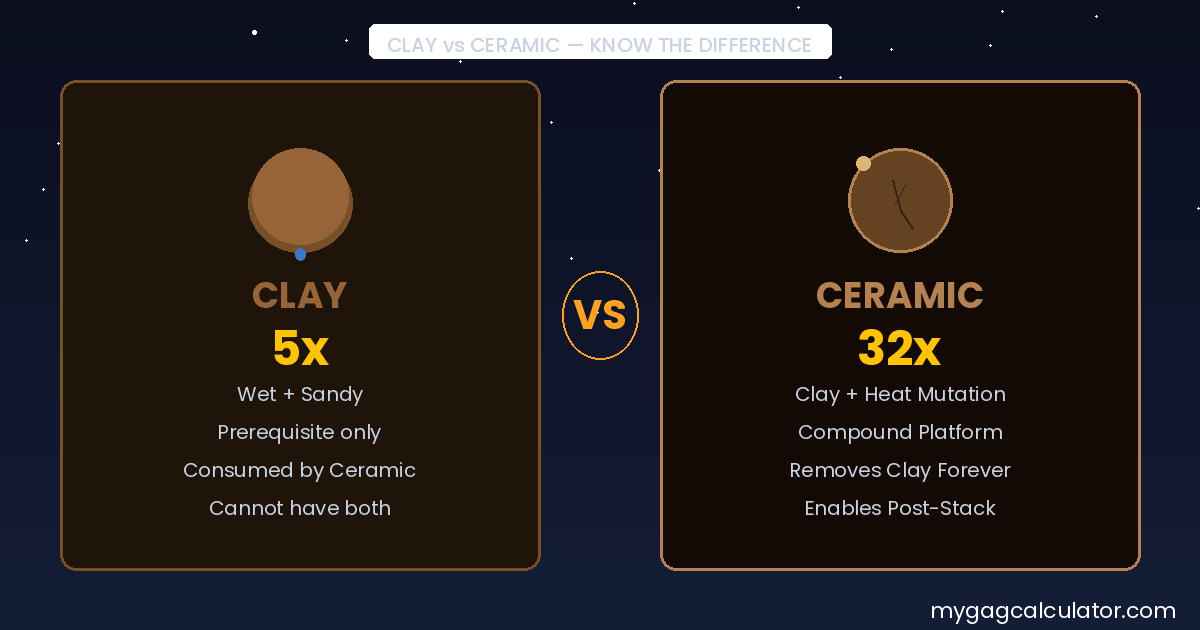
This is the most common source of confusion in the Ceramic community. Players regularly mix up Clay and Ceramic because Clay is the prerequisite for Ceramic, and Ceramic is sometimes described as an upgrade of Clay. Here is the exact distinction:
| Mutation | Multiplier | How It Forms | What Happens Next |
|---|---|---|---|
| Clay | 5x | Wet + Sandy (both active on same crop) | Stays on crop until heat mutation arrives |
| Ceramic | 32x | Clay + any heat mutation | Clay is removed permanently; Ceramic takes its slot |
Clay does not turn into Ceramic automatically. The heat mutation must arrive while Clay is active. If a crop has Clay and a Heatwave passes but no Sundried mutation lands, Clay stays. The moment any heat mutation connects with a Clay crop, Ceramic forms and Clay disappears forever. Players cannot have both Clay and Ceramic on the same crop at any point.
How to Get the Ceramic Mutation in Grow a Garden: Step-by-Step
Ceramic requires two separate mutation events to land on the same crop in sequence. There is no shortcut around Stage 1. Here is the complete path.
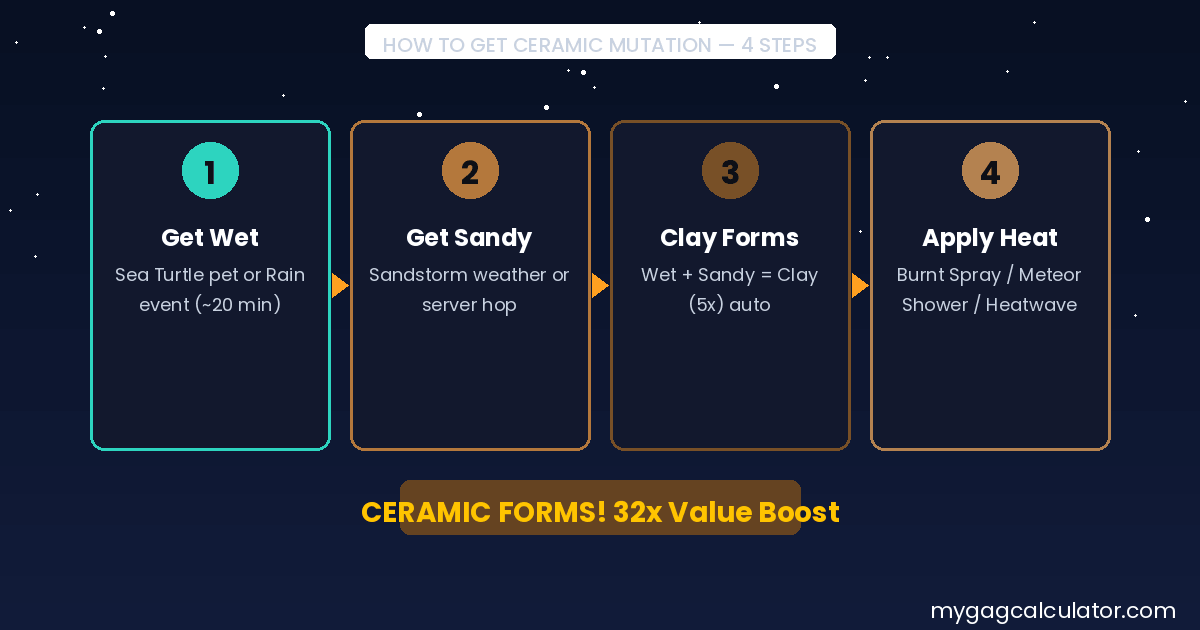
Stage 1: Form the Clay Mutation (Wet + Sandy)
Clay forms automatically the moment a crop has both Wet and Sandy mutations active at the same time. The order does not matter, Wet first or Sandy first both work, as long as both land on the same crop before the weather cycle ends.
Getting Wet (2x)
| Method | Reliability | Notes |
|---|---|---|
| Rain weather event | Very High | Occurs approximately every 20 minutes. Most reliable passive source. |
| Sea Turtle pet | On Demand | Applies Wet directly without waiting for weather. Best active method. |
| Thunderstorm event | Low | Occurs every 2 to 6 hours. Also triggers Shocked chance. Not ideal for planning. |
| Water Sprinkler gear | Medium | Applies Wet on a timer. Useful for AFK farming sessions. |
Getting Sandy (3x)
Sandy is only triggered by the Sandstorm weather event. No pet applies Sandy directly in standard gameplay. When Sandstorm hits, the sky turns a deep yellow and sand fills the map. Any crop already carrying Wet will combine with Sandy and immediately form Clay.
Sandstorm frequency is not officially published by the game. Based on community session tracking across multiple servers, Sandstorm appears roughly once every 45 to 90 minutes per server. This is observational data, not confirmed rates. The best way to reduce wait time is server hopping, covered in a dedicated section below.
| Blood Moon tip: Blood Moon occurs every 4 hours (permanent since the Bizzy Bees update) and increases the rate of multiple mutations applying in a single session. Plant target crops 10 to 15 minutes before an expected Blood Moon or Sandstorm to maximize the window for Wet and Sandy to both land. |
Stage 2: Apply a Heat Mutation to Clay
The moment Clay forms, any one of seven heat mutations will convert it to Ceramic. The heat mutations are not equal in accessibility. Here is an honest ranking:
| Heat Mutation | Multiplier | Method | Admin Only? | Stays After Ceramic? |
|---|---|---|---|---|
| Burnt | 4x | Burnt Mutation Spray or Cooked Owl pet (legacy) | No | No. Burnt is removed when Ceramic forms. |
| Sundried | 85x | Heatwave event or Tanning Mirror gear | No | Yes. Sundried stays on the crop after Ceramic forms. |
| Meteoric | 125x | Meteor Shower event (every 4 hours, permanent) | No | Yes. Meteoric stays. Highest-value free trigger. |
| Molten | 25x | Volcano admin event | Yes | Yes. Molten stays after Ceramic forms. |
| Fried | 8x | Fried Chicken admin event | Yes | No. Fried is removed when Ceramic forms. |
| Cooked | 10x | Cooked Owl pet (unobtainable for new players) | No* | Unverified. Do not plan stack around it. |
| Plasma | Varies | Laser Storm admin event | Yes | Yes. Plasma stays after Ceramic forms. |
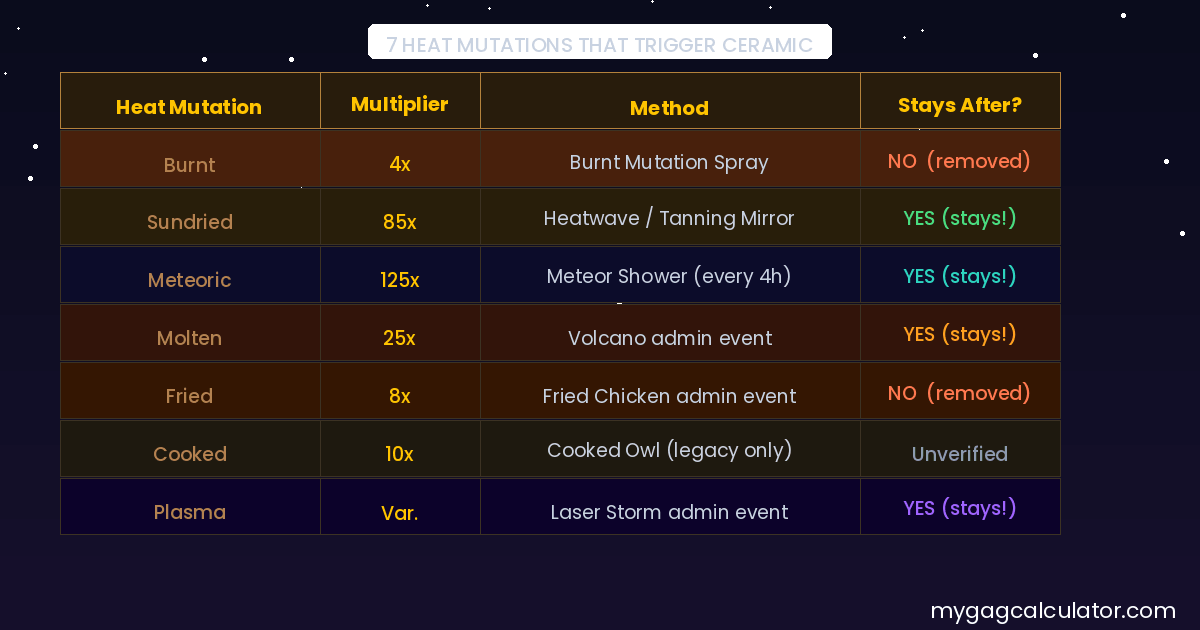
| Key insight on heat triggers: Three heat mutations (Sundried, Meteoric, Molten) stay on the crop after Ceramic forms. Three others (Burnt, Fried, Cooked) are consumed. Choosing Sundried or timing Clay to coincide with a Meteor Shower gives a dramatically more valuable starting position than using Burnt Spray alone. |
Why the Burnt Mutation Spray Is Still the Most Reliable Method
Meteor Shower fires every 4 hours and Sundried via Heatwave offers high residual value, but Burnt Mutation Spray remains the best method for most active farmers. The reason is control. Spray is player-triggered. The moment Clay forms, the spray fires and Ceramic appears. There is no waiting for a second weather cycle.
| Method | RNG Layers | Avg. Time to Ceramic | Cost | Verdict |
|---|---|---|---|---|
| Burnt Spray + Sea Turtle | 1 (Sandstorm only) | Under 20 min active play | 3 Summer Coins | Best for active farmers |
| Meteor Shower (Meteoric) | 2 (Sandstorm + 4hr timing) | 0 to 4 hours | Free | Best free method; high residual value |
| Heatwave (Sundried) | 3 (Wet + Sandstorm + Heatwave) | 2 to 4 hours average | Free | High value if Sundried stays; high RNG cost |
| Admin events | Unpredictable | Depends on schedule | Free | Highest ceiling (Meteoric/Molten stays); no control |
Burnt Mutation Spray costs 3 Summer Coins and is only purchasable during the Summer Harvest event. It can be used anytime after purchase. Stockpiling 15 to 20 sprays during the Summer Harvest is the single best use of Summer Coins for mid-to-late game farming. For a full breakdown of the event and its rewards, see the Grow a Garden Summer Campfire Event guide.
| Important: Burnt Mutation Spray is purchase-locked to the Summer Harvest event. If the event is not currently active, the Cooked Owl pet is the only non-admin non-RNG Burnt path, and it is unobtainable for new players. During off-season periods, the Meteor Shower timing method becomes the best free path to Ceramic. |
Server Hopping: How to Find Sandstorm in Under 25 Minutes
Server hopping is a legitimate and widely-used strategy in the Grow a Garden community. Different servers run on independent weather cycles. A Sandstorm that just ended on one server may be active on another server right now.
How to Server Hop for Ceramic
- Open the Grow a Garden game page on Roblox.
- Click the three-dot menu on the game listing and select Servers.
- Browse available servers. Community Discord bots post real-time weather alerts per server ID.
- Join a server where Sandstorm is currently active or very close to firing.
- Plant the target crop the moment joining. Keep Sea Turtle active for Wet on demand.
- Have Burnt Mutation Spray ready for the instant Clay forms.
- If Sandstorm has already passed on the new server, hop again rather than waiting.
| From community tracking: Server hopping reduced average Clay formation time from 90 minutes (waiting on a single server) to under 25 minutes across repeated sessions. The key is joining servers that are mid-cycle. Grow a Garden Discord weather bots make this significantly faster since community members post active Sandstorm server IDs in real time. |
| Critical reminder: Crops do not transfer between servers. Keep high-value seeds in inventory and plant immediately on joining. Never server hop with crops already in the ground or growth progress is lost. |
Tracking server-specific weather patterns is easier with the Grow a Garden Weather Tracker, which helps identify when key events are most likely to appear based on observed cycle data.
The Iguana Pet Shortcut: Converting Frozen Crops to Ceramic
This path is absent from most competing guides and is one of the most useful pieces of advanced knowledge for Ceramic farming.
If a crop already has the Frozen mutation and a player wants to convert it to Ceramic, the Iguana pet provides a direct path. As of version v1714+, Wet cannot be applied to a crop that already carries Frozen because the combination creates a mutation conflict. The Iguana removes Frozen entirely before Wet re-enters the stack, which is why this workaround functions.
Iguana to Ceramic Path
- Apply the Iguana pet to the Frozen crop. Iguana melts Frozen and reverts the crop to Wet.
- Wait for a Sandstorm or server hop to find one. Sandy lands on the Wet crop.
- Wet plus Sandy triggers Clay automatically.
- Apply Burnt Mutation Spray immediately. Ceramic forms.
There is also an alternative community-observed behaviour: Rain can trigger Clay from a Sandy crop even when the crop carries Frozen, because in some cases Rain converts Sandy into Clay without directly adding the Wet mutation. This path has been reported in community discussions. If a crop has Sandy plus Frozen, it is worth testing whether Rain converts it before using an Iguana. For more on pet-assisted mutation strategies, the Grow a Garden Pet Calculator can help identify which pets are worth pairing for specific mutation goals.
Admin Events and Ceramic: What to Know
Admin events are server-wide mutations triggered manually by the Grow a Garden development team. They are not part of the standard weather rotation and do not run on any fixed schedule. For the full list of known admin events and how to prepare for them, see the Grow a Garden admin events schedule guide.
If a Clay crop is in the ground when an admin event fires (Volcano, Meteor, Laser Storm), Ceramic forms instantly with the admin mutation remaining on the crop. This is the highest-ceiling outcome for Ceramic farming. Molten (25x) or Meteoric (125x) staying on the crop from the first moment Ceramic forms creates a significantly stronger starting stack than Burnt Spray alone.
Admin events are announced in advance through the official Grow a Garden Discord and in-game notifications approximately one hour before major updates. Using a private server during announced admin events protects crops from being accidentally harvested by other players.
The Mutation Value Formula and Ceramic Stack Math
Understanding how Grow a Garden calculates sell value is essential for making smart decisions about when to sell and what to stack next. The official formula from the Grow a Garden Fandom Wiki:
| Crop Value = Base Value x (Weight / Base Weight) squared x Variant Multiplier x [1 + (Sum of All Mutation Multipliers) minus Number of Mutations Applied] |
What Each Part Means
- Base Value: the crop raw sell price at standard weight (example: Dragon Fruit = 1,000 Sheckles)
- Weight factor: squared. A crop at twice base weight earns 4x more, not 2x. This is the most underestimated variable in the game.
- Variant multiplier: None/Ripe = 1x, Silver = 5x, Gold = 20x, Rainbow = 50x
- Mutation sum: all mutation multipliers added together, then subtract the number of mutations applied
Running Stack Math: Dragon Fruit Example (1,000 Base Sheckles, Gold Variant, 3x Weight)
Weight factor squared at 3x weight = 9. Gold variant multiplier = 20.
| Stack Stage | Mutation Sum Calculation | Effective Multiplier | Approx. Sheckles (Gold, 3x weight) |
|---|---|---|---|
| Ceramic only | 1 + 32 minus 1 = 32 | 32x | 576,000 |
| Ceramic + Sundried (retained as trigger) | 1 + 32 + 85 minus 2 = 116 | 116x | 2,088,000 |
| Ceramic + Meteoric (retained as trigger) | 1 + 32 + 125 minus 2 = 156 | 156x | 2,808,000 |
| Ceramic + Sundried + Frozen (post-stack) | 1 + 32 + 85 + 10 minus 3 = 125 | 125x | 2,250,000 |
| Ceramic + Sundried + Frozen + Sandy | 1 + 32 + 85 + 10 + 3 minus 4 = 127 | 127x | 2,286,000 |
| Sundried alone (no Ceramic) | 1 + 85 minus 1 = 85 | 85x | 1,530,000 |
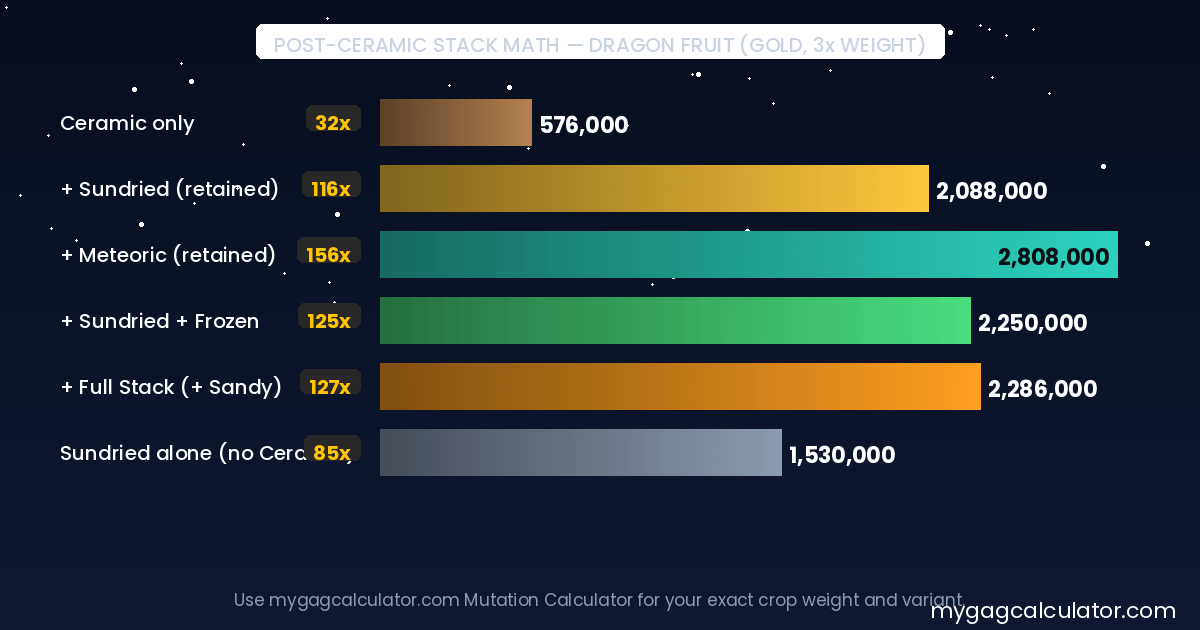
Source: Grow a Garden Fandom Wiki formula. Values shown are illustrative at the stated weight and variant. Actual output depends on exact crop weight. For precise numbers on any combination, use the Grow a Garden Mutation Calculator which applies the official formula in real time.
| The table proves the core strategic point: Ceramic alone (576,000) looks weak compared to Sundried alone (1,530,000). But Ceramic triggered by Sundried, with the full post-stack applied, reaches 2,088,000 at the same crop weight and variant. The compound path always wins for any crop of meaningful base value. |
Weight is the single biggest variable most players ignore. A Dragon Fruit at 3x base weight with the same Ceramic-plus-Gold stack earns 9 times more than the identical stack at base weight. Grow first, mutate second. The Grow a Garden Weight Calculator shows exactly how weight compounds with mutation multipliers before committing to a sell.
What Happens After Ceramic Forms: The Full Post-Ceramic Stack
Ceramic removes Clay and resets that mutation slot. Once it is active, the crop can begin receiving new mutations in previously blocked positions. This is the part of Ceramic farming that most guides skip entirely.
Mutation Behaviour on Ceramic Formation
| Mutation | Behaviour When Ceramic Forms | Strategic Note |
|---|---|---|
| Clay | Removed permanently | Expected. Ceramic takes its slot. |
| Burnt (used as trigger) | Removed | Ceramic forms but no heat bonus remains. Standard Spray path. |
| Fried (used as trigger) | Removed | Same as Burnt. Admin-only trigger with no residual value. |
| Cooked (used as trigger) | Likely removed (unverified) | Do not plan around this interaction until confirmed. |
| Sundried (used as trigger) | STAYS. High-value starting position. | 32x + 85x in stack from minute one after Ceramic forms. |
| Meteoric (used as trigger) | STAYS. Very high-value starting position. | 32x + 125x from minute one. Best free trigger outcome. |
| Molten (used as trigger) | STAYS. | 32x + 25x. Admin event only. |
| Plasma (used as trigger) | STAYS. | Admin event only. |
Optimal Post-Ceramic Stack Path (Priority Order)
- Ceramic forms. The 32x baseline is set.
- Reapply Wet immediately using Sea Turtle pet. Do not wait for Rain.
- Watch for Snow event. Chilled mutation lands on the Wet crop. Wet plus Chilled forms Frozen (10x) automatically.
- Frozen removes Wet. This clears the conflict, and Sandy can now be reapplied via Sandstorm.
- Pursue Sundried via Heatwave or Tanning Mirror for 85x added to the stack.
- If Meteor Shower fires while the stack is building, Meteoric (125x) adds to the total.
- Run the exact stack through the Mutation Calculator before selling. Never estimate a high-value crop.
Snow event frequency is not officially published. Community session tracking estimates Snow at roughly once every 60 to 120 minutes per server. Server hopping applies here too: join a server with Snow currently active to skip the wait. Planning these post-Ceramic steps in advance, before Ceramic even forms, is the difference between a 576,000 Sheckle sell and a 2+ million Sheckle sell. The Grow a Garden Crop Planner can help sequence the full mutation path before starting a session.
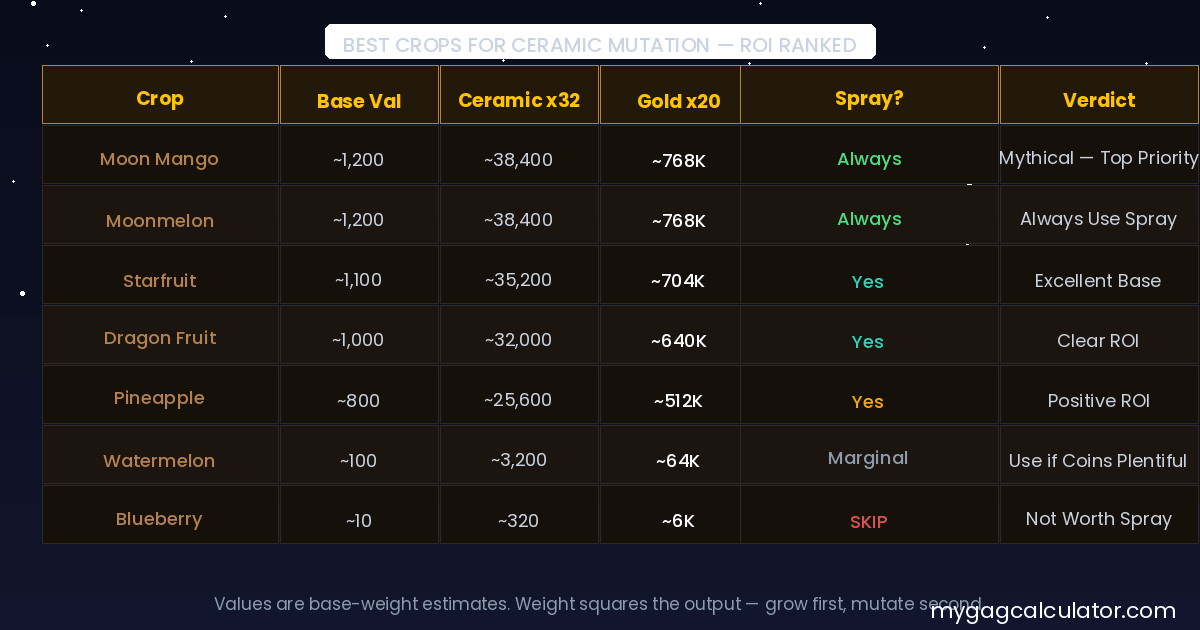
Best Crops for Ceramic Mutation: Ranked by ROI
| Crop | Base Sheckles | Ceramic x32 (base wt) | With Gold Variant (x20) | Spray Decision |
|---|---|---|---|---|
| Blueberry | ~10 | ~320 | ~6,400 | Skip. Save spray for better crops. |
| Watermelon | ~100 | ~3,200 | ~64,000 | Marginal. Use only if coin supply is high. |
| Pineapple | ~800 | ~25,600 | ~512,000 | Yes. Positive ROI. |
| Dragon Fruit | ~1,000 | ~32,000 | ~640,000 | Yes. Clear ROI, strong post-stack base. |
| Starfruit | ~1,100 | ~35,200 | ~704,000 | Yes. Excellent Ceramic base. |
| Moonmelon | ~1,200 | ~38,400 | ~768,000 | Always. Top standard-tier priority. |
| Moon Mango | ~1,200+ (Mythical) | ~38,400+ | ~768,000+ | Always. Highest-priority Ceramic target. |
These values are base-weight estimates using community-sourced crop data. Exact base Sheckle values shift with game patches. For precision before a major trade, run the numbers in the Grow a Garden Profit Calculator which reflects current verified values.
For players farming Princess Thorn, one of the rarest crops in the game, the Ceramic mutation path is particularly valuable given the base crop value. The Princess Thorn guide covers how to source this crop and which mutations combine best with it.
Ceramic Mutation Compatibility: What Stacks and What Does Not
Cannot Stack With Ceramic
| Mutation | Reason |
|---|---|
| Clay | Ceramic permanently replaces Clay. One or the other, never both. |
| Burnt (post-formation) | Incompatible once Ceramic is active. Cannot be reapplied after Ceramic forms. |
| Wet + Sandy simultaneously | Applying both after Ceramic would attempt to reform Clay. Apply Wet first, then let Snow form Frozen, then reapply Sandy. |
Can Stack With Ceramic (Post-Formation)
| Mutation | Multiplier | How to Apply Post-Ceramic |
|---|---|---|
| Sundried | 85x | Remains if used as trigger; reapplicable via Heatwave or Tanning Mirror. |
| Meteoric | 125x | Remains if used as trigger (Meteor Shower, every 4 hours). |
| Molten | 25x | Remains if used as trigger (Volcano admin event). |
| Wet | 2x | Reapply via Sea Turtle pet immediately after Ceramic forms. |
| Frozen | 10x | Wet + Chilled from Snow event forms Frozen. Primary post-Ceramic target. |
| Sandy | 3x | Reapply via Sandstorm after Frozen removes Wet. |
| Disco | 125x | Admin event or Disco Bee. Compatible with Ceramic. |
| Celestial | 120x | Meteor Shower event (high RNG). Compatible with Ceramic. |
For a real-time check of any mutation combination and whether it produces a conflict or a valid stack, the Grow a Garden Trade Calculator and Mutation Calculator both reflect current compatibility rules.
Ceramic vs Sundried vs Shocked vs Meteoric: Honest Comparison
| Mutation | Multiplier | Standard Play? | Frequency/Ease | Best Role |
|---|---|---|---|---|
| Clay | 5x | Yes | Wet + Sandstorm | Prerequisite only. Not a destination. |
| Ceramic | 32x | Yes | Clay + Burnt Spray | Compound platform. Enables the full stack. |
| Sundried | 85x | Yes | Heatwave (medium RNG) | Best when retained after Ceramic formation. |
| Frozen | 10x | Yes | Snow event (medium RNG) | Essential post-Ceramic stack step. |
| Meteoric | 125x | Yes (every 4hrs) | Meteor Shower (permanent) | Best single-mutation retention on Ceramic. |
| Shocked | 100x | Yes | Thunderstorm (2 to 6hrs) | Top standalone. Harder to compound. |
| Celestial | 120x | Yes | Meteor Shower (high RNG) | Near-admin difficulty for standard players. |
| Disco | 125x | Admin/Disco Bee | Rare event | Stacks with Ceramic for elite total. |
The comparison shows why Ceramic is underrated when looked at in isolation. At 32x standalone, it appears weaker than Sundried (85x) or Shocked (100x). But Ceramic is the only standard-gameplay mutation that acts as a compound platform, resetting mutation slots and enabling further stacking. For more detailed comparison of Sundried and how it pairs with Ceramic, the Sundried mutation guide covers the Tanning Mirror path, Paradisal combo, and stacking math in depth.
Common Mistakes and Critical Warnings
- Selling immediately after Ceramic forms. The post-stack adds 40 to 70 percent more Sheckles on high-value crops.
- Harvesting a Clay crop before applying heat. Always apply Burnt Spray the instant Clay forms. Clay does not persist between sessions.
- Wasting spray on common low-value crops. Blueberries and Watermelons do not justify a Burnt Spray. Reserve it for Dragon Fruit, Starfruit, Moon Mango, Moonmelon.
- Applying Wet and Sandy simultaneously after Ceramic. This attempts to reform Clay. Apply Wet first, wait for Snow to form Frozen, then reapply Sandy.
- Ignoring crop weight before mutating. Weight squares the output. A heavy crop with Ceramic earns far more than a light crop with the same stack. Grow first, mutate second.
- Not server hopping when Sandstorm is delayed. Waiting 90 minutes on a cold server is avoidable with a single hop to an active Sandstorm.
- Missing the Meteor Shower timing window. Now that Meteor Shower fires every 4 hours, planning Clay crop timing around this cycle gives a free Meteoric (125x) retained on the crop.
- Relying on the Cooked Owl as a primary Burnt path. The Cooked Owl is unobtainable for new players. Only the Burnt Mutation Spray is a reliable Burnt source in standard gameplay today.
Is the Burnt Mutation Spray Worth 3 Summer Coins?
| Crop Base Value | Ceramic x32 (base wt) | With Gold (x20) | Spray Decision |
|---|---|---|---|
| Under 50 Sheckles | Under 1,600 | Under 32,000 | Skip. Save coins for better crops. |
| 100 to 500 Sheckles | 3,200 to 16,000 | 64,000 to 320,000 | Marginal. Depends on coin supply. |
| 500 to 1,000 Sheckles | 16,000 to 32,000 | 320,000 to 640,000 | Yes. Positive ROI at this tier. |
| 1,000+ Sheckles (Dragon Fruit, Starfruit) | 32,000+ | 640,000+ | Always. High ROI, clear priority. |
| 1,200+ Sheckles (Moon Mango, Moonmelon) | 38,400+ | 768,000+ | Always. Top priority. Do not skip. |
| Stockpile recommendation: Purchase 15 to 20 Burnt Sprays during the Summer Harvest event. They carry over between sessions indefinitely and are the most consistent Ceramic trigger available. For planning how many sprays to use per session against potential Sheckle output, the Grow a Garden Profit Calculator at mygagcalculator.com does the math in seconds. |
Frequently Asked Questions
What is the Ceramic mutation in Grow a Garden?
Ceramic is a compound environmental mutation with a 32x Sheckle value multiplier. It forms when a Clay mutation (created by Wet plus Sandy) receives any heat mutation. Added in the Prehistoric Update on July 5, 2025. No admin events are required. It is available through standard gameplay using the Burnt Mutation Spray from Summer Harvest.
Is the Ceramic mutation multiplier 30x or 32x?
The community-verified figure as of 2026 is 32x. Multiple active Grow a Garden calculator sites and community tracking databases list Ceramic at 32x. An earlier version of this guide reported 30x based on in-game testing in May 2026 at version v1714+. Given that the broader community consensus has since settled on 32x, all current Sheckle math on this page uses 32x. Always verify current values at mygagcalculator.com before any significant trade, since multipliers can change with patches.
How do you get the Ceramic mutation fast in Grow a Garden?
The fastest active method is: use the Sea Turtle pet for Wet on demand, then server hop to a server with an active Sandstorm to get Sandy. Clay forms automatically. Apply Burnt Mutation Spray (3 Summer Coins from Summer Harvest) the instant Clay appears. Ceramic forms immediately. Average active time with this method is under 20 minutes.
Does Clay disappear when Ceramic forms?
Yes. Clay is permanently removed when Ceramic forms. The two mutations cannot coexist on the same crop. Ceramic takes the slot Clay occupied and Clay cannot be reformed on a crop that has Ceramic.
What mutations combine to make Ceramic?
Ceramic requires two stages. First, Wet plus Sandy combine to form Clay. Second, Clay plus any heat mutation (Burnt, Sundried, Meteoric, Molten, Fried, Cooked, or Plasma) combines to form Ceramic. Sandy alone plus Burnt does not make Ceramic. Clay must be the intermediate step.
Can Ceramic and Sundried be on the same crop?
Yes. If Sundried was the heat trigger used to form Ceramic, it stays on the crop after formation. Sundried can also be reapplied via Heatwave after Ceramic is active. The combined effective multiplier is 1 plus 32 plus 85 minus 2, which equals 116x. This is one of the highest-value standard-gameplay stacks available.
How often does Sandstorm occur in Grow a Garden?
Sandstorm frequency is not officially published by the development team. Based on community session tracking, Sandstorm appears roughly once every 45 to 90 minutes per server. Server hopping to a server with an active Sandstorm reduces the effective wait to under 25 minutes in most sessions.
What is the Snow event and why does it matter for Ceramic?
Snow is a weather event that applies the Chilled mutation. When Chilled lands on a crop that already has Wet, Frozen (10x) forms immediately. After Ceramic, reapplying Wet and then waiting for Snow to create Frozen is the most important post-Ceramic stack step. Snow frequency is estimated at once every 60 to 120 minutes per server, though not officially confirmed.
Can Sandy be reapplied after Ceramic forms?
Yes, but not simultaneously with Wet. Apply Wet first via Sea Turtle pet, then wait for Snow (Chilled) to form Frozen. Frozen removes Wet, which clears the mutation conflict. Then Sandy can be reapplied via Sandstorm for a 3x addition to the stack. Applying Wet and Sandy at the same time after Ceramic forms would attempt to reform Clay and is blocked by the game.
What pets help with getting the Ceramic mutation?
The Sea Turtle pet applies Wet on demand, eliminating dependency on the Rain weather event. The Iguana pet removes Frozen from a crop, allowing the Wet plus Sandy to Clay conversion to proceed on crops that were previously blocked. The Cooked Owl pet can apply Burnt, but it is unobtaiched for new players. For a complete breakdown of which pets pair best with specific mutation goals, see the Grow a Garden Pet Calculator.
Is the Ceramic mutation worth farming in Grow a Garden?
Yes, for any crop with a meaningful base value. The 32x multiplier alone is strong on high-value crops. But the real case for farming Ceramic is the post-stack: Ceramic resets mutation slots so Frozen, Sundried, Sandy, and other mutations can be layered on top. A Dragon Fruit at 3x weight with Ceramic plus Sundried retained earns over 2 million Sheckles with Gold variant, compared to 576,000 for Ceramic alone. The compound path is the entire point.
Conclusion
Ceramic is the most strategically versatile mutation achievable through standard Grow a Garden gameplay. Its 32x multiplier looks modest next to Shocked (100x) or Celestial (120x), but every section of this guide has shown that Ceramic is not competing with those mutations. It is creating the conditions for them.
The players generating the most Sheckles from Ceramic are the ones who treat formation as step one, not the finish line. They retain Sundried or time Clay for the Meteor Shower cycle. They reapply Wet immediately after Ceramic forms and wait for Snow to build the Frozen step. They run the full stack through the Mutation Calculator before selling.
That is the difference this guide exists to close. Use the Mutation Calculator, the Profit Calculator, and the Weather Tracker to plan every session around real numbers rather than estimates.