Published by: Saif (Updated: Jul 2026) | Platform: Roblox | Game: Grow a Garden
| The Paradisal Mutation in Grow a Garden (GAG1) gives crops a 100x sell value multiplier. It is a fused mutation: both the Verdant mutation (4x) and the Sundried mutation (85x) must land on the same crop simultaneously, after which they automatically combine into Paradisal and replace both prerequisites. It was added June 21, 2025, as part of the Summer Harvest Event. The multiplier was later updated from its original 18x to 100x, making it the only mutation in GAG1 history to have its multiplier changed post-launch. Paradisal does not exist in Grow a Garden 2 (GAG2). |
The Paradisal Mutation Grow a Garden is one of the most talked-about mutations in the game — and for good reason. It sits at a 100x sell value multiplier, it has a story behind it (the original 18x value was patched mid-game, making it the only mutation ever to receive a multiplier change), and it requires a two-step fusion chain that trips up even experienced players. This guide covers everything: what Paradisal actually is, the exact three ways to get it, how the fusion triggers, which crops to target, whether the grind is worth it at your current Sheckle level, and where it sits in a late-game stacking build. Use the Grow a Garden mutation calculator to model exactly how Paradisal affects any crop before committing to the strategy.
Players searching for Paradisal in Grow a Garden 2 (GAG2) will find a direct answer at the bottom of this guide: Paradisal is a GAG1-exclusive mutation and does not currently exist in GAG2, which runs a separate mutation system.
What Is the Paradisal Mutation in Grow a Garden?
Paradisal is a fused environmental mutation in Grow a Garden that applies a 100x sell value multiplier to any crop it lands on. When it triggers, the affected crop turns lime green and emits golden sun-ray particles in all directions. The mutation label displayed on the crop reads ‘Paradisal’ in neon green text — one of the most visually distinct effects in the entire game. Get complete guide on all mutations in GAG1.
It was introduced on June 21, 2025, as part of the Summer Harvest Event, alongside the Scarlet Macaw pet and the Tanning Mirror gear. At launch, Paradisal carried an 18x multiplier. The game was later updated and the multiplier was revised to its current 100x figure — a change confirmed by the Grow a Garden Fandom Wiki, which explicitly notes: ‘Paradisal is the only mutation that has its multiplier changed.’ This history matters because dozens of older guides and community posts still reference 18x as the current value. That number is outdated. The correct, confirmed figure is 100x.
Paradisal is classified in the Mythical rarity tier — the second-highest tier in GAG1’s system, sitting below Divine. In the mutation rarity hierarchy (Common, Uncommon, Rare, Epic, Legendary, Mythical, Divine), Mythical places Paradisal among the most exclusive obtainable mutations in the game. For a broader understanding of how all mutations work and stack, see the complete guide on what mutations do in Grow a Garden.
Is Paradisal 18x or 100x? — Setting the Record Straight
Multiple high-authority guides — including some published by large gaming outlets — still show 18x as Paradisal’s multiplier. Here is the confirmed breakdown:
| Source | Value Shown | Correct? |
| Grow a Garden Fandom Wiki (primary source) | 100x (updated) | Yes — current |
| Many older guides and Reddit posts | 18x (original) | No — outdated |
| MyGAGcalculator | 100x (confirmed) | Yes — current |
The confusion persists because the update happened post-launch, and many guides were never revised. If someone offers a trade citing 18x as Paradisal’s value, they are working from old data.
How Does the Paradisal Fusion Work?
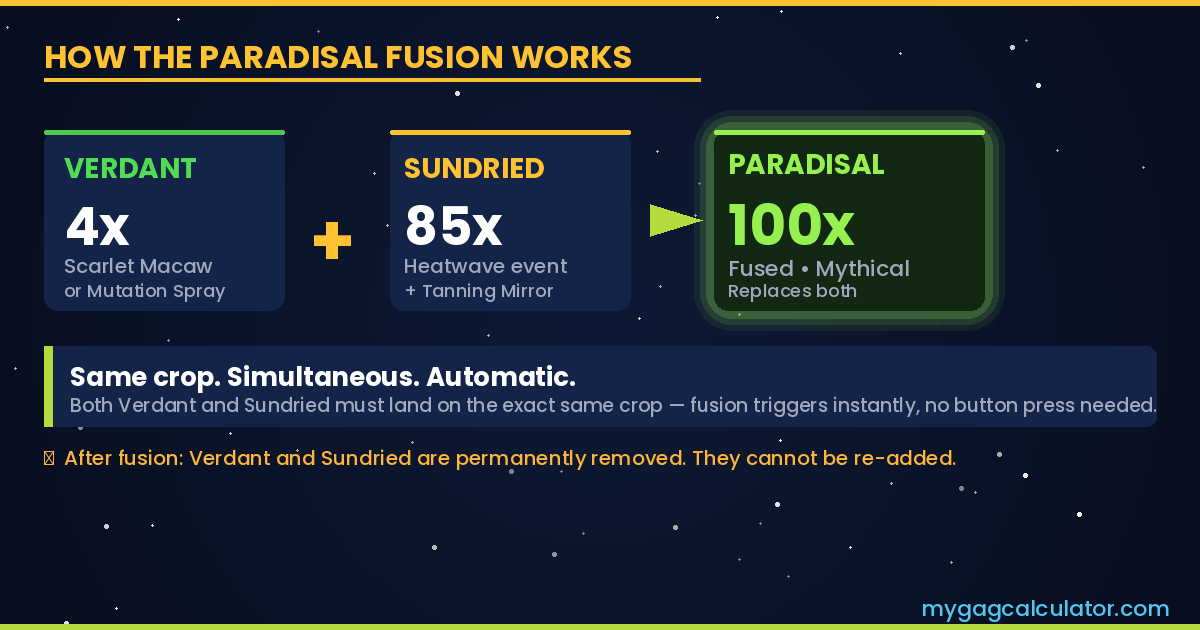
Paradisal is a fused mutation — it does not appear on its own through weather or a direct pet application. Instead, it forms automatically when two specific mutations coexist on the same crop at the same time:
- Verdant (4x) — applied by the Scarlet Macaw pet, Mutation Spray Verdant, or the Solar Flare admin event
- Sundried (85x) — applied during a Heatwave weather event, aided by the Tanning Mirror gear, or during Solar Flare
When both Verdant and Sundried are simultaneously present on the same crop, they automatically fuse into Paradisal. No button press is required. Both prerequisite mutations disappear and are permanently replaced. After fusion, it is no longer possible to have Verdant or Sundried on that crop — the Fandom Wiki confirms: ‘Paradisal removes Verdant and Sundried. It’s no longer possible to stack both Paradisal and Verdant or Sundried.’
This mechanic is identical in structure to how the Frozen mutation works. When the Wet mutation and the Chilled mutation both land on the same crop, they fuse into Frozen, replacing both. Paradisal follows the same combo-replacement logic. Understanding this is essential because it also explains the stacking cost: Verdant (4x) and Sundried (85x) independently would multiply to 340x combined. Paradisal gives 100x. In raw stacking math, keeping them separate is better — but Paradisal cannot be prevented once both are on the same crop, and it has significant trade value and aesthetic prestige that the independent stack does not.
The order of operations does not matter. Verdant-first-then-Sundried and Sundried-first-then-Verdant both trigger the fusion. What matters is that both mutations must be on the exact same crop at the same time. The Scarlet Macaw applies Verdant to a random crop, which is the most common failure point: if the Macaw puts Verdant on crop A and the Heatwave sunbeams hit crop B, no fusion happens.
How to Get the Paradisal Mutation in Grow a Garden: All Three Methods
There are three paths to triggering the Paradisal fusion. They differ significantly in cost, reliability, and required capital. Here is the side-by-side comparison:
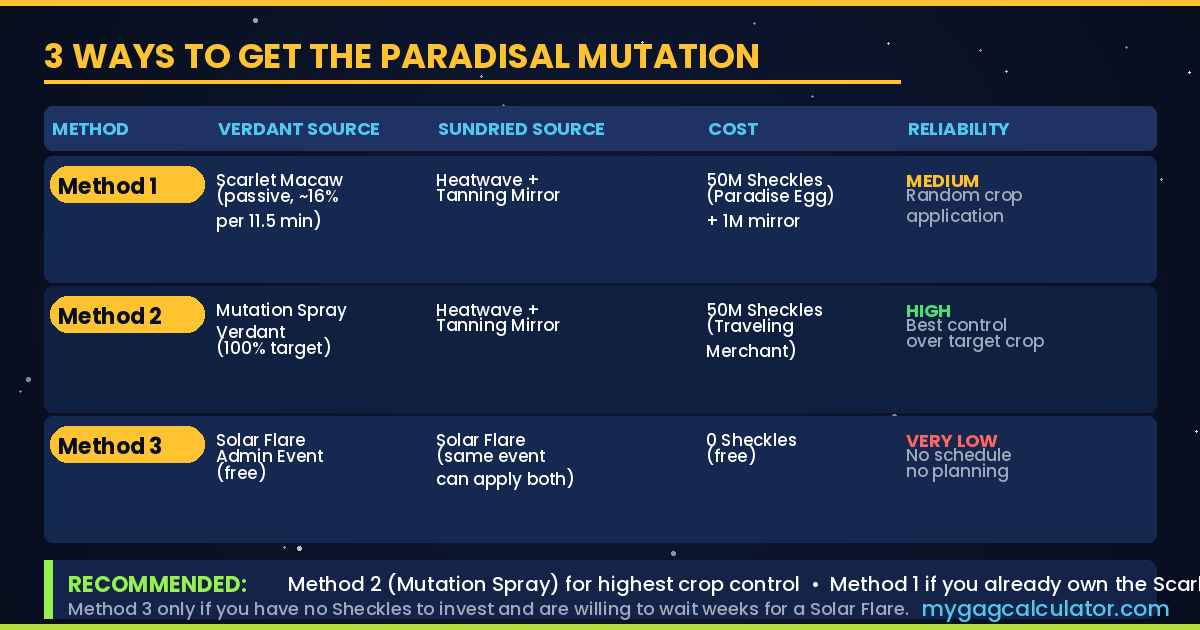
| Method | Verdant Source | Sundried Source | Cost (Sheckles) | Controllability | Recommended For |
| Method 1: Scarlet Macaw + Heatwave | Scarlet Macaw (passive, 16% chance per 11.5 min) | Heatwave event + Tanning Mirror | 50M (egg) + 1M (mirror) | Medium | Players with 100M+ who want the Macaw long-term |
| Method 2: Mutation Spray Verdant + Heatwave | Mutation Spray Verdant (100% success, specific crop) | Heatwave event + Tanning Mirror | 50M (spray) + 1M (mirror) | High | Players without Macaw who want the most reliable path |
| Method 3: Solar Flare Admin Event | Solar Flare (applies Verdant to crops) | Solar Flare (also applies Sundried) | 0 Sheckles | Very Low | Patient players who monitor Discord for event announcements |
Method 1: Scarlet Macaw + Heatwave (Most Common Active Path)
The Scarlet Macaw is the primary Verdant source in the game. It is obtained by hatching the Paradise Egg, which costs 50,000,000 Sheckles or 139 Robux and appears in the Pet Egg Shop at a 7% restock chance with a 6-hour 40-minute hatch time. The Macaw itself has an 8% hatch rate from the Paradise Egg, placing it in the Legendary rarity tier.
Once equipped, the Scarlet Macaw passively attempts to apply the Verdant mutation to a random crop in the garden approximately every 11.5 minutes, with a roughly 16% chance of success per attempt. Multiple community sources report slightly different values — Beebom documents 16.25%, DurbinRock records 15.90% every 11 minutes 51 seconds. Both agree on the core reality: the Macaw fails on the majority of attempts, and it applies to a random crop, not a chosen one.
This randomness is the biggest practical obstacle. The Tanning Mirror, sold from the Gear Shop for 1,000,000 Sheckles or 219 Robux, is a Mythical-tier gear with a once-per-day restock chance that partially addresses this: it redirects Heatwave sunbeams toward a chosen crop, improving the odds that the crop with Verdant also receives Sundried. The recommended execution is: let the Macaw apply Verdant to a crop, then immediately place the Tanning Mirror adjacent to that crop before the next Heatwave window. Review the full gear list and buying order to understand where the Tanning Mirror fits in the priority ladder.
Method 2: Mutation Spray Verdant + Heatwave (Most Reliable)
For players without a Scarlet Macaw, the Mutation Spray Verdant is the cleaner alternative. It is sold by the Traveling Merchant — a rotating NPC that visits the game periodically with items unavailable in the standard Gear Shop — for 50,000,000 Sheckles. The spray applies Verdant directly to a chosen crop with 100% success and zero RNG on application.
This removes the random-crop problem entirely. A player uses the spray on a high-value target crop, places the Tanning Mirror next to it, then waits for a Heatwave event to direct the sunbeams and apply Sundried. When both land on the same crop, Paradisal triggers. This is the most straightforward path for players who have the Sheckles but not the Macaw. Use the profit calculator to check whether a 50M Sheckle spend on the spray makes financial sense at the current stage of an account.
Method 3: Solar Flare Admin Event (Free But Unpredictable)
The Solar Flare is an admin-activated weather event with the ability to apply both Verdant and Sundried to crops in a single event window, making a one-event Paradisal theoretically possible. The significant catch: Solar Flare follows no public schedule. It is activated at the discretion of game administrators, most often in the 2-hour window before a major game update, and has no countdown or advance warning. Players monitoring the official admin events schedule and the game’s Discord server have the best chance of being online when it fires. For players without 50M Sheckles to spend, Solar Flare is the only free method — but it cannot be planned around the way Method 1 and 2 can.
Step-by-Step: Triggering the Paradisal Fusion
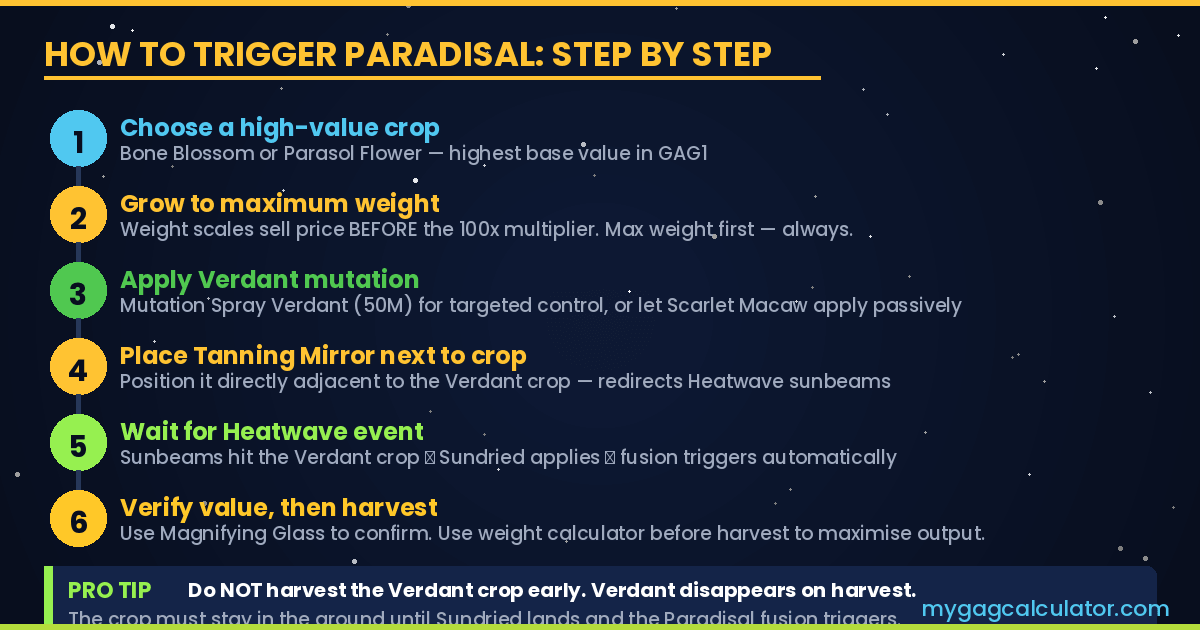
Here is the exact execution sequence for the highest-reliability path (Method 2 with Mutation Spray Verdant):
- Step 1. Select a high-value target crop (Bone Blossom or Parasol Flower are the top choices — details in the section below).
- Step 2. Grow the crop to maximum weight before doing anything else. Crop weight scales the sell value before the mutation multiplier applies. A max-weight crop with Paradisal significantly outperforms a minimum-weight crop with the same mutation.
- Step 3. Apply Mutation Spray Verdant directly to the target crop. Verdant turns the crop green. Both visual effects confirm the mutation is present.
- Step 4. Place the Tanning Mirror directly adjacent to the Verdant crop. This redirects incoming Heatwave sunbeams toward that crop.
- Step 5. Wait for a Heatwave weather event. When Heatwave sunbeams hit the Verdant crop, Sundried is applied. Both mutations are briefly visible on the crop.
- Step 6. Fusion triggers automatically. The crop converts to Paradisal. Both Verdant and Sundried disappear. The fruit glows lime green with golden sun rays.
- Step 7. Use the Magnifying Glass to verify the crop’s value before harvesting. Then use the weight calculator to confirm the exact sell price.
The weight calculator is the fastest way to confirm exact crop weight and projected sell value with the Paradisal multiplier applied before committing to a harvest.
Why the Fusion Fails (Common Mistakes)
- The Scarlet Macaw applied Verdant to the wrong crop. Solution: position the Tanning Mirror next to whichever crop receives Verdant, not a pre-selected target.
- The crop was harvested after getting Verdant, before the Heatwave fired. Verdant disappears on harvest. The Verdant crop must be left in the ground until Sundried lands.
- The Heatwave sunbeams hit a different crop. Solution: the Tanning Mirror must be placed immediately next to the Verdant crop, not elsewhere in the garden.
- Players assumed Solar Flare would come and waited instead of using the Macaw or Spray. Solar Flare has no schedule and may not appear for weeks.
- Crop weight was ignored, resulting in a low-value Paradisal crop. Always grow to max weight first — use the crop planner to time growth cycles around Heatwave windows.
Best Crops for the Paradisal Mutation in Grow a Garden
The 100x multiplier applies uniformly to any crop, but absolute Sheckle output is determined by the crop’s base value multiplied by weight and then by the mutation multiplier. These are the highest-yield Paradisal targets in GAG1:
| Crop | Base Value | With Paradisal (100x) | Notes |
| Bone Blossom | Very High | Tens of millions | Top Paradisal target; high base + high weight ceiling |
| Parasol Flower | Very High | Tens of millions | Second-best target; see the full Parasol Flower guide |
| Candy Blossom | High | High millions | Strong blossom-type crop for Paradisal |
| Sunflower | Medium-High | Millions | Reliable mid-tier option with good weight scaling |
| Mushroom | Medium | Solid millions | More accessible for mid-game players |
For the highest absolute returns, Bone Blossom and Parasol Flower are the clear top targets. The gap between them and mid-tier crops at 100x exceeds 4,000,000 Sheckles per harvest. It is worth waiting for the right crop to be ready before using a 50M Sheckle spray or waiting through multiple Heatwave windows.
Crop weight scales the final sell price before the multiplier applies. A max-weight Bone Blossom with Paradisal will significantly outperform a minimum-weight version of the same crop. For weight mechanics and how to maximize them, the weight calculator guide explains the exact formula. Giant crops provide the highest weight ceilings — more on that in the giant crops guide.
Is the Paradisal Mutation Worth the Grind?
This is the question most guides skip or answer poorly. The direct answer depends on where a player currently sits in the game. Paradisal at 100x is not the highest multiplier in GAG1. Here is where it sits in the current tier list:
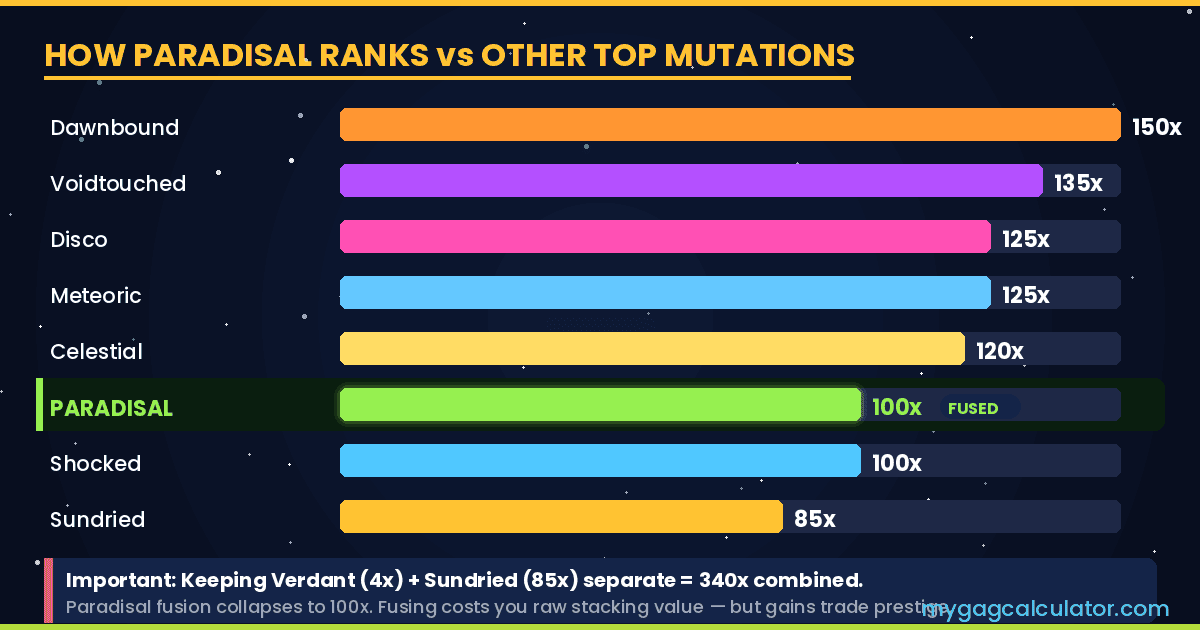
| Mutation | Multiplier | Source | vs Paradisal |
| Dawnbound | 150x | Sun God admin event | 50x higher |
| Voidtouched | 135x | Black Hole event | 35x higher |
| Disco | 125x | Disco Bee pet / admin | 25x higher |
| Meteoric | 125x | Meteor Shower event | 25x higher |
| Celestial | 120x | Meteor Shower event | 20x higher |
| Paradisal | 100x | Verdant + Sundried fusion | Baseline |
| Shocked | 100x | Thunderstorm / Lightning Rod | Equal — but easier |
| Sundried alone | 85x | Heatwave event | 15x lower — but stackable |
The comparison to Shocked (100x) is especially relevant: Shocked delivers the same 100x multiplier and is obtainable through the Thunderstorm weather event — a standard, schedulable event that does not require a 50M Sheckle pet egg or an additional 50M Sheckle spray. For pure Sheckle farming, the Shocked path is more capital-efficient.
There is also a mathematical consideration unique to Paradisal as a fused mutation: keeping Verdant (4x) and Sundried (85x) as independent stackable mutations would yield a combined multiplier of 4 x 85 = 340x on the same crop. Fusing into Paradisal collapses that to 100x. Once fused, neither Verdant nor Sundried can be re-added. This is the hidden cost of the fusion that no competitor guide currently addresses: triggering Paradisal permanently reduces raw Sheckle output compared to what independent stacking would have given. For the math behind any specific crop, the mutation calculator runs the exact comparison.
Who Should Chase Paradisal
- Players with 100M+ Sheckles who already own the Scarlet Macaw and Tanning Mirror: yes, pursue Paradisal every Heatwave. The marginal cost is low.
- Late-game stacking builds: Paradisal contributes 100x to a Rainbow-anchored stack that can exceed 200,000x combined. In that context, the 100x is valuable.
- Trade-focused players: Paradisal carries strong trade value due to its prestige as a fused Mythical mutation with visible particle effects.
Who Should Not Chase Paradisal Yet
- Players below 100M Sheckles: spending 50M on a Paradise Egg for an 8% shot at the Macaw, plus potentially another 50M on Mutation Spray Verdant as a fallback, plus 1M on a Tanning Mirror, is a significant capital commitment. Build Sheckle reserves first using the fast Sheckle farming guide.
- Players without a Heatwave window: do not use the Mutation Spray Verdant until a Heatwave is confirmed incoming. Once Verdant is applied, the crop clock is ticking.
- Players whose priority is raw Sheckle output: consider chasing Dawnbound (150x) or Voidtouched (135x) first, as both outperform Paradisal on a single mutation basis.
Stacking Paradisal with Other Mutations
After Paradisal triggers, both Verdant and Sundried are permanently gone from the crop. They cannot be reapplied. However, Paradisal itself stacks multiplicatively with every other compatible mutation. In GAG1, mutations compound: a crop with Paradisal (100x), Rainbow (50x), and Dawnbound (150x) does not total 300x — it multiplies to 100 x 50 x 150 = 750,000x.
According to the Grow a Garden Fandom Wiki, Paradisal appears in the theoretical maximum combined-multiplier list of 67 stackable mutations, which reaches a combined multiplier exceeding 200,000x when fully optimized. For the full picture on how stacking math works and which mutations conflict, see the comprehensive guide on all mutations in Grow a Garden.
Mutations that stack well on top of Paradisal in a late-game build:
| Mutation | Multiplier | Notes |
| Rainbow | 50x | Variant mutation; from Butterfly pet; requires 5+ mutations already present |
| Shocked | 100x | From Thunderstorm; stackable with Paradisal |
| Celestial | 120x | From Meteor Shower; strong stack partner |
| Voidtouched | 135x | From Black Hole event; high-value add-on |
| Dawnbound | 150x | Highest standard multiplier; pairs excellently with Paradisal |
| Bloodlit | 4x (GAG1) | Low individual value but stackable; Blood Moon is frequent |
| Aurora | Variable | Stackable; see the Aurora mutation guide for the Cosmic fusion trap warning |
One important compatibility note: the Aurora mutation can fuse with Celestial into Cosmic, which actually reduces the combined value compared to keeping them separate. Plan the full mutation stack before chasing individual additions — the trade calculator is the fastest way to evaluate whether a proposed stack or trade is fair value.
Is Paradisal in Grow a Garden 2 (GAG2)?
No. Paradisal does not exist in Grow a Garden 2. GAG2 launched on June 12, 2026, as a standalone game running a completely separate mutation system. The official GAG2 Fandom Wiki lists the current mutation set as: Gold (10x), Rainbow (25x), Electric (70x), Frozen (40x), Bloodlit (80x), Starstruck (45x), and Shocked (100x) for standard mutations, plus Chained, Solarflare, and Pizza in the special category. Paradisal is not on the list.
GAG2 also runs a fundamentally different mutation mechanic: crops can only carry one mutation at a time, and mutations do not stack. This makes the entire Paradisal fusion concept — which depends on two mutations being simultaneously present — structurally incompatible with GAG2’s system.
For players looking to maximize earnings in GAG2, the complete GAG2 mutations guide covers the full mutation list, how GAG2 weather events differ from GAG1, and the best strategies for the sequel’s mechanics. The GAG2 beginner guide is also the recommended starting point for players new to the sequel.
The GAG1 pet calculator and GAG2 Pet calculator can help identify which pets are worth the investment in each game.
Paradisal Mutation: Common Mistakes to Avoid
These are the errors that cost players the most time and Sheckles when chasing Paradisal:
- Trusting 18x as the current multiplier. Multiple live guides still list this outdated figure. The correct value is 100x, confirmed by the Fandom Wiki.
- Chasing Paradisal with under 100M Sheckles. The total cost of entry (Paradise Egg + Spray fallback + Tanning Mirror) can exceed 101M Sheckles. Build capital first.
- Not positioning the Tanning Mirror correctly. It must be placed directly adjacent to the crop that already has Verdant. Placing it elsewhere in the garden does not redirect sunbeams to that crop.
- Harvesting the Verdant crop too early. Verdant disappears on harvest. The crop must stay in the ground until Sundried lands and fusion triggers.
- Waiting for Solar Flare instead of taking action. Solar Flare is free but has no schedule. Waiting for it when the Mutation Spray Verdant is available is a false economy.
- Ignoring crop weight before chasing the mutation. Apply Verdant to a crop only after it has been grown to maximum weight. The weight scales the sell price before the 100x multiplier applies.
- Thinking Verdant and Sundried still stack with Paradisal after fusion. They do not. Once Paradisal triggers, both are permanently replaced.
- Assuming Paradisal is the highest available multiplier. Dawnbound (150x), Voidtouched (135x), Disco (125x), Meteoric (125x), and Celestial (120x) all exceed Paradisal’s 100x as single mutations.
Frequently Asked Questions
What is the Paradisal Mutation in Grow a Garden?
Paradisal is a fused Mythical-tier mutation in GAG1 that applies a 100x sell value multiplier to crops. It forms automatically when both the Verdant and Sundried mutations are simultaneously present on the same crop. The crop turns lime green and emits golden sun-ray particles.
Is Paradisal 18x or 100x?
The current confirmed value is 100x. The original 18x was the launch value; it was updated in a post-launch patch. Paradisal is the only GAG1 mutation that has ever had its multiplier changed.
How do you get the Paradisal Mutation in Grow a Garden?
There are three methods. Method 1: Own a Scarlet Macaw pet (from the Paradise Egg at 50M Sheckles, 8% hatch rate) and wait for the Macaw to apply Verdant, then use the Tanning Mirror during a Heatwave to add Sundried. Method 2: Buy Mutation Spray Verdant from the Traveling Merchant for 50M Sheckles and apply it to a chosen crop, then use the Tanning Mirror to get Sundried during a Heatwave. Method 3: Be online during a Solar Flare admin event, which can apply both Verdant and Sundried in one window — but Solar Flare has no predictable schedule.
Can you get Paradisal without the Scarlet Macaw?
Yes. The Mutation Spray Verdant (available from the Traveling Merchant for 50M Sheckles) applies Verdant directly to any chosen crop with 100% success. A Heatwave then adds Sundried, triggering the fusion. The Solar Flare admin event can also apply both without any item cost, but it cannot be predicted or planned around.
Does Paradisal remove Verdant and Sundried?
Yes. Once the fusion triggers, both Verdant and Sundried are permanently replaced by Paradisal. They cannot be re-added afterward.
Is Paradisal worth it in Grow a Garden?
For players with 100M+ Sheckles who already own the Scarlet Macaw and Tanning Mirror, yes — pursue it every Heatwave. For players below that threshold, it is more capital-efficient to build Sheckle reserves first. Players focused on raw value may also want to prioritize Dawnbound (150x), Voidtouched (135x), or Disco (125x), which all exceed Paradisal’s 100x multiplier.
What mutations can stack with Paradisal?
Most mutations stack with Paradisal, including Shocked (100x), Celestial (120x), Voidtouched (135x), Dawnbound (150x), and Rainbow (50x). The exception is that Verdant and Sundried cannot be reapplied once the fusion completes. In a fully optimized late-game stack, Paradisal appears in the theoretical maximum combined multiplier list of 67 stackable mutations, which exceeds 200,000x total.
Is Paradisal in Grow a Garden 2?
No. Paradisal is a GAG1-exclusive mutation added in the June 2025 Summer Harvest Event. It does not exist in Grow a Garden 2, which has its own separate mutation system where crops can only carry one mutation at a time.
What crops are best for Paradisal?
Bone Blossom and Parasol Flower are the top targets because of their high base values. Always grow the target crop to maximum weight before applying Verdant, since weight scales the sell price before the 100x multiplier is applied.
Final Verdict on the Paradisal Mutation
The Paradisal Mutation is the most historically interesting mutation in Grow a Garden — the only one to have its multiplier revised post-launch, the one with the most outdated information still circulating, and the one that requires genuine strategic planning to trigger correctly. At 100x, it is not the ceiling of the mutation system, but it is a legitimate late-game asset with strong trade value and meaningful stacking potential in Rainbow-anchored max builds.
The correct path depends on capital. Players with 100M+ Sheckles and a Scarlet Macaw should chase it every Heatwave. Players without the Macaw can use Mutation Spray Verdant for a reliable no-RNG Verdant application. Players in the early-to-mid game should build Sheckles first. For all of those scenarios, the mutation calculator gives exact projected values, and the weather tracker helps plan Heatwave session timing. The GAG1 farming guide covers the full Sheckle progression roadmap for players building toward the 100M+ threshold.