Published by: Saif (Jun 2026) | Platform: Roblox | Game: Grow a Garden 2
| How to Make Sheckles Fast in Grow a Garden 2
The fastest method is to stack every multiplier before selling. Start with tomatoes and carrots to hit 700 Sheckles, then switch to bamboo. Plant crops in tight clusters inside sprinkler range, reach 100 size luck, wait for the right weather mutation, activate friend boost (plus 10 percent per friend, up to 70 percent for seven friends), and sell using the Daily Deal. After the bamboo nerf, Dragon Fruit, Ghost Pepper, and Moon Bloom are the mid-game and end-game standards. The sell formula is: Total Price = Sell Value x Size Factor x Size Multiplier x Mutation Multiplier x Decay Penalty x Friends Bonus. Every variable in that formula is a lever. Miss one, and the profit drops hard. |
Sheckles are the in-game currency that powers everything in Grow a Garden 2, from seeds and gear to pets, plot expansions, and guild contributions. Without a steady Sheckle income, progression stalls fast. The good news is the farming system is deeper than most players realize, and the players who understand it earn exponentially more than those who do not.
This guide covers the complete Sheckle farming system from zero to billions, written for Roblox players at every stage of the game. It includes the official sell formula in plain language, every confirmed mutation and its source event, the four progression phases, sprinkler size luck mechanics, the June 20, 2026 update changes (Bargain removal, Double or Nothing introduction, Daily Deal update, Aurora mutation), and the unique mechanics that most guides skip entirely.
The meta shifted significantly after the bamboo nerf and the June 20 update. Any guide that still leads with Bargain or treats bamboo as the end-game method is outdated. This one reflects exactly where things stand on June 29, 2026. Here is complete Grow a Garden 2 guide for beginners, what to do in first 30 mins.
What Are Sheckles in Grow a Garden 2?
Sheckles are the primary in-game currency in Grow a Garden 2. Players use them to buy seeds from Sam’s Seed Shop, purchase gear from the Gear Shop, acquire pets, expand plots, and participate in guild systems. Unlike the original game, players start with a noticeably lower Sheckle balance in GAG2, which makes the early grind tighter and every spending decision more meaningful. See our complete guide on GAG2 seeds.
Sheckles cannot be traded between players directly, but the economy flows through crop selling, the Auction House, and guild events. Players can also purchase Sheckles with Robux, though this guide focuses on earning them through gameplay since free Sheckles earned through smart farming will always outpace a one-time purchase as the game scales.
The in-game currency is spelled “Sheckles” in GAG2. Some community sources use “shekels” or “coins” interchangeably, but Sheckles is the correct in-game term.
The Exact Sell Formula Behind Every Sheckle Players Earn
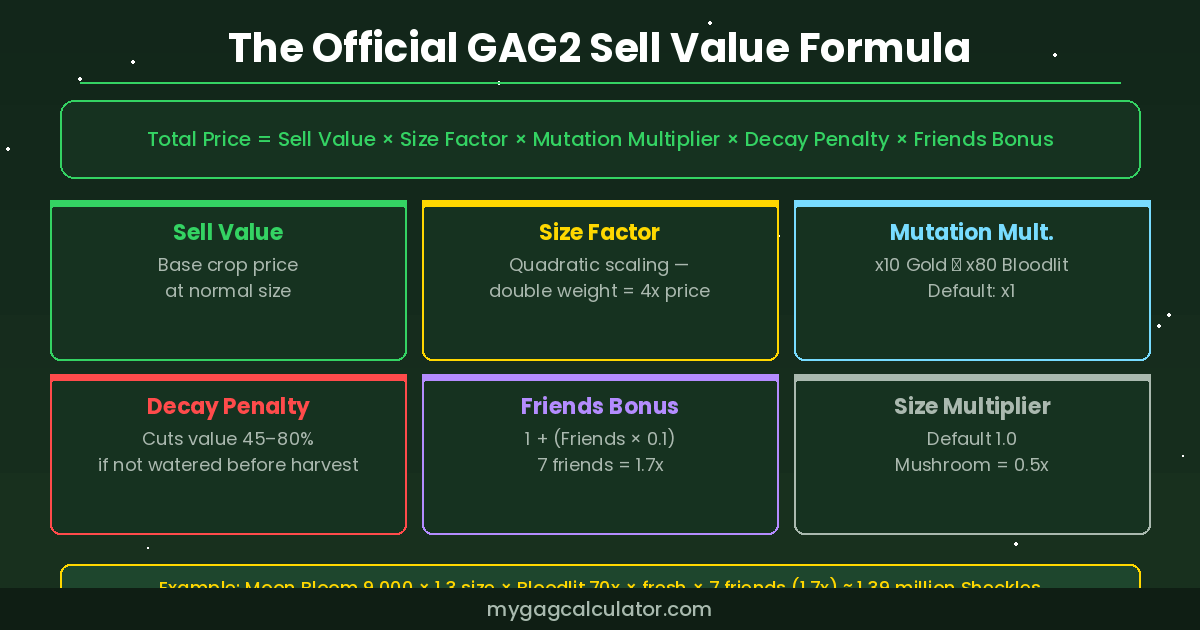
This is the most important section in the guide, and it is the one that almost no competitor covers clearly. Understanding the formula is what separates players who earn millions per session from those who earn thousands.
The official sell formula confirmed from community research and the Fandom wiki is:
Total Price = Sell Value x Size Factor x Size Multiplier x Mutation Multiplier x Decay Penalty x Friends Bonus
Here is what each variable means in practice:
Sell Value is the base price of the crop at its normal size. Every crop has a different base value. Moon Bloom has a base of approximately 9,000 Sheckles, Mushroom around 13,000, Ghost Pepper around 2,500, and Bamboo substantially lower.
Size Factor is the contribution of the fruit’s physical size to the final price. Weight scaling is quadratic, meaning a crop that is twice the base weight sells for roughly four times the base price. A crop three times the base weight sells for approximately nine times more. This is why growing large plants is the core money mechanic, not just a nice bonus.
Size Multiplier defaults to 1 for most crops. Mushroom is an exception at 0.5x, meaning it sells at half the calculated value. Knowing per-crop multipliers helps players prioritize correctly.
Mutation Multiplier defaults to 1 with no mutation. A Bloodlit crop applies x60 to x80 on top of the weight-adjusted total. This is where crops go from thousands to millions of Sheckles in a single weather event.
Decay Penalty cuts sell value by 45 to 80 percent if the crop is not watered before harvest. This single variable is responsible for more lost income than any other mechanic in the game. A freshly watered crop and a pale decayed crop of the same size and mutation can sell for wildly different amounts.
Friends Bonus is calculated as 1 plus (Friends x 0.1). With seven friends in the server, this becomes 1.7x. That bonus stacks on top of everything else, meaning a well-timed group sell with mutations active is the highest-earning moment in any session.
The result is floored to the nearest integer, with a per-crop minimum applied last so no crop ever sells for zero.
Worked example: Moon Bloom base value 9,000 Sheckles x size factor 1.3 (crop slightly above base weight) x Bloodlit x70 mutation x no decay x 7 friends (1.7x) = approximately 11,700 x 70 x 1.7 = around 1.39 million Sheckles from one crop.
Players who want to run these numbers before selling should use the GAG2 profit calculator to estimate any crop value by entering the plant, weight, mutation, and friend count.
The Single-Harvest Mutation Penalty (Almost Nobody Explains This)
This mechanic changes the strategy for bamboo and other single-harvest crops more than any other rule in the game. See our guide on best crops to grow for shekcles in GAG2.
Single-harvest crops, which include Bamboo, Carrot, Tulip, Mushroom, and Glow Mushroom, only receive one-quarter of a mutation multiplier. Multi-harvest crops receive the full multiplier.
What this means in practice: a Bloodlit mutation worth x80 on a Dragon Fruit is effectively only x20 on Bamboo. A Rainbow mutation worth x30 on Ghost Pepper becomes x7.5 on Bamboo. The crops that feel like the safest mutation targets (cheap single-harvest plants sitting in the garden) are actually the worst mutation earners in the game.
This single fact reshapes the strategy around Blood Moon and Starfall events. Before those events trigger, players should clear their bamboo inventory by harvesting it, then make sure high-value multi-harvest crops are ripe and waiting in the garden. Catching a Blood Moon hit on a large Dragon Fruit or Moon Bloom is worth ten times more than the same event hitting a plot full of bamboo.
For a complete breakdown of how mutations interact with crop types and weight scaling, the GAG2 mutation calculator covers every confirmed mutation with per-crop value estimates.
The Four Phases of Sheckle Farming
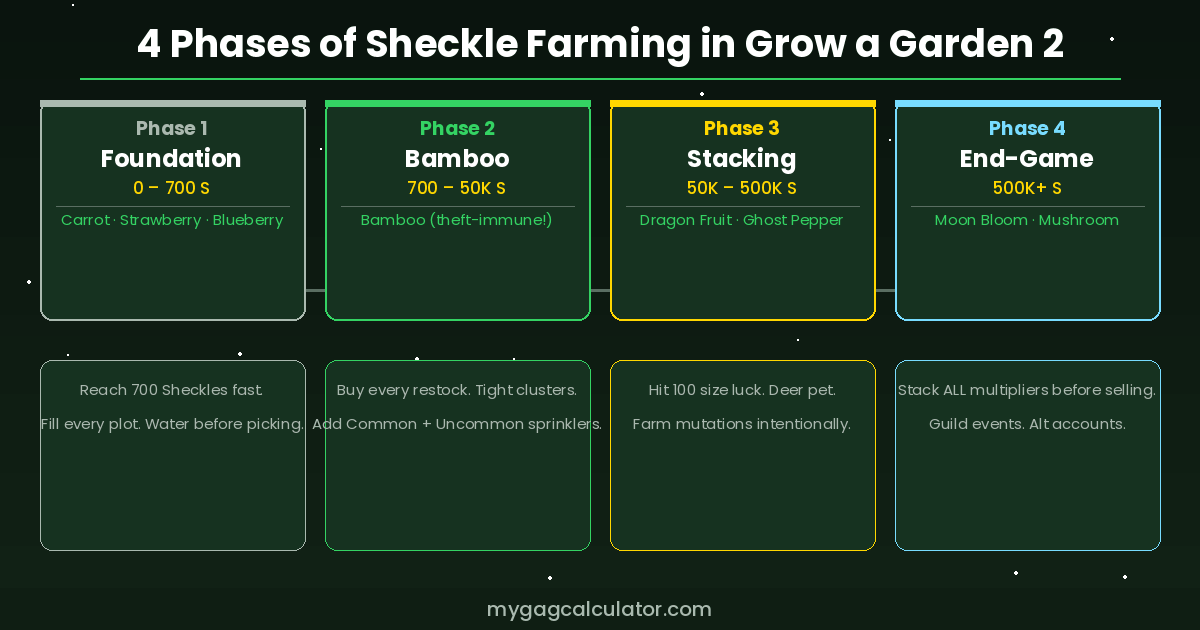
Sheckle farming in Grow a Garden 2 is not one strategy repeated forever. It is four distinct phases, each with different crops, goals, and priorities. Players who stay in Phase 2 thinking bamboo is the final answer hit a ceiling. Players who skip Phase 2 and chase rare seeds immediately run out of cash flow.
| Phase | Sheckle Range | Primary Crop | Main Goal |
| Phase 1: Foundation | 0 to 700 | Carrot, Strawberry, Blueberry | Hit 700 as fast as possible |
| Phase 2: Bamboo | 700 to 50,000 | Bamboo | Stack cycles, reach 100 size luck |
| Phase 3: Mid-Game | 50,000 to 500,000 | Dragon Fruit, Ghost Pepper | Chase mutations, use friend boost |
| Phase 4: End-Game | 500,000 and above | Moon Bloom, Mushroom | Stack all multipliers per sell |
Phase 1: Foundation (0 to 700 Sheckles)
The most important goal in the early game is not to earn a lot of money. It is to reach 700 Sheckles as fast as possible. That number is the economic watershed of GAG2. Once a player has 700 Sheckles, the bamboo cycle becomes available, and income velocity multiplies.
The right crops at this stage are Carrot, Strawberry, and Blueberry. They are cheap, grow quickly, and restock reliably. Every plot should be filled at all times. An empty plot earns zero Sheckles and wastes growth time that could compound into the next reinvestment cycle.
At this stage, players should not spend Sheckles on gear, decorative items, or pets. Every Sheckle earned should go back into seeds. The one exception is watering. Watering crops before picking is the single most important habit in Phase 1, because the decay penalty alone can cut value by nearly half.
Players who redeem the code TEAMGREENBEAN on first login receive 3 free Epic Green Bean seeds. These are the best free early-game item in the game and give a meaningful head start without spending a single Sheckle.
Phase 2: Bamboo Phase (700 to 50,000 Sheckles)
At 700 Sheckles, the strategy shifts entirely to bamboo. Bamboo has three properties that make it the cleanest early escalator in GAG2: it costs around 700 Sheckles per seed, it grows in approximately 35 seconds at base (around 12 seconds during rain), and it cannot be stolen. That theft immunity makes it the only crop that is completely safe to farm on public servers without a defense setup.
The bamboo farming loop is simple. Buy every bamboo seed from Sam’s Seed Shop at each restock (approximately 7 to 10 seeds every five minutes). Plant them in a tight cluster. Add at least a Common and Uncommon sprinkler inside the cluster zone. Harvest as soon as crops reach full size. Sell, then replant while waiting for the next restock.
The restock timer is the actual bottleneck at this phase, not the growth time. Players who master the restock rhythm keep seeds stocked between cycles and never leave a plot empty.
One important correction: bamboo is a single-harvest crop, so mutation multipliers are reduced to one-quarter of their face value. During Phase 2, players should harvest bamboo immediately rather than holding for mutations. The velocity of repeated cycles outperforms mutation fishing at this balance level.
The Deer pet (50,000 Sheckles) is the right first pet investment once Phase 2 is established. It cuts growth time by 10 percent, which means more harvests per session, more mutation chances per hour, and faster reinvestment cycles. A Deer pays itself back in roughly ten minutes of active bamboo farming.
Bamboo is no longer the end-game carry after the nerf. It is the escalator to Phase 3. The moment a player can afford Dragon Fruit or Ghost Pepper seeds consistently, bamboo should become a secondary background crop, not the main income source.
Phase 3: Mid-Game Stacking (50,000 to 500,000 Sheckles)
Phase 3 is where the sell formula starts producing serious numbers. Cheap seeds got weaker after the nerf. Rare seeds now scale much better. Dragon Fruit is the cleanest mid-game pick because it is a multi-harvest crop, takes mutations at full multiplier, and can sell for strong value even without mutations. With an Electric or Starstruck mutation, it becomes a significant income source.
The priority in Phase 3 is reaching 100 size luck with sprinklers. The size luck system controls how heavy crops grow. Without any sprinkler, size luck is 0, giving just a 1 percent doubling chance and mostly Normal-weight harvests. At 100 luck, every harvest has a 5 percent doubling chance and a real probability of landing in the Colossal band (14.5 to 17.5 times the base weight). A Colossal Dragon Fruit is worth approximately 200 times more than a Normal one before mutations are even applied.
The most cost-efficient way to reach the 100 luck cap is a Rare sprinkler (plus 40 luck) combined with a Legendary sprinkler (plus 65 luck). Together they reach 105 luck, which is cut to the 100 cap. This combination is cheaper than a single Super sprinkler while delivering the same doubling chance. The Super sprinkler’s advantage is its 5x growth speed, which only matters if speed is more valuable than the cost difference.
Stacking more sprinklers beyond the 100 cap adds nothing. Players who have reached the cap should stop buying sprinklers and redirect Sheckles into seeds or pets.
In Phase 3, players should start farming mutations intentionally. That means keeping ripe crops in the garden before known weather event windows, using the GAG2 weather tracker to time harvests around event cycles, and clearing single-harvest crops before high-multiplier events like Blood Moon so multi-harvest crops catch the full benefit.
Phase 4: End-Game Multiplier Stacking (500,000 Sheckles and above)
Phase 4 is not about finding a new method. It is about executing the same multiplier stacking loop with better inputs. Moon Bloom, Mushroom, and Dragon’s Breath are the end-game standard crops because their high base values mean quadratic weight scaling produces staggering final prices.
At this level, the Turtle pet becomes relevant. It costs 70,000 Sheckles, adds plus 10 backpack slots per equip, and slows walk speed by 2. Three Turtles give 30 extra inventory slots, meaning players can carry far more mutated crops into a single sell. That backpack expansion directly scales Daily Deal value, because more inventory in the bag means a larger total on the 2.2x multiplier. The speed penalty can be offset with a Bunny pet (plus 5 walk speed) if movement is a bottleneck.
Alt accounts for seed buying become meaningful at this stage. Seed stock in Sam’s Seed Shop is shared across all players on the same server. If a rare seed appears, it appears for everyone. Using alt accounts to buy additional stock, then mailing seeds to the main account, solves the biggest mid-to-late-game bottleneck: not enough of the right seeds per restock cycle.
Guild participation adds another Sheckle income layer. Weekly guild events reward top contributors, and a single large mutated sale timed to a guild event window often earns more points than ten smaller sells. Players should join an active guild early and prioritize contributing rather than waiting to be established first.
Players looking for the right crops to invest in at end-game can reference the detailed GAG2 seeds and crops guide for base values, restock frequency, and mutation compatibility by crop.
Sprinklers and Size Luck: The Core Weight System
Sprinklers are the most important gear investment in Grow a Garden 2 for Sheckle farming, not because they speed up growth (though they do), but because size luck is the hidden driver of crop weight, and crop weight scales the sell price quadratically.
When a crop is harvested, the game rolls it into one of six weight bands from Normal through Colossal. Each band multiplies the crop’s base weight. The higher the size luck stat, the more likely the crop lands in a higher band and the more likely it passes through lucky double rolls that push weight up further. A Bamboo with a 5kg base weight that lands in Colossal can weigh 72 to 87 kg, which at the base sell formula makes it worth hundreds of times more than a Normal-band harvest.
| Tier | Size Luck | Growth Speed | Cost (Sheckles) | Notes |
| Common | +7 | 1.5x | Low | Entry level |
| Uncommon | +14 | 2x | Moderate | Pair with Common early |
| Rare | +40 | 3x | ~50,000 | Best mid-game value |
| Legendary | +65 | 4x | High | Rare + Legendary = 105 luck (capped at 100) |
| Super | +100 | 5x | ~300,000 | Hits cap alone, but pricier |
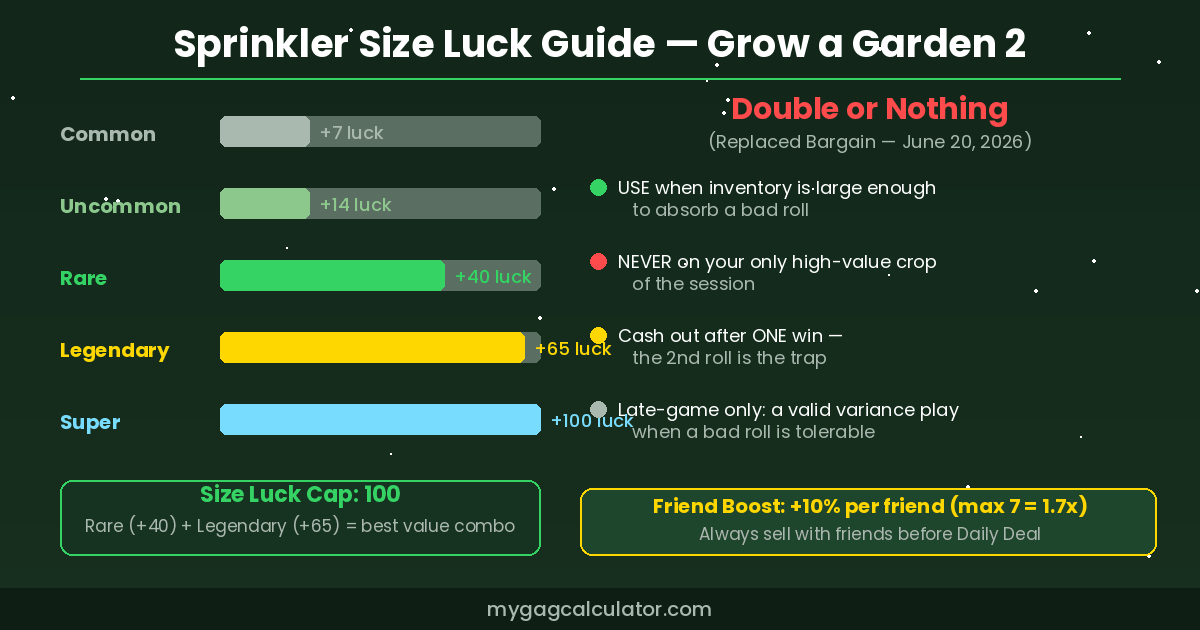
* All sprinklers last 2 minutes after placement. Place them after planting, not before, so the duration is not wasted.
A key clarification on stacking: size luck is hard-capped at 100 across all active sprinklers. Placing additional sprinklers beyond what is needed to hit 100 does nothing. Players should place sprinklers on their highest-value crop clusters rather than spreading them evenly across a full plot. A Super sprinkler covering a Mushroom cluster earns more per event than the same sprinkler covering ten Carrot plants.
Sprinklers also passively increase mutation probability during normal growth, not just during weather events. This is why upgrading sprinkler tier matters even after reaching the size luck cap. Higher tiers improve both the growth speed and the passive mutation chance simultaneously.
To calculate exact weight odds for any crop and sprinkler combination before committing resources, the GAG2 weight calculator estimates weight band probabilities based on chosen size luck values.
All Mutations in Grow a Garden 2 and How to Farm Each One
Mutations are the largest single Sheckle multiplier in the game. A plain crop sells for whatever its base value and weight produce. The same crop caught in a Blood Moon event can sell for 60 to 80 times more. Understanding which mutation comes from which event, and timing harvests accordingly, is what separates efficient farmers from players who miss profitable windows.
Only one mutation can sit on a crop at a time in GAG2. Unlike the original game, mutations do not stack. A new weather mutation replaces the existing one. This is a critical mechanical difference. Players who leave a Gold-mutated bamboo in the garden hoping to add Rainbow on top will instead lose the Gold mutation when Rainbow triggers.
| Mutation | Multiplier | Source Event | Single-Harvest Effective |
| Gold | x10 | Passive / Dragonfly pet | x2.5 |
| Frozen | x14 | Blizzard | x3.5 |
| Electric | x25 | Lightning | x6.25 |
| Rainbow | x30 | Midas Moon / Unicorn pet | x7.5 |
| Aurora | x40-42 | Aurora (night only) | x10-10.5 |
| Starstruck | x50 | Starfall | x12.5 |
| Bloodlit | x60-80 | Blood Moon | x15-20 |
| Pizza * | x5 | Not yet live | x1.25 |
| Solarflare * | x5 | Not yet live | x1.25 |
| Chained * | x8 | Not yet live | x2 |
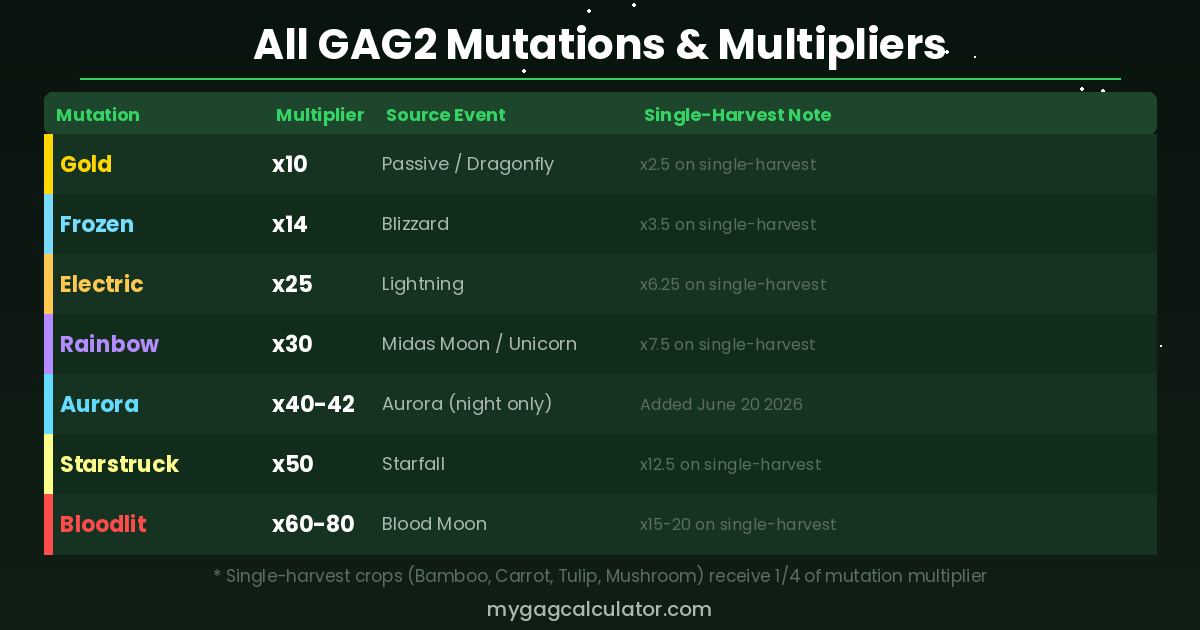
* Pizza, Solarflare, and Chained are confirmed in the game files but not yet live as of June 29, 2026. Keep an eye on the GAG2 weather events guide for updates on when they go live.
For the complete mutation breakdown including per-crop value examples, the all mutations in Grow a Garden 2 guide covers every confirmed mutation with multipliers, source events, and the key differences from the original game.
Key Mutation Mechanics Players Miss
First: the decay reset rule. A mutation landing on a decayed crop resets its sell-value decay penalty to fresh, even if the fruit still looks visually pale. A crop that has been sitting too long and caught a Blood Moon hit is worth the full mutated price, not a discounted one. Players who harvest pale crops immediately before a Blood Moon triggers are leaving significant money on the table.
Second: Aurora is a night-only mutation added in the June 20, 2026 update. It carries a x40 to x42 multiplier and only triggers during the Aurora weather event after dark. This makes overnight AFK sessions in a private server much more valuable than before, since crops sitting in the garden at night now have an additional high-multiplier event window.
Third: the Gold mutation on single-harvest crops has an effective multiplier of only x2.5 (one-quarter of x10), while on multi-harvest crops it is the full x10. For players using the Golden Dragonfly pet to boost Gold mutation rates, the pet pays off best on large plots of multi-harvest crops, not bamboo.
Players interested in the Gold mutation specifically and its interaction with the Dragonfly pet should read the gold mutation guide for ROI analysis and optimal pet pairings.
The Selling System: Daily Deal, Double or Nothing, and Friend Boost
The June 20, 2026 update changed the selling system significantly. Players searching for guides about Bargain are looking for a feature that no longer exists. Here is the current sell mechanic breakdown.
Daily Deal (x2.2 Multiplier)
The Daily Deal applies a x2.2 multiplier to an entire sell. As of June 20, 2026, it no longer requires payment to view the offer. This removes the previous risk of paying to see an offer and then deciding it was not worth taking.
The optimal Daily Deal strategy is to save it for the single most valuable sell of the day, which means waiting until the backpack is full of mutated, fresh crops with friend boost active. Using the Daily Deal on a weak inventory of unmatured Carrots is one of the most common and costly mistakes in the game.
The Daily Deal stacks with friend boost and mutations. A full inventory of Bloodlit Dragon Fruit with seven friends active and the Daily Deal triggered in the same transaction is the single highest-earning moment most players will encounter in a session.
Double or Nothing (Replaced Bargain on June 20, 2026)
Bargain was removed from the game on June 20, 2026. The Steven NPC selling mechanic still exists, but the Bargain option has been replaced by Double or Nothing.
Double or Nothing re-rolls the entire inventory value. It can result in a doubled payout or a significant loss. This is a gambling mechanic, not an income strategy. Here is the practical decision framework:
- Use Double or Nothing only when the inventory is large enough that a bad roll is tolerable and a win doubles a meaningful amount.
- Never use it on the only high-value crop of a session. A failed roll on a single large Bloodlit Mushroom that took hours to grow is a session-ending mistake in early and mid-game.
- The psychological trap is the second roll. One win feels safe, then greed triggers another attempt. The rule is simple: if losing it would be frustrating, do not gamble it.
- Late game with a large full inventory is the only time Double or Nothing becomes a legitimate variance play. At that stage, a bad roll is absorbed by the rest of the inventory, and a win on a high-value crop covers several bad rolls.
For players who want to model potential gains before using Double or Nothing, the GAG2 trade calculator can help estimate whether the risk-to-reward ratio makes sense for a given inventory value.
Friend Boost
Every friend in the same server adds a 10 percent sell bonus, confirmed from the official Fandom mechanics page. Seven friends gives a 1.7x multiplier on every sale (Friends Bonus = 1 + 7 x 0.1 = 1.7). This bonus stacks on top of mutation multipliers and the Daily Deal.
The practical implication is that players should coordinate large sells with friends rather than selling solo. A group of seven farming together and selling simultaneously earns 70 percent more per transaction than the same players selling alone in separate sessions. Players who consistently sell without friend boost are leaving significant Sheckles on the table every session.
The Auction House
The Auction House uses a Dutch auction format. Lots rotate approximately every 30 minutes. Items including seeds, crops, pets, and gear are listed with a starting price that decreases over the auction window. The strategic play is to identify high-value lots early and decide whether to buy at the current price or wait for the price to drop closer to the minimum. Buying too early loses margin; waiting too long risks losing the lot.
Best Pets for Making Sheckles in Grow a Garden 2
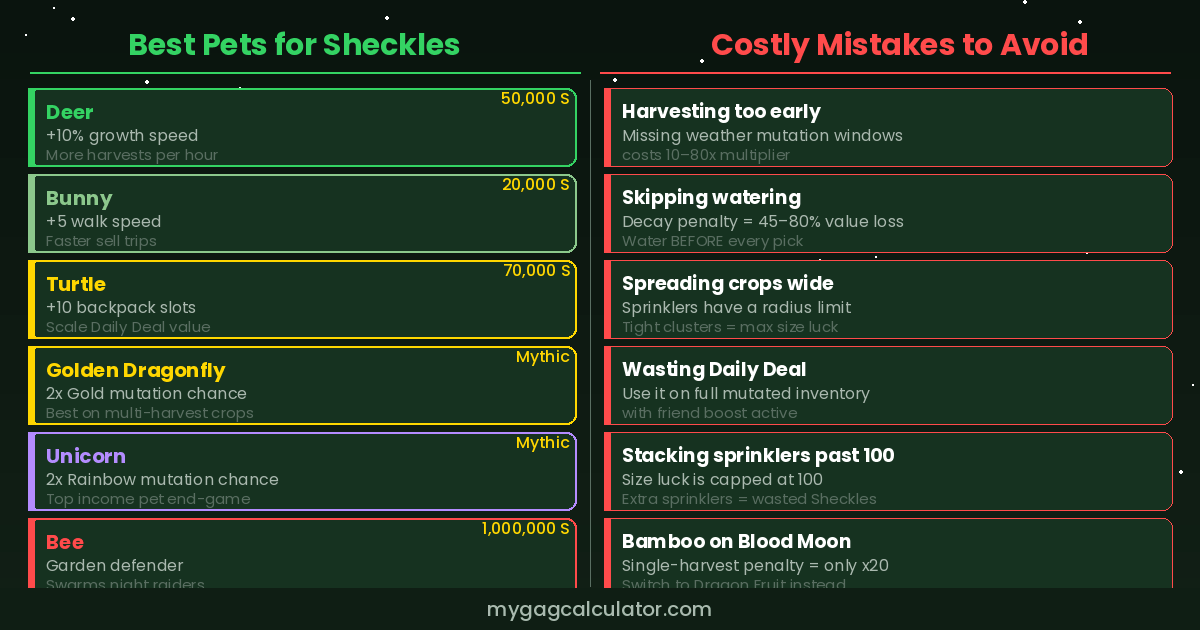
Pets in GAG2 spawn randomly on the map with a timer. Players must purchase them before the timer expires. Another player can outbid mid-walk, so escort every pet purchase home actively. By default, players can equip three pets. The first additional slot costs 200,000 Sheckles.
Here is the recommended acquisition order for income-focused players:
- Deer (50,000 Sheckles, Rare): The first income pet most players should buy. A 10 percent growth time reduction applies to every crop cycle. Multiple Deer stack, and two or three compounding on a single plot produce a noticeable throughput increase. More harvests per hour means more mutation chances and faster reinvestment.
- Bunny (20,000 Sheckles): A cheap walk speed boost (plus 5 speed) that reduces the time spent running between plots and the sell stand. At 20,000 Sheckles it is accessible in Phase 2 and pairs with Turtle to offset the speed penalty from backpack stacking.
- Golden Dragonfly (Mythic): Doubles the Gold mutation chance. Most effective on large plots of multi-harvest crops. Worth buying once the farm is large enough that mutation rolls happen frequently throughout a session.
- Unicorn (Mythic): Doubles the Rainbow mutation chance. Rainbow is a x30 multiplier (full value on multi-harvest crops), making Unicorn the strongest income pet for players focused on high-value crop mutation farming.
- Turtle (70,000 Sheckles, Rare): Adds plus 10 backpack slots per equip at the cost of minus 2 walk speed. Three Turtles give 30 extra slots. Best used in Phase 4 to maximize Daily Deal transaction size. Offset the speed penalty with a Bunny.
- Bee (1,000,000 Sheckles): Garden defense on public servers. Swarms intruders while the player is away. Relevant once the plot contains high-value crops worth defending.
Advanced players can use the GAG2 pet calculator to compare pet ability values and ROI against current crop income before making a purchase decision.
Garden Defense and Server Strategy
Crops can only be stolen at night in Grow a Garden 2. Standing inside a garden locks it, preventing anyone from taking crops while the owner is present. The theft window is specifically the night cycle on public servers.
Bamboo is theft-immune regardless of server type or time of day. This makes it the only crop that can safely sit in a public server garden overnight with no defense. Every other crop category is vulnerable during the night cycle.
For players farming high-value crops like Moon Bloom, Dragon’s Breath, or large mutated Dragon Fruit, a free private server is the cleanest solution. It removes the theft window entirely, allows safe AFK mutation farming, and is the recommended setup for any overnight session.
For public server play, the Gnome provides basic garden protection. The Bear pet (5,000,000 Sheckles, Mythic) pins intruders and throws them out of the garden. The Venom Spitter, a Mythic-tier plant added in the June 20, 2026 update, discourages night raiders from targeting a plot. The Bee pet swarms intruders passively while the player is away.
Players who do want to raid other gardens for Sheckles should note that it is only viable in Phase 1 and Phase 2 as a way to bootstrap early income. Raiding exposes the raider’s own crops to retaliation theft during the same night cycle, so it becomes a net negative strategy once a player has anything valuable in their own garden.
AFK Farming and the Shop Macro Loop
AFK farming works best in Phase 3 and beyond, when the primary goal shifts from active cycle velocity to waiting for mutations. Bamboo can sit for 5 to 6 hours AFK while mutations accumulate, but because of the single-harvest penalty, it is better to AFK farm multi-harvest crops and let weather events hit them. See our guide on GAG2 AFK farming setup.
The AFK shop macro catches rare seed restocks overnight. Sam’s Seed Shop restocks approximately every five minutes. A simple macro that clicks the buy button for a target seed type catches stacks of rare seeds that would otherwise be missed during sleep hours. The rule for macros: set it up cleanly, test it for several minutes before leaving it overnight, and make sure enough Sheckles remain in the balance to buy the seeds. A broken macro that presses nothing all night wastes the session.
Private server AFK is the only recommended setup. Public server AFK leaves crops exposed during night cycles and is not worth the risk once a garden contains anything valuable.
Common Mistakes That Destroy Sheckle Income
- Harvesting too early: Players who harvest crops right as they mature miss the weather event window. The largest single Sheckle gains come from catching a high-multiplier event on ripe crops, not from turning over inventory as fast as possible.
- Skipping watering before harvest: The decay penalty removes 45 to 80 percent of sell value. Watering before picking is the single most impactful free habit in the game.
- Spreading crops across the whole plot: Sprinklers have a limited radius. Crops outside the overlap zone get no size luck bonus. Tight cluster planting keeps all crops inside the highest-luck zone.
- Burning the Daily Deal on weak crops: The Daily Deal is the single most valuable sell mechanic in the game. Using it on a handful of unmatured Carrots because a player was impatient costs thousands of Sheckles in lost multiplier value.
- Stacking sprinklers beyond 100 luck: Additional sprinklers past the cap add zero benefit. That Sheckle investment should go into seeds or pets instead.
- Chasing rare seeds in Phase 1: Spending early Sheckles on expensive rare seeds before reaching bamboo is the most common beginner mistake. Cash flow dies, plots sit empty, and progression stalls.
- Holding Bamboo for Blood Moon: Because of the single-harvest mutation penalty, bamboo only receives one-quarter of the Blood Moon Bloodlit multiplier. It is better to harvest bamboo before the event and use the freed plot space to grow a multi-harvest crop that receives the full multiplier.
- Using Double or Nothing on a single high-value crop: One failed roll on a player’s only large mutated Mushroom can undo an entire session. Double or Nothing is only appropriate on surplus inventory.
Free Sheckles: Codes, Gifts, and Golden Carrots
The active redeem code as of June 2026 is TEAMGREENBEAN, which provides 3 free Epic Green Bean seeds on first redemption. This is the best free starter item currently available in the game.
Golden Carrots are a newer currency tied to an out-of-game voting website. Voting on the site earns Golden Carrots that convert into in-game rewards. The voting site operates on a card-swipe format and was introduced alongside the June 20, 2026 update.
The mailbox gifting system allows players to send seeds and items to other accounts. Players who set up alt accounts for seed buying can use this system to mail seeds to their main account, effectively multiplying the seed purchasing power per restock cycle.
Planning Crops Around Sheckle Goals
One area where most players lose efficiency is the gap between knowing what crops to grow and actually timing those crops around weather event windows and sell mechanics. The GAG2 crop planner helps players lay out which crops to plant in each plot slot, schedule harvests around expected event windows, and identify the highest-ROI crop choice for any given Sheckle budget.
Players comparing the value of selling a crop directly versus holding it for trade should also use the GAG2 trade calculator to see seed-to-Sheckle conversion rates and whether a particular seed is worth more as a sale or a trade. See best crops to grow in GAG2.
Frequently Asked Questions
What is the fastest way to make Sheckles in Grow a Garden 2?
Stack every multiplier before selling: plant high-value seeds in tight clusters, reach 100 size luck with sprinklers, wait for a weather mutation event, activate friend boost, and sell with the Daily Deal. After the bamboo nerf, Dragon Fruit, Ghost Pepper, and Moon Bloom are the top crops for mid-game and end-game farming.
Is Bamboo still good after the nerf?
Yes, but only in Phase 2 (700 to 50,000 Sheckles). Bamboo is no longer the end-game carry. It is cheap, fast, and theft-immune, making it the best early escalator. Once funds allow, players should move to Dragon Fruit, Ghost Pepper, or Mushroom for better mutation scaling and full multipliers.
What replaced Bargain in Grow a Garden 2?
Bargain was removed on June 20, 2026 and replaced with Double or Nothing. Double or Nothing re-rolls the entire inventory value and can either double it or result in a significant loss. It should only be used on surplus inventory, never on a single high-value crop.
How does the single-harvest mutation penalty work?
Single-harvest crops (Bamboo, Carrot, Tulip, Mushroom, Glow Mushroom) only receive one-quarter of a mutation multiplier. A Bloodlit mutation worth x80 on Dragon Fruit is effectively only x20 on Bamboo. Clear single-harvest crops before high-multiplier events and replace them with multi-harvest crops.
What is the sell formula in Grow a Garden 2?
Total Price = Sell Value x Size Factor x Size Multiplier x Mutation Multiplier x Decay Penalty x Friends Bonus. Weight scales quadratically: double the weight means roughly four times the price. Mutations multiply the weight-adjusted total, and friends bonus adds 0.1 per friend (up to 7 friends for 1.7x).
Can Bamboo be stolen in Grow a Garden 2?
No. Bamboo has theft immunity. Players can safely leave Bamboo in public servers overnight without losing it to raiders during the night cycle.
What is the Aurora mutation and how do you get it?
Aurora is a night-only weather event mutation added in the June 20, 2026 update. It applies a multiplier of approximately x40 to x42. Crops must be ripe in the garden when Aurora weather triggers at night.
When should players use the Daily Deal?
Save the Daily Deal for the biggest, most valuable sell of the day: a full backpack of mutated crops with friend boost active. The Daily Deal applies a x2.2 multiplier and no longer requires payment to view as of June 20, 2026.
How many friends are needed for maximum friend boost?
Seven friends in the same server gives a 1.7x multiplier (1 + 7 x 0.1 = 1.7). This is the confirmed maximum from the official game mechanics. Each additional friend beyond seven does not increase the bonus further based on current community data.
Should players expand their plot early?
No. Plot expansion should only happen when a player genuinely runs out of growing space. Buying expansion space in Phase 1 or Phase 2 when plots are not yet full is wasted Sheckles that could go toward better seeds or the first Deer pet.
Final Word: The Loop That Builds Billions
Making Sheckles fast in Grow a Garden 2 is not one trick repeated forever. It is a progression system with four phases, a sell formula with six variables, a mutation system with twelve confirmed entries, and a selling mechanic that rewards patience and timing more than raw speed.
The players who earn the most are not the ones who harvest every crop the moment it matures. They are the ones who understand that a single well-timed sell with mutations active, friend boost running, and the Daily Deal triggered is worth more than ten rushed solo transactions.
Master the formula. Play each phase for what it is designed to do. Stack every multiplier before selling. And use the calculators on this site to run the numbers before making big spend decisions, because knowing the output before committing resources is the difference between growing millions and growing billions.
For ongoing data on crop values, mutation multipliers, weather events, and gear stats as the game updates, the MyGAGcalculator is updated alongside every major GAG2 patch. All seven tools on the site are designed specifically for GAG2 players who want accurate numbers rather than rough estimates.
For players who want to cross-reference the sell value formula against real community-tested sale data, the Grow a Garden 2 Fandom wiki maintains an up-to-date mechanics page at growagarden2.fandom.com where the official price formula and weight band code are documented.