Published by: Saif (Jul 2026) | Platform: Roblox | Game: Grow a Garden 2
The Grow a Garden 2 Auction Stand looks like a straightforward discount shop. It is not. Most players lose Sheckles at the Auction not because they pick the wrong items, but because they watch the wrong number. The price ticker is only half the story. The stock counter running alongside it is the other half, and ignoring it is the single most common reason players end up empty-handed at 11 seconds remaining.
This Grow a Garden 2 auction guide breaks down every mechanic behind the Auction Stand, identifies exactly which items are worth buying at each budget level, and walks through the sniping strategy that experienced players use to consistently win the best lots. Use the GAG2 Profit Calculator alongside this guide to verify whether any specific item’s Sheckle cost makes sense for the crop value it produces in a player’s current setup.
The Auction Stand was added to Grow a Garden 2 on June 28, 2026, alongside the Hypno Bloom seed. Both arrived in the same update and are directly linked: Hypno Bloom is one of the primary seeds the Auction supplies that the regular Seed Shop almost never stocks.
Grow a Garden 2 Auction at a Glance
| Auction Mechanic | Key Fact |
| Location | Center of the map, between Seed Shop and Gear Shop |
| Reset frequency | Every 30 minutes (community-verified; Fandom wiki formula notes 15 min — see timer note in guide) |
| Items per rotation | 6 lots: Seeds, Seed Packs, Crops, Gears, Crates, Eggs, Pets |
| Price direction | Prices only drop — Dutch auction format |
| Price drop interval | Roughly every 13 seconds per decrement cycle |
| Stock type | Globally shared — all players on the server compete for the same pool |
| Best items to buy | Super Watering Can, Common Egg, Hypno Bloom, Dragon’s Breath |
| Items to skip | Common/Uncommon seeds available in the regular Seed Shop |
| Who should use it | Mid-game (5M+ Sheckles) and endgame players |
| Currency required | Sheckles only — no Robux required |
What Is the Grow a Garden 2 Auction Stand?
The Auction Stand is a server-wide marketplace run by the Auctioneer NPC, located at the center of the map between the Seed Shop and the Gear Shop. It is a permanent mechanic, not a limited-time event, and it functions as the only in-game source of certain high-value items that rarely or never appear elsewhere.
The Auctioneer wears a cowboy hat with a brown jacket and trousers. Players interact with the NPC directly to view available lots and make purchases using Sheckles. No Robux are required to participate, which makes the Auction the most accessible route to rare seeds for players who prefer not to spend real money.
Six lots rotate simultaneously every 30 minutes. Each lot can be a Seed, Seed Pack, Crop, Gear, Crate, Egg, or Pet. Every lot carries its own starting price, stock quantity, and price decrement rate. Once all stock for a lot is purchased or the 30-minute timer expires, that lot is gone. It does not carry over to the next rotation, and the catalog changes with every reset.
The Timer Conflict — What the Data Actually Shows
| Data note: The official Fandom wiki mechanics page states ‘All lots are replaced simultaneously every 15 minutes,’ while the Miraheze wiki, every major community guide, and player-tested observation consistently report a 30-minute reset. The 15-minute figure likely reflects an earlier version or a wiki editing error. The 30-minute rotation is what players experience in live servers as of July 2026. Verify in-game by checking the visible countdown timer at the Auction Stand. |
What Makes the Auction Different from the Seed Shop
The regular Seed Shop restocks every 5 minutes on a global clock and offers fixed prices. The Auction Stand offers time-limited lots with decreasing prices and limited global stock. The practical difference is significant: players can always buy Bamboo (700 Sheckles) from the Seed Shop if they wait long enough. Players can only get a Common Egg through the Auction Stand or as a Guild reward, and both windows are narrow.
For a full picture of which seeds appear in the regular shop and at what odds, the Grow a Garden 2 seeds guide covers every Seed Shop crop by rarity, price, and restock frequency alongside Robux-only options like Dragon’s Breath.
How the Grow a Garden 2 Dutch Auction Works
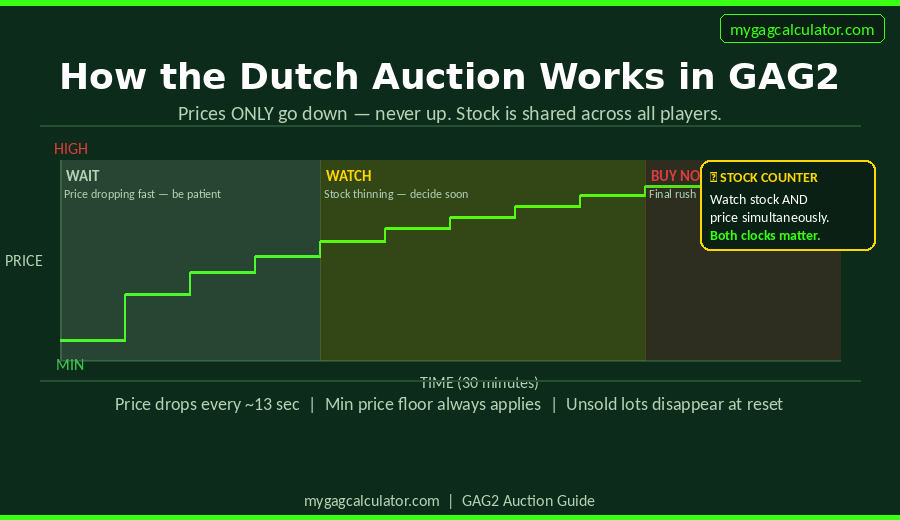
A Dutch auction is the opposite of a traditional auction. Instead of competing buyers driving the price up through bids, the price begins high and falls automatically over time. Nobody bids. The seller (the Auctioneer NPC) drops the price on a fixed schedule, and the buyer decides when the price has dropped far enough to justify purchasing before someone else does.
In Grow a Garden 2, this creates a specific kind of pressure that traditional auction games do not. Players do not bid against each other. They race against each other. The moment the price drops to a level that enough players consider acceptable, the stock starts disappearing fast.
The Price Formula (Plain English)
The Fandom wiki publishes the actual calculation. In plain language: the current price equals the starting price minus a fixed percentage of that starting price, multiplied by how many decrement intervals have passed since the lot launched. Prices drop roughly every 13 seconds based on that interval. There is always a minimum price floor. Once that floor is reached, the price stops dropping regardless of how much time remains.
The practical implication is important: because the drop is percentage-based rather than a flat Sheckle reduction, expensive items lose far more Sheckles per tick than cheap items. A lot starting at 500 million Sheckles drops faster in absolute Sheckle terms than one starting at 5 million, even if the interval is identical.
Shared Global Stock — The Mechanic Most Players Miss
Every lot has a single stock pool shared across all players on that server. There is no per-player allocation. When another player purchases three units of a lot, those three units are gone from the total available to everyone else. If a server has 30 active players all watching the same Dragon’s Breath lot, the stock can drain from 500 to zero in under two minutes even if the 30-minute timer has barely started.
This is why watching only the price timer is the wrong approach. Stock levels and the price timer must be monitored simultaneously. A lot with 2,000 units in stock and 20 minutes remaining behaves completely differently from a lot with 80 units in stock and 20 minutes remaining. The strategies for each situation are opposite.
The Two-Clock Framework: Why Most Players Lose the Lot
Every Auction lot runs on two clocks at once. The price clock drops the cost on a 13-second interval. The stock clock counts down available units each time any player on the server makes a purchase. Mastering the Auction means reading both clocks simultaneously and making a decision based on which one is moving faster.
Reading the Price Clock
The price clock rewards patience. The longer a player waits, the lower the cost. Early minutes of any rotation deliver the worst value per Sheckle. The cheapest prices appear in the final few minutes. This is what beginners observe and decide to exploit by waiting as long as possible.
Reading the Stock Clock
The stock clock punishes patience on popular items. As the price drops into a range that more players consider acceptable, purchase volume accelerates sharply. By the final 30 to 60 seconds of a popular lot, multiple players are often clicking simultaneously. Popular items can go from 200 units to 0 in under 15 seconds.
Purchase cooldown: a 5 to 8 second cooldown exists between purchases on the same item (community-verified). This means rapid-clicking does not let a single player drain stock instantly — but a server with 15 active players buying simultaneously still clears large stocks very quickly.
The Decision Point — When to Pull the Trigger
The decision rule is straightforward once both clocks are visible. When stock is above 500 units, the lot is safe to wait on for most of the rotation. When stock drops below 100 units, the window to wait is closing. When stock drops below 20 units, the buying window is essentially now or never, regardless of where the price is. Waiting for the absolute price floor on a lot with 15 units remaining is almost always how players end up watching that lot sell out while deciding.
A useful mindset shift: the goal is not to pay the lowest possible price. The goal is to pay a price low enough to justify the purchase before the item is gone. These are different objectives, and confusing them is the source of most auction regret.
What to Buy and What to Skip — The Full Decision Table
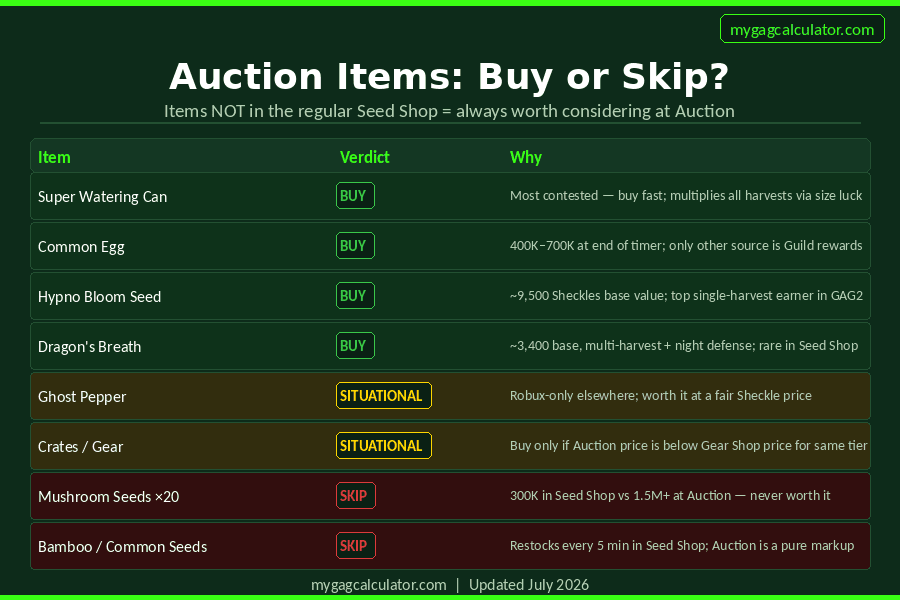
Not every item that appears at the Auction Stand is worth paying a premium for. The rule is direct: if the item appears regularly in the Seed Shop or Gear Shop at a lower price, the Auction is a convenience tax and nothing more. If the item almost never appears in those shops, the Auction is the only viable Sheckle-based route to owning it.
| Item | Verdict | Reason | Target Price Range |
| Super Watering Can | BUY | Most contested item; fastest sellout; directly improves harvest weight through size luck gains | Buy in range |
| Common Egg | BUY | Previously only from Guild Rewards; 400,000-700,000 Sheckles at final seconds; best acquisition value in the Auction | 400K-700K |
| Hypno Bloom Seed | BUY | ~9,500 Sheckles base fruit value; top single-harvest Sheckle earner; also has a night hypnosis defensive ability | Market rate |
| Dragon’s Breath Seed | BUY (situational) | ~3,400 Sheckles base value; multi-harvest advantage; rarely in Seed Shop; direct alternative to ~1,499 Robux purchase | Below Robux equivalent |
| Ghost Pepper | BUY (if priced fairly) | Robux-only via Ghost Pepper Pack gacha (1% drop at 99 Robux per roll); strong defensive and earning plant | Well below gacha cost |
| Crates | SITUATIONAL | Worth buying only if the contents justify the Sheckle premium over waiting for Gear Shop stock | Check crate tier |
| Gear (Sprinklers) | SITUATIONAL | Buy only if auction price is below Gear Shop price for the same tier | Below shop price |
| Mushroom Seeds (x20) | SKIP | 300,000 Sheckles at Seed Shop vs 1,500,000+ at Auction start — a 5x markup for the same item | Never |
| Bamboo Seeds | SKIP | Restocks regularly at 700 Sheckles each in Seed Shop; auction price is always a markup | Never |
| Common/Uncommon Seeds | SKIP | Anything that appears in the regular shop on a normal rotation should not be bought at auction prices | Never |
The convenience tax principle: paying 1.5 million Sheckles for Mushroom seeds that cost 300,000 Sheckles in the Seed Shop is a 1.2 million Sheckle loss for no gain. The only scenario where this makes any sense is if a player has so many Sheckles that the loss is genuinely irrelevant — which is itself an argument for not buying common items at auction prices since those Sheckles could fund better lots in the next rotation.
For crates specifically, the Grow a Garden 2 Crates Guide breaks down which crate tiers produce genuinely rare drops and which ones rarely justify the premium — essential reading before bidding on any crate lot at the Auction.
Hypno Bloom vs Dragon’s Breath — Which to Buy When Both Appear
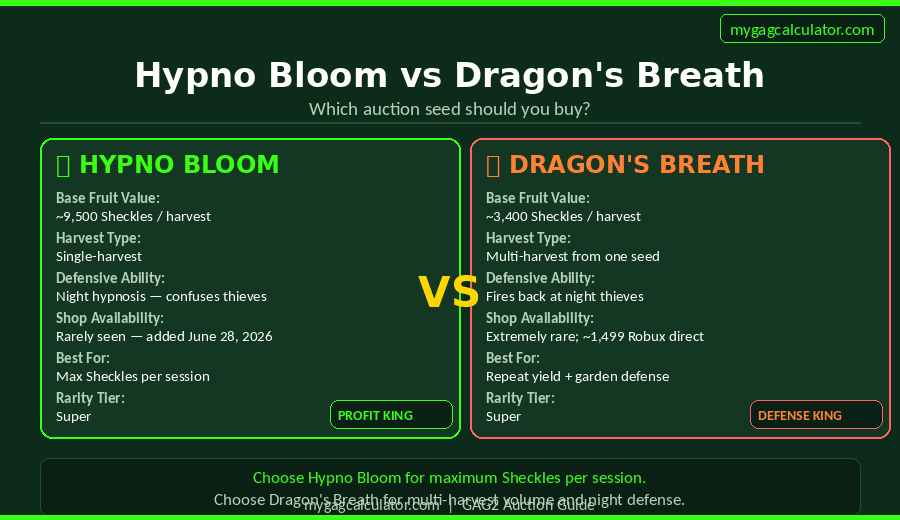
Both seeds are rare enough that the Auction is often the most reliable Sheckle-only route to owning either. When both appear in the same rotation, or when a player needs to choose between saving for one versus the other, the comparison below helps make that call.
| Factor | Hypno Bloom | Dragon’s Breath |
| Base fruit value | ~9,500 Sheckles per harvest | ~3,400 Sheckles per harvest |
| Harvest type | Single-harvest | Multi-harvest — regrows fruit |
| Defensive ability | Night hypnosis ability — confuses thieves | Fires back at thieves; strong deterrent |
| Seed Shop availability | Rarely seen; added with June 28 update | Extremely rare; mostly Robux-only (~1,499 Robux direct) |
| Best for | Players maximizing single-session Sheckle ceiling | Players who want defensive utility and repeat yield |
| Verdict | Buy if profit per session is the priority | Buy if multi-harvest volume and defense matter more |
The short version: Hypno Bloom produces more Sheckles per individual harvest. Dragon’s Breath produces more Sheckles over time through repeated harvests from a single seed and adds meaningful garden defense. A player in a server with frequent night stealing should weight Dragon’s Breath more heavily. A player optimizing for a single high-value session before logging off should choose Hypno Bloom.
To model the exact sell value either seed will produce at a given weight and mutation, the Grow a Garden 2 Weight Calculator gives precise Sheckle output per kilogram before committing to either purchase. Running both seeds through the calculator before a rotation helps set a rational price ceiling for each.
Auction vs Daily Deal vs Seed Shop — Where Sheckles Go Furthest
This comparison does not appear in any other guide covering the Auction Stand, but it matters. Three systems compete for Sheckle attention during a session: the Auction Stand, the Daily Deal, and the Seed Shop. Understanding which one deserves priority at any given moment prevents the most common budget mistake.
The Daily Deal offers a 2.2x sell multiplier on crop base value once every 12 hours. That is a selling mechanic, not a buying mechanic, but it competes with the Auction indirectly: a player who drains their balance at the Auction may have nothing left to invest in high-value seeds before the Daily Deal window. The correct order within a session is: farm first, sell into the Daily Deal if active, then enter the Auction with surplus Sheckles.
The Seed Shop is simply cheaper for everything that appears there. The rule is absolute: if an item is available in the regular Seed Shop at a lower price, skip that item at the Auction entirely. The Auction earns its place only for items the Seed Shop does not reliably supply.
For guidance on which weather events interact with crop values and when to time a sell versus hold decision, the GAG2 weather events guide is the reference to check before deciding whether to sell before an Auction window or hold for a Lightning or Blizzard event that could multiply a harvest value dramatically.
Auction Strategy by Player Stage — Beginner, Mid-Game, and Endgame
Early Game: Under 5 Million Sheckles — Skip the Auction
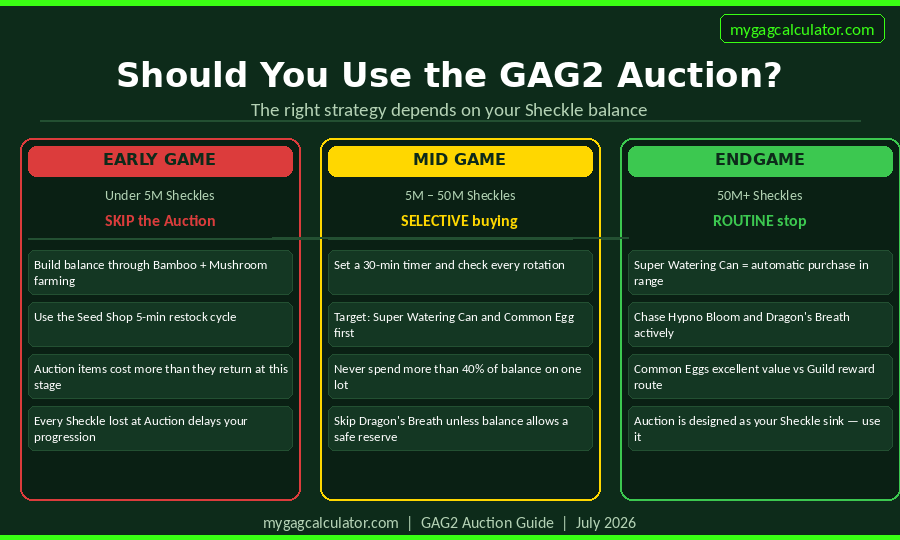
The Auction is an endgame-capable tool wearing a beginner-friendly costume. For players under 5 million Sheckles, the Auction is a distraction. Even the cheapest competitive lots (Common Eggs at 400,000 Sheckles) represent a significant portion of a new player’s balance, and the items available at that stage do not produce enough return to justify the risk of depleting capital.
The better early-game path is covered in the Grow a Garden 2 beginner guide: start with multi-harvest common crops like Strawberry and Blueberry, move to Bamboo, then use the Seed Shop cycle for Epic seeds before considering the Auction at all.
The how to make Sheckles fast in GAG2 guide details the fastest legitimate routes to building the 5 million Sheckle baseline that makes Auction participation viable.
Mid-Game: 5 Million to 50 Million Sheckles — Selective Participation
This is where the Auction becomes relevant. Set a phone or browser timer for every 30 minutes and be at the Auction Stand when the rotation fires. The target list at this stage is narrow: Super Watering Can first, Common Egg if it appears. Do not stretch into Dragon’s Breath or Hypno Bloom unless the Sheckle balance after the purchase leaves enough to maintain normal farming operations. A rule of thumb: never spend more than 40 percent of the current balance on a single Auction lot.
Endgame: 50 Million Sheckles and Above — Routine Participation
At this stage, the Auction becomes a regular stop rather than a calculated gamble. Super Watering Cans should be treated as automatic purchases whenever they appear and the price has dropped into a comfortable range. Hypno Bloom and Dragon’s Breath are viable at most price points in the rotation. Common Eggs remain excellent value relative to the Guild pathway that previously produced them.
The Auction is intentionally designed as a Sheckle sink at this stage. The game generates currency quickly through farming, and the Auction is one of the primary mechanisms for removing excess Sheckles from the economy. For endgame players, spending at the Auction is not a mistake — it is the intended use of the mechanic.
Understanding how the guild system produces Common Eggs as a reward tier helps evaluate whether the Auction price for those eggs represents fair value. The Grow a Garden 2 Guild Guide covers the full reward structure including egg tier placement by guild ranking.
Sniping Strategy — The Method That Consistently Works
Set the Timer Before the Rotation Fires
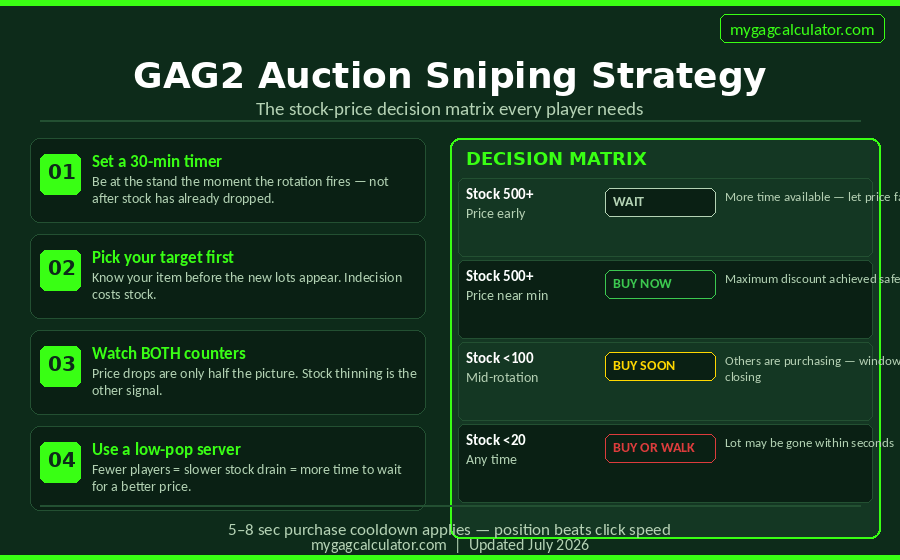
The single biggest structural advantage available to any player is being at the Auction Stand the moment the new rotation appears. Players who walk over after noticing the lot are already competing at a disadvantage. Setting a 30-minute repeating timer ensures the Stand is visible at the moment lots appear rather than after 5 to 10 minutes of stock has already been purchased.
Identify the Target Before the Rotation Starts
Decide which item in the rotation is the priority before indecision costs the window. Spending the first 90 seconds of a new rotation evaluating whether Hypno Bloom or Dragon’s Breath is the better purchase means making that decision while stock is already depleting. Pick a target item category beforehand and commit to it when the lot appears.
The Stock-Price Decision Matrix
Four scenarios, four responses:
| Situation | Stock Level | Action |
| High stock, price still high | 500+ units, 20+ min remaining | Wait. The lot is safe and the price has significant room to fall. |
| High stock, price near floor | 500+ units, under 5 min remaining | Buy now. The discount is close to maximum and the lot is still available. |
| Low stock, price still dropping | Under 100 units, mid-rotation | Buy soon. Other players are purchasing. Do not wait for the floor. |
| Very low stock, any price | Under 20 units, any time | Buy immediately at whatever the current price is or walk away. The lot will not survive another minute. |
Low-Population Server Advantage
Joining a less populated server before a rotation fires reduces competition for every lot in that rotation. The Auction stock is server-specific: the same 6 lots appear on every server simultaneously, but each server has its own pool of stock. A server with 12 players depletes stock more slowly than a server with 40 players. The practical step: switch servers 5 to 8 minutes before the expected reset fires and check the player count before the new rotation appears. You can check our guide on private server setup in GAG2.
The Purchase Cooldown Reality
A 5 to 8 second purchase cooldown applies between buys of the same item (community-verified). This means click speed is less decisive than price positioning. The player who has already decided at exactly what price to buy, and executes the moment the price crosses that threshold, consistently outperforms the player who waits and then tries to react faster than others. Speed helps at the margin, but position is the primary variable.
What to Do When the Lot Sells Out Before the Purchase
It happens even to experienced players. The correct response is to wait for the next rotation, not to server-hop hoping another server has better stock. The catalog changes with every rotation, and the lot that sold out on the current rotation may not appear in the next one. Patience and consistent timing across multiple rotations is more reliable than reactive server-hopping after a miss.
The Super Watering Can — Why It Is the Automatic Buy
The Super Watering Can is consistently the most contested item at the Auction Stand. It sells out faster than any other category, often before the price has dropped significantly, because experienced players recognize its compounding value immediately.
Super Watering Cans contribute to the size luck system that determines harvest weight. The full mechanics of how size luck stacks, the 100-point cap, and which sprinkler combinations reach that cap most efficiently are covered in the GAG2 sprinkler calculator and Grow a Garden 2 Sprinkler Guide. The short version for Auction context: a Super Watering Can in combination with the right sprinkler setup pushes harvests toward maximum weight, which directly multiplies the Sheckle value of every single crop on the plot.
The compounding effect makes the Super Watering Can worth paying above the ideal price point. Missing a Super Watering Can lot because the price was still dropping costs more in lost harvest value over subsequent sessions than the Sheckle difference between buying at 60 percent price drop versus 80 percent price drop.
To calculate precisely how much each kilogram of weight is worth on any specific crop, the Grow a Garden Weight Calculator provides exact sell-value estimates per kilogram input.
How Auction Purchases Interact with Mutations and Weather Events
A Super Watering Can or high-tier sprinkler purchased from the Auction does not exist in isolation — it multiplies the value of everything grown with it, especially during weather events. In Grow a Garden 2, one mutation can sit on a crop at a time. A new mutation replaces the previous one rather than stacking. This makes timing even more important: the right gear from the Auction, paired with a weather event, produces exponentially higher returns than either variable alone.
Lightning weather in GAG2 carries a 70x mutation multiplier. A Dragon’s Breath or Hypno Bloom acquired through the Auction, grown with a Super Watering Can that pushed its weight toward the ceiling, and harvested during a Lightning weather event represents the best Sheckle output achievable in a single session. Understanding how to time that sequence is covered in the GAG2 weather events guide and the mutations guide.
To see the exact multiplier a specific mutation applies to any crop’s base value, the Grow a Garden Mutation Calculator calculates sell value outputs for every mutation tier.
Auction Items and Night Stealing — Protecting the Investment
High-value seeds purchased from the Auction, particularly Dragon’s Breath and Hypno Bloom, become theft targets in public servers during the 2-minute night phase. The Grow a Garden 2 day cycle runs 10 minutes total: 7 minutes 30 seconds of day, 30 seconds of sunset, and 2 minutes of night. Night is the only window when other players can steal from plots.
Dragon’s Breath has a built-in anti-theft ability that punishes thieves — a key reason some players prefer it over Hypno Bloom despite the lower per-harvest value. For players building a layered defense strategy after acquiring high-value seeds through the Auction, the Grow a Garden 2 night stealing defense guide covers walls, defensive plants, and pet placement strategies that protect expensive crops between sessions.
The Most Common Auction Mistakes (And How to Avoid Them)
- Waiting for the final 1 to 2 seconds on popular items. Popular lots sell out before reaching the price floor. By the last 10 seconds of a contested item, multiple players are buying simultaneously. The player who waited for the cheapest possible price ends up with nothing while faster buyers clear the remaining stock.
- Buying common seeds at Auction prices. The 5x markup example is not an edge case. It applies to any seed or item that restocks regularly in the Seed Shop or Gear Shop. The Auction premium is only justified for items that cannot be reliably obtained through the standard shops.
- Watching only the price counter while ignoring the stock counter. Price and stock must be monitored together. A lot with falling price and falling stock requires a faster decision than a lot with falling price and stable stock.
- Spending the entire Sheckle balance on one lot. Concentrating the full balance on a single Auction item leaves nothing for the Seed Shop cycle, the next Auction rotation, or emergency purchases. Spread buys across rotations and keep a reserve.
- Joining the Auction without a Sheckle reserve. Without a meaningful balance, even perfect timing produces nothing. Building the balance comes first. The Auction is the spending mechanic, not the earning mechanic.
- Participating in the Auction during early game. The Auction competes for capital that early-game players need for seed reinvestment. A 400,000 Sheckle Common Egg is an excellent purchase at 50 million balance and a devastating mistake at 800,000 balance.
- Ignoring the Daily Deal sell window to watch the Auction. The Daily Deal 2.2x multiplier is a one-time per 12 hours opportunity. Missing it to sit at the Auction Stand is a net Sheckle loss if the crops available to sell during that window are high-value.
The Sheckle Sink Design — Why the Auction Is Built the Way It Is
Understanding the Auction’s design intent changes how players approach it. The Auction Stand is intentionally structured as a permanent Sheckle sink. The farming loop in Grow a Garden 2 generates currency at a high rate, particularly for endgame players running high-tier setups with weather event timing. Without mechanisms to remove Sheckles from circulation, inflation would make rare items inaccessible to newer players by pushing community price expectations out of reach.
The Auction absorbs surplus Sheckles from players who have more than they can efficiently reinvest through normal farming channels. The items it offers are premium enough to justify that expenditure without feeling like waste. From a game economy perspective, this is deliberate and functional: it keeps Sheckle values stable enough that mid-game players can still participate meaningfully in the trading economy.
For players who want to understand the full Grow a Garden 2 economy — including how trade values shift around Auction rotations when rare seeds flood or dry up — the Grow a Garden Trade Calculator helps evaluate whether a seed acquired from the Auction at a given price is worth trading or holding, based on current market value benchmarks.
Pets at the Auction — What to Know
Pets occasionally appear in Auction rotations. The decision framework is the same as for seeds: buy if the pet almost never appears through other routes; skip if it can be obtained more cheaply through the Pet Egg shop or map spawns. Rare and above tier pets that surface at the Auction represent a genuine opportunity, particularly for players who have not yet been able to hatch the target pet from eggs.
Pet rarity tiers, abilities, and acquisition paths in GAG2 — including which pets are worth prioritizing at the Auction versus hatching from eggs — are covered in the Grow a Garden 2 Pet Calculator and the pet abilities guide.
Note on auction pet pricing: pets that appear at the Auction tend to have individual stock counts lower than seed lots, which means they sell out faster despite often having higher per-unit prices. The stock counter on pet lots should be weighted even more heavily than for seed lots when deciding how long to wait for a price drop. See GAG2 pet tier list.
Planning the Purchase: Using Calculators Before Each Rotation
The biggest edge players can have at the Auction is not reflexes — it is knowing exactly what a targeted item is worth before the rotation fires. Players who arrive without a price ceiling in mind make emotional decisions under time pressure. Players who arrive knowing their maximum acceptable price buy with discipline.
The Grow a Garden Crop Planner helps model how a Hypno Bloom or Dragon’s Breath seed will perform over multiple sessions given current sprinkler setup and mutation probability, making it easier to calculate a rational Sheckle ceiling before the Auction rotation starts.
The Grow a Garden Profit Calculator converts seed cost (including Auction purchase price) into expected Sheckle return, which makes the break-even math transparent: if a Hypno Bloom costs 50 million Sheckles at auction and produces 9,500 Sheckles base per harvest, how many harvests with what mutation are needed to recoup the purchase? That answer should be known before clicking buy.
Frequently Asked Questions
How often does the Grow a Garden 2 Auction reset?
The Auction Stand resets every 30 minutes based on community-verified observations across live servers. The Fandom wiki’s mechanics page contains a formula that implies a 15-minute rotation, which conflicts with what players observe. Until the in-game timer is tested against both figures, the 30-minute figure is the reliable operational number. Check the visible countdown timer at the Auction Stand in-game for confirmation.
How many items appear in each Auction rotation?
Six lots appear simultaneously at every reset. Each lot belongs to one of these categories: Seeds, Seed Packs, Crops, Gears, Crates, Eggs, or Pets. Each lot carries its own starting price, stock quantity, and price drop rate.
Do prices go up or down in the Grow a Garden 2 Auction?
Prices only go down. The Auction uses a Dutch auction format where the starting price is the highest the item will ever cost during that rotation. Prices drop roughly every 13 seconds until either the stock is sold out or the timer expires.
Is auction stock shared between players?
Yes. All players on the same server compete for the same global stock pool. When another player purchases units of a lot, those units are permanently removed from the available stock for everyone else on that server.
Can another player buy an auction item before I do?
Yes. This is the core tension of the Auction mechanic. Popular items regularly sell out before the timer expires, sometimes well before. The stock counter must be watched alongside the price counter.
What are the best items to buy at the Grow a Garden 2 Auction?
Super Watering Cans, Common Eggs (400,000-700,000 Sheckles at end of timer), Hypno Bloom Seeds (~9,500 Sheckles base fruit value), and Dragon’s Breath Seeds (~3,400 Sheckles base, multi-harvest) are the highest-value purchases. These items are rare or unavailable in the regular Seed Shop.
Is the auction worth it for beginners?
No. Players under 5 million Sheckles should focus on building their balance through the farming loop before participating in the Auction. The Auction is best suited for mid-game and endgame players who have established a stable economic foundation and have surplus Sheckles to deploy.
Does the Grow a Garden 2 Auction use Robux?
No. All Auction purchases are made with Sheckles only. The Auction is fully free-to-play, which is one of its primary advantages over purchasing Dragon’s Breath directly with Robux (~1,499 Robux).
What happens to auction lots that are not purchased?
Unsold lots disappear when the 30-minute timer expires. They do not carry over to the next rotation. The next rotation brings an entirely new set of 6 lots, which may or may not include the same categories.
How do I know when to buy during the auction?
Watch both the price counter and the stock counter simultaneously. When stock drops below 100 units, the decision window is narrowing fast. When stock drops below 20 units, buy at the current price or accept the risk of losing the lot entirely. Do not wait for the price floor on contested items.
What is the minimum price in the Grow a Garden 2 Auction?
Each lot has its own minimum price floor defined by the game. The price will not drop below that floor regardless of how much time remains. The floor varies by item category and is visible on the lot listing.
Is the Grow a Garden 2 Auction pay-to-win?
The Auction itself only accepts Sheckles, making it free-to-play accessible. However, players with larger Sheckle balances (often endgame farmers) have a structural advantage because they can absorb higher prices without depleting their reserve. The system favors time investment over direct spending.
Final Thoughts
The Grow a Garden 2 Auction rewards players who treat it as a skill rather than a shop. The mechanics are transparent once the two-clock framework is understood: price and stock must both be tracked simultaneously, the buy decision is based on which clock is moving faster, and the items worth pursuing are exactly those the regular economy cannot reliably supply.
For beginners: build the Sheckle reserve first. For mid-game players: set the 30-minute timer and target Super Watering Cans and eggs selectively. For endgame players: the Auction is a routine stop and an intentional part of the economy’s design. The Roblox version of Grow a Garden 2 continues to expand the Auction catalog as new content drops, so checking in every rotation remains valuable even after mastering the current item pool.
Before each Auction rotation, run the expected purchase through the Profit Calculator to confirm the Sheckle cost makes sense against projected returns. The best auction strategy starts with the math, not the excitement of the countdown timer.
For verified community mechanic data including the official price formula, the Grow A Garden 2 Wiki on Fandom is a recommended reference for checking formula updates as the game evolves.