Published by: Saif (May 2026) | Platform: Roblox | Game: Grow a Garden
As Grow a Garden Venom pet mutation there are few pet mutations in Roblox Grow a Garden which generate as much search traffic, trading hype, and genuine confusion. Players see it on high-level pets, watch it referenced in tier lists, and immediately want to know how it works and whether it is worth chasing.
This guide covers every angle: what Venom does mechanically, where it actually comes from, the exact XP drain math, the most powerful setup built around it, which pets benefit most, and how it stacks up against the closest alternatives. Before diving in, there is one point worth clearing up immediately.
| Venom is a pet mutation, not a crop mutation. It is applied to pets and boosts their passive ability. Players sometimes confuse it with the Toxic crop mutation (applied by the Cockatrice pet to crops) or the Corrosive mutation. Those are separate mechanics entirely. This guide covers the Venom pet mutation only. |
What Is Grow a Garden Venom Pet Mutation?
The Venom mutation is an exclusive pet mutation introduced to Grow a Garden during the New Year Event update. It belongs to a special category of mutations that cannot be obtained from the standard Pet Mutation Machine. Instead, it is applied passively during gameplay through the ability of a specific prismatic pet. Visit our guide on what does mutation do in GAG?
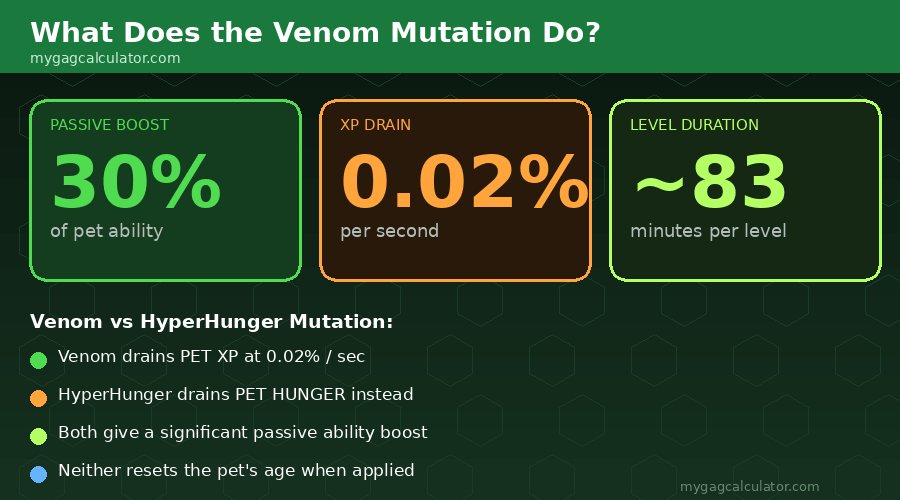
When a pet receives the Venom mutation, two things happen. First, that pet gains a 30% passive ability boost, meaning whatever its base passive does, it now does 30% more of it. Second, the mutation begins draining the pet’s XP bar at a rate of 0.02% per second. This drain mechanic is what makes Venom a nuanced choice rather than a straightforward upgrade.
Visually, a pet with the Venom mutation takes on a distinct greenish-purple glow with particle effects resembling venom dripping off its body. The effect is noticeable and makes it immediately identifiable in any garden setup.
Mechanically, it behaves similarly to the HyperHunger pet mutation, except instead of draining the pet’s hunger, Venom drains its XP. This distinction matters because hunger and XP regenerate through different in-game systems. See all mutations in Grow a Garden.
| Key stat: Venom grants a 30% passive ability boost and drains 0.02% XP per second. One full mutation level lasts approximately 1 hour 23 minutes 20 seconds at that drain rate. |
How to Get the Venom Mutation in Grow a Garden
Step 1: Acquire the Giant Scorpion
The Giant Scorpion is the only source of the Venom pet mutation in the game. It is a prismatic-tier pet, the highest rarity available, and the first non-limited prismatic pet ever added to Grow a Garden. It also holds the distinction of being the third pet in the game to grant an exclusive pet mutation, following the Headless Horseman and Ice Golem, both of which are limited-time pets. The Giant Scorpion is not limited, making it the only always-available source of an exclusive pet mutation.
There are two routes to getting the Giant Scorpion.
Route A: Buy an official Grow a Garden plushie from PhatMojo (phatmojo.com). The package includes a unique redemption code. Redeem it inside the game and the Giant Scorpion appears in your inventory. This is the only direct method.
Route B: Trade for it using in-game tokens. As of May 2026, the Giant Scorpion trades in a range of 3.15 billion to 34.70 billion tokens. That spread is wide because value depends heavily on the pet’s age, traits, and current market demand. Use the Grow a Garden Trade Calculator to check current fair-value estimates before committing to a deal.
Step 2: Understand the Scorpion Sting Ability
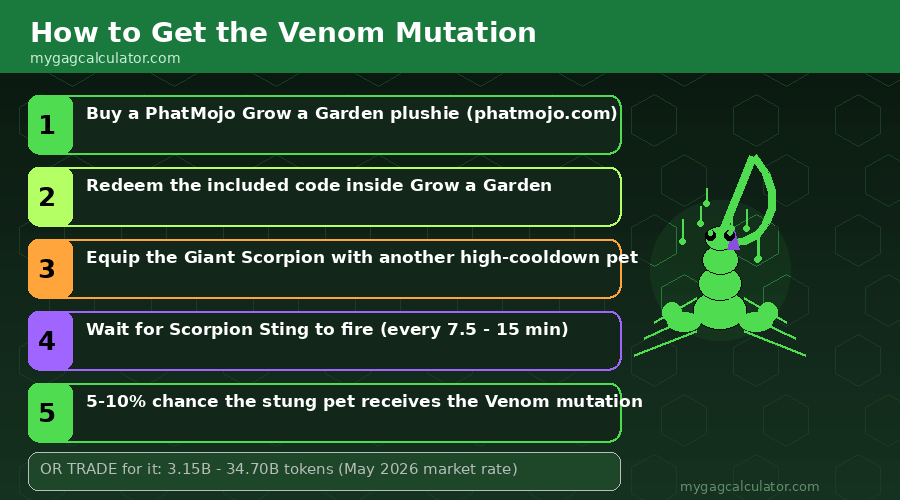
The Giant Scorpion’s ability is called Scorpion Sting. It works as follows: at a timed interval, the scorpion identifies the pet in the lineup with the highest remaining cooldown and stings it. That sting immediately refreshes the stung pet’s ability, effectively resetting its cooldown. On top of that refresh, there is a 5% to 10% chance (approximately 7.04% per the Fandom wiki’s live data) that the stung pet also receives the Venom pet mutation.
The sting interval scales with the scorpion’s level. At Age 1 (base), it fires every 15 minutes 9 seconds. At Age 50 (max), it fires every 7 minutes 30 seconds. The table below shows the practical impact.
| Scorpion Level (Age) | Sting Interval | Venom Chance | Daily Sting Count |
| Age 1 (Base) | Every 15 min 09 sec | 5-10% (~7.04%) | ~95 stings/day |
| Age 25 (Mid-level) | Every ~11 min | 5-10% (~7.04%) | ~131 stings/day |
| Age 50 (Max) | Every 7 min 30 sec | 5-10% (~7.04%) | ~192 stings/day |
The mutation lasts until one of three things happens: another pet mutation is applied and overwrites it, a Pet Shard is used on that pet, or a Cleansing Pet Shard is used to remove it cleanly.
Step 3: Confirm the Venom Was Applied
After a sting, check the affected pet’s mutation status. The visual glow and the Venom label in the pet stats panel confirm it. Keep in mind that the Scorpion Sting targets the pet with the highest cooldown at the time of activation, so rotating which pet has the longest cooldown will influence which pet receives the sting and any subsequent Venom application.
The XP Drain: Full Math Breakdown
The 0.02% per second drain figure is often mentioned without context. Here is the actual math so players can make an informed decision.
At 0.02% per second, a full XP level (100%) depletes in exactly 5,000 seconds. That converts to 83 minutes and 20 seconds, or roughly 1 hour 23 minutes. Over a full 24-hour session, Venom would drain approximately 17.3 levels of XP if the pet never regained any. Know the best way to farm battle XP.
In practice, that number drops sharply once a pet hits max level (Age 50). At max level, XP accumulation mechanics change and the drain is largely irrelevant to progression. The table below maps the practical impact across different pet stages.
| Pet Age (Level) | Venom XP Drain/sec | Time Until 1 Level Depleted | Practical Impact |
| Age 1-10 (Early) | 0.02%/sec | ~1 hr 23 min per level | Noticeable – slow early leveling |
| Age 25-40 (Mid) | 0.02%/sec | ~1 hr 23 min per level | Manageable with Dilophosaurus |
| Age 50 (Max) | 0.02%/sec | N/A – already maxed | Completely irrelevant – pure benefit |
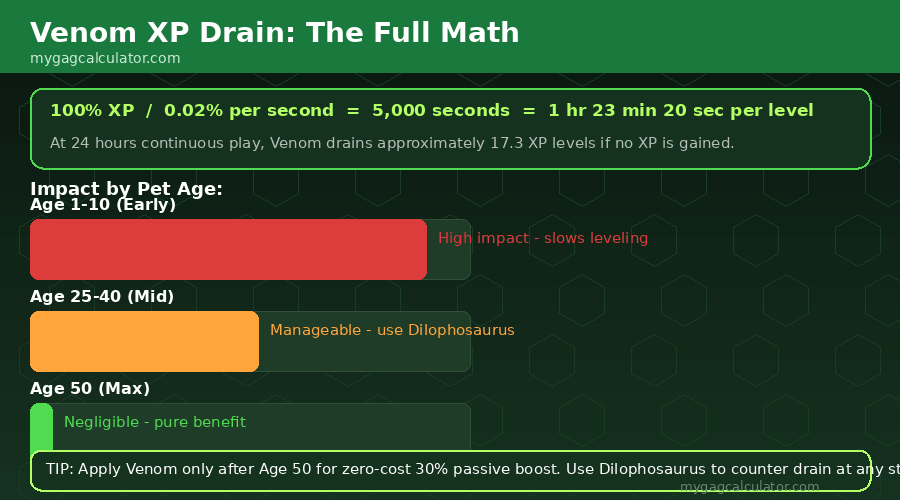
The takeaway is straightforward: Venom is a burden for low-level pets and a non-issue for max-level pets. Applying it before a pet reaches max level is a trade-off, not an outright mistake, but the ideal timing is after the pet has been fully leveled.
Players who want to track XP drain and passive boost values across different age thresholds can use the GAG Pet Calculator to model exactly how the mutation interacts with each pet’s ability at any age.
The Dilophosaurus Combo: Making Venom Drain-Free
This is the angle almost no written guide covers in detail, and it is the most important optimization for anyone running Venom long-term.
The Dilophosaurus, named Shano in-game, is a Mythical-tier dinosaur pet added with the Pet Mutations update on July 12, 2025. Its ability fires every 10 minutes: Shano opens its frills and spits venom that spreads across up to 10.89 random pets simultaneously. Each pet that is hit receives either 92.24 seconds of cooldown reduction or 2,179.13 XP.
Now consider Venom’s drain: 0.02% XP per second equals 72 XP drained per 60 seconds (assuming a 100-unit XP scale). Over 10 minutes, that is roughly 720 units of XP drained. The Dilophosaurus restores approximately 2,179 XP per activation every 10 minutes.
The result is that the Dilophosaurus replenishes XP at more than three times the rate Venom drains it. Any pet with both the Venom mutation and a Dilophosaurus active in the lineup sees its XP net-positive, making the drain effectively zero in practice.
| The Venom plus Dilophosaurus combination is the strongest AFK-forever passive farm setup in the current meta. Venom amplifies what your pet does by 30%, and Dilophosaurus eliminates the only drawback. |
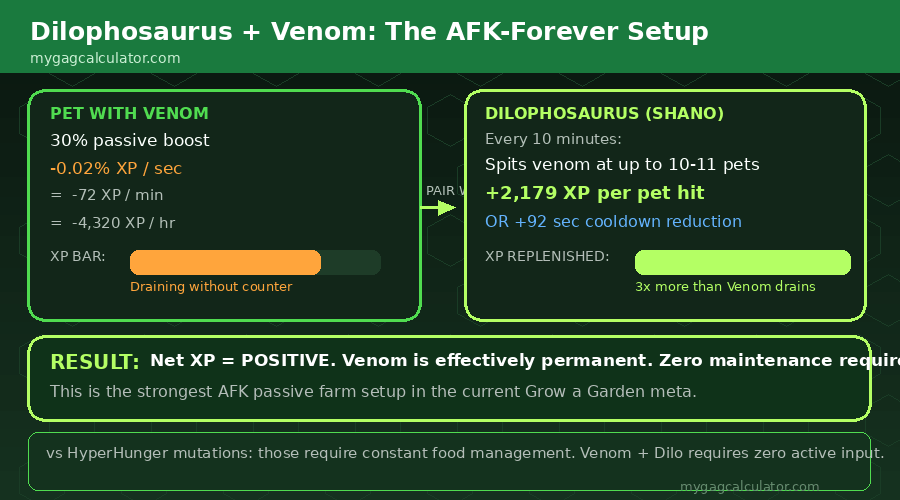
This setup is particularly powerful compared to the HyperHunger mutation, which requires constant food management to maintain its boost. Venom with Dilophosaurus requires no active input whatsoever.
Best Pets to Put the Venom Mutation On
Venom does not improve every pet equally. Because it amplifies the base passive by 30%, pets with already powerful passives see the largest absolute gains. Below are the strongest candidates and why each one benefits specifically.
| Pet | Rarity | Base Passive | With Venom (+30%) | Why It Works |
| Lion | Mythical | Passive ability boost | 30% stronger passive output | High base value, stacks powerfully |
| Queen Bee | Divine | Duplicates nearby fruits | Duplicates fire 30% more often | Double-skill pet, massive output gain |
| Raccoon | Divine | Duplicates plant in another plot | 30% more frequent duplication | Scales across servers, compounds fast |
| Dilophosaurus | Mythical | XP / cooldown boost to 10 pets | 30% amplified group buff | Direct counter to Venom XP drain |
| Kitsune | Prismatic | Strong passive ability | 30% boost to already top-tier passive | Prismatic pet synergy, late-game dominant |
As a general rule, apply Venom to the pet whose passive ability already contributes the most to the garden’s overall output. Amplifying a weak passive by 30% yields a small gain. Amplifying a dominant passive by 30% reshapes what the entire garden produces.
Avoid applying Venom to double-skill pets that are still below Age 30. The XP drain will slow leveling in a noticeable way. For those pets, use Nightmare temporarily and switch to Venom after reaching Age 50.
To model what a 30% passive boost does to a specific pet at each age stage, the GAG Pet Calculator shows live ability values with and without mutation boosts applied.
The Passive Pet Venom Loop (Advanced Method)
One of the most discussed topics on TikTok and in the GAG community is applying Venom to passive pets through a specific sequencing method. This is an advanced technique and worth understanding before attempting.
The basic logic works as follows. The Scorpion Sting targets the pet with the highest active cooldown. If a player manages the cooldown state of their lineup carefully, they can influence which pet the scorpion chooses to sting. By timing other ability uses, a target pet can be set up with the longest remaining cooldown at the precise moment the Scorpion Sting fires. The sting then has a 5-10% chance of applying Venom directly to that pet.
Some players also explore the Mimic pet’s role in this loop. The Mimic Octopus copies abilities from other pets in the lineup. If the Mimic copies the Scorpion Sting, it has been reported to also carry the Venom application chance, though this behavior is not officially confirmed in the Fandom wiki and may have changed across patches.
The cleanest version of this method uses a Soul Flame mutation on a secondary pet to time cooldown windows correctly before a sting fires. The exact loop steps depend on the specific lineup, but the core idea is cooldown manipulation to ensure the right pet is the highest-cooldown target when Scorpion Sting activates.
| Important: The passive pet Venom loop involves cooldown timing and may be affected by future patches. Always confirm current behavior in the Grow a Garden Discord or Fandom wiki before building a strategy around it. |
Venom vs Other Pet Mutations: Side-by-Side Comparison
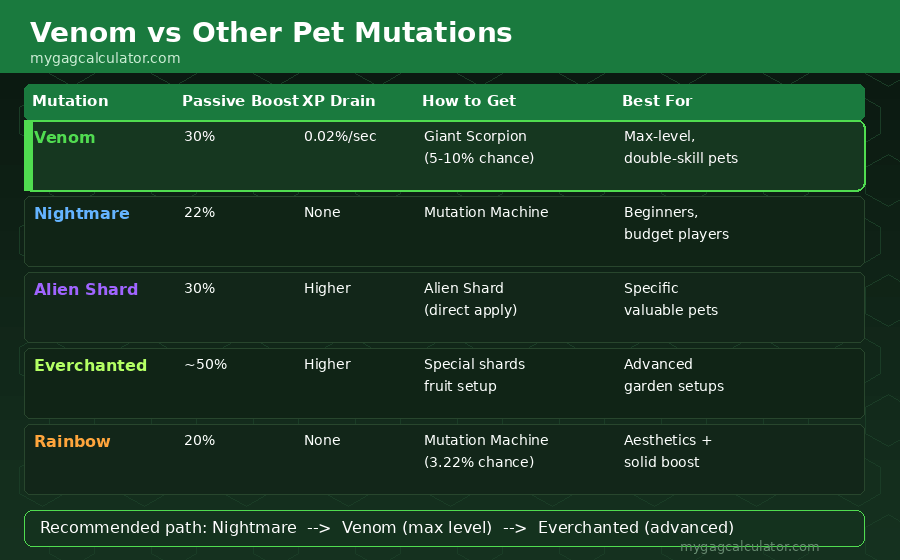
Players debating whether to chase Venom or use an alternative mutation need a clear comparison. The table below covers the most relevant options.
| Mutation | Passive Boost | XP Drain | How to Get | Best For |
| Venom | 30% | 0.02%/sec | Giant Scorpion sting (5-10% chance) | Max-level, double-skill pets |
| Nightmare | 22% | None | Mutation Machine | Beginners, budget players |
| Alien Shard | 30% | Higher | Alien Shard (direct apply) | Specific rare pets |
| Everchanted | ~50% | Higher | Special shards, fruit setup required | Advanced setups |
| Rainbow | 20% | None | Mutation Machine (3.22% chance) | Aesthetics + solid boost |
| HyperHunger | Varies | Drains hunger | Specific pets | AFK hunger farming |
The recommended progression path used by the majority of optimized players is: start with Nightmare (low cost, no drain, solid 22% boost), then upgrade to Venom once the pet reaches max level, and eventually move toward Everchanted when the garden has the fruit setup needed to maximize its potential.
Venom holds a specific advantage over the Alien Shard mutation at equal boost levels: its XP drain rate is lower, making it more sustainable across long sessions. Venom also has no cooldown of its own as a mutation effect since the 30% boost is always active once applied.
For players tracking the Sheckle value of mutation combinations over time, the Grow a Garden Profit Calculator models how passive ability boosts translate into currency gains per hour.
How to Remove the Venom Mutation
There are three ways to remove the Venom mutation from a pet.
The first is to use a Cleansing Pet Shard, which removes the mutation cleanly without replacing it. The pet returns to its unmutated state.
The second is to put the pet through the Pet Mutation Machine. This costs 500 million Sheckles, requires the pet to be Age 50 or older, takes one hour to complete, and resets the pet’s age back to 1. The process applies a new random mutation that overwrites Venom entirely.
The third is to use a regular Pet Shard or a specialized mutation shard on the pet directly. This also overwrites the existing mutation.
Most players who want to transition from Venom to Everchanted use the Mutation Machine route, accepting the age reset as part of the upgrade process. Players who simply want to reset a pet without targeting a specific new mutation prefer the Cleansing Pet Shard for its simplicity.
Is the Venom Mutation Worth It?
The honest answer depends on where a player is in their progression.
For players with max-level pets and a Dilophosaurus already in the lineup, Venom is one of the best mutations available. The 30% passive boost is significant, the XP drain becomes a non-factor, and the setup requires no ongoing management. The only barrier is obtaining the Giant Scorpion, which either requires buying a PhatMojo plushie or trading a substantial number of tokens.
For players still leveling their pets or without a Dilophosaurus, Nightmare is the smarter interim choice. It is cheaper, accessible through the Mutation Machine, has no XP drain, and provides a solid 22% boost to keep productivity high while working toward Venom.
Players who focus on trading and want to maximize Sheckle output per hour should run the numbers through the Grow a Garden Profit Calculator to see whether the 8% difference in passive boost between Venom and Nightmare justifies the acquisition cost at their current garden scale.
| Bottom line: Venom is the better mutation at max level with Dilophosaurus support. Nightmare is the better choice if the pet is still being leveled. The recommended path remains Nightmare first, Venom second, Everchanted third. |
Bug History and Current Status
When the Giant Scorpion first launched, Scorpion Sting had a documented bug: instead of applying the Venom mutation, it returned an error message to the player. The bug was traced to the Venom mutation not being fully integrated into the game’s backend at launch. Early TikTok content from January 2026 shows multiple creators warning players not to trade for the Giant Scorpion because the ability was non-functional.
The bug has since been resolved. Scorpion Sting now correctly applies Venom at the stated 5-10% probability. Players seeing old content from early 2026 warning about this issue can disregard those warnings as they reflect a patched bug.
The mutation application bug was not the only issue. There was also a brief visual glitch where the Venom mutation effect would not display correctly on certain pets in the garden view. That display issue has also been patched.
Giant Scorpion Trading Value and Market Data
Because the Giant Scorpion is the only source of the Venom mutation, its trading value is directly tied to how much players value Venom itself. As of May 2026, the Giant Scorpion trades in a range of 3.15 billion to 34.70 billion tokens according to TradeKitsune’s live market data, with 515 active trades recorded. The spread is wide because the pet’s value varies significantly based on its age, traits, and current meta demand.
The Giant Scorpion is classified as a T1 pet in the current tier list, the highest available tier. Its combination of cooldown refresh utility and Venom application chance makes it uniquely valuable in two separate areas simultaneously.
For players deciding between the PhatMojo route and trading, the calculation is not straightforward. The plushie has a real-money cost, while the token route requires significant in-game grinding or leveraging other valuable assets. The Grow a Garden Trade Calculator can help estimate whether a specific offer is fair-value or tilted unfavorably.
Track Venom’s Impact with the Mutation Calculator
Understanding Venom’s value in isolation is one thing. Seeing how it interacts with a specific crop setup, pet lineup, and weather pattern is another. The Grow a Garden Mutation Calculator lets players input their current garden configuration and see how pet mutations, including Venom, affect total crop value output.
For players managing multiple plots and wanting to optimize planting decisions around a Venom-boosted pet’s cooldown pattern, the Grow a Garden Crop Planner maps growing cycles against pet ability timers. And for tracking Sheckle output during different weather events while running a Venom setup, the Grow a Garden Weather Tracker shows which weather conditions align best with passive-boost farming.
Frequently Asked Questions
What is the Venom mutation in Grow a Garden?
The Venom mutation is an exclusive pet mutation that grants the affected pet a 30% passive ability boost. It slowly drains the pet’s XP at 0.02% per second. It can only be applied by the Giant Scorpion’s Scorpion Sting ability and cannot be obtained through the standard Pet Mutation Machine.
How do you get the Venom mutation in Grow a Garden?
The only way to receive the Venom pet mutation is through the Giant Scorpion’s Scorpion Sting. Every 7.5 to 15 minutes, the Giant Scorpion stings the pet with the highest cooldown and there is a 5-10% chance that sting applies Venom. The Giant Scorpion itself requires either a PhatMojo plushie code or a large token trade.
Is Venom a pet mutation or a crop mutation?
Venom is a pet mutation. It is applied to pets, not crops. Players sometimes confuse it with Toxic (a crop mutation applied by the Cockatrice) or Corrosive (a combined crop mutation). These are completely separate mechanics.
Does the Venom mutation drain XP?
Yes. Venom drains 0.02% XP per second. One level depletes in approximately 1 hour 23 minutes at that rate. On max-level pets, the drain is irrelevant. Pairing with a Dilophosaurus restores XP faster than Venom drains it.
How long does one level of Venom mutation last?
At 0.02% drain per second, 100% of one XP level depletes in 5,000 seconds, which is 1 hour 23 minutes and 20 seconds. That assumes no XP is gained from any other source during that window.
Is Venom better than Nightmare mutation in Grow a Garden?
For max-level pets, yes. Venom offers a 30% passive boost versus Nightmare’s 22%. For pets still being leveled, Nightmare is safer because it has no XP drain. Most players upgrade from Nightmare to Venom after reaching max level.
What is the best pet to use the Venom mutation on?
Venom works best on high-passive pets at or near max level. The Lion, Queen Bee, and Raccoon are consistently recommended choices. The key principle is that Venom amplifies whatever the pet already does, so the stronger the base passive, the greater the gain.
Can you put Venom on passive pets?
Yes, and this is a sought-after technique. By managing cooldown timing in the lineup, players can influence which pet the Giant Scorpion stings, potentially directing Venom toward a preferred passive pet. This requires careful lineup management and timing but is achievable.
Can you remove the Venom mutation in Grow a Garden?
Yes. Use a Cleansing Pet Shard to remove it cleanly, apply a new mutation through the Pet Mutation Machine to overwrite it, or use a specialized mutation shard on the pet directly.
What does the Dilophosaurus do with the Venom mutation?
The Dilophosaurus (Shano) spits venom at up to 10-11 pets every 10 minutes, granting each approximately 2,179 XP. Since Venom drains far less XP over that same 10-minute period, the Dilophosaurus effectively neutralizes the drain, making Venom a permanent passive buff with no maintenance required.
Is the Giant Scorpion worth buying just for Venom?
For late-game players building an optimized passive farming setup, yes. The Giant Scorpion also provides significant cooldown refresh utility independent of Venom, making it valuable even before a successful Venom application. For early- or mid-game players, the token cost of trading for one may be better invested elsewhere first.
How rare is the Venom mutation in Grow a Garden?
Venom has a 5-10% application chance per Scorpion Sting. At max level, the Giant Scorpion stings approximately 192 times per day. That means roughly 10-19 opportunities per day for Venom to be applied per sting cycle. The rarity is in owning the Giant Scorpion rather than in the mutation application rate itself.